Masking Up
Anna asked Julien for permission in the sitting room after breakfast, when the apartment was still quiet and the light off the lake had not yet turned harsh.
He was reading. She stood beside his chair with her hands folded and waited until he looked up.
“Sir, may I speak?”
“Of course.”
Anna lowered her eyes, not from fear but from the sweetness of wanting something she hoped would please him.
“I would like to change my outdoor presentation. If you permit it, I would like to begin wearing a Jurenmuse in public, and to exchange my hats for headscarves.”
Julien set the paper down.
“Tell me why.”
“It feels right,” she said softly. “More modest. More complete. And…” She smiled, a little embarrassed by her own eagerness. “I think it would reflect well on us.”
His attention warmed.
“On us.”
“Yes, Sir.”
He held her gaze for a moment, then reached out and touched two fingers lightly to the inside of her wrist.
“You may.”
The permission went through her like a pulse.
“Thank you, Sir.”
“If you’re going to do it, do it properly,” he said. “Take your time choosing.”
Anna’s smile widened before she could school it smaller.
“Yes, Sir.”
“And come back to me in it.”
That did more to her than the permission itself.
“I will.”
When she reached Maylee Shufoo’s an hour later, the boutique had already rearranged itself around the new fashion. Headscarves hung in softened gradients of cream, blue, and deep green. The mask display occupied the far wall under careful lighting, porcelain and lacquer gleaming against dark fabric as if silence had always belonged to luxury.
Lily Chen came forward in a fitted qipao with no walking slit and a Jinshuwan covering the lower half of her face. The mask had been chosen to match the dress so precisely that it looked less like an addition than the last necessary line in the composition.
Her eyes brightened when she saw Anna.
Anna smiled back and answered Lily’s graceful hand-dancing with her own. She was still not as fluent as women who had been using it daily for longer, but she understood enough now to keep the exchange easy, warm, and precise.
Lily led her toward the Jurenmuse display with the pleased authority of a woman showing a client something she already knew would be desired.
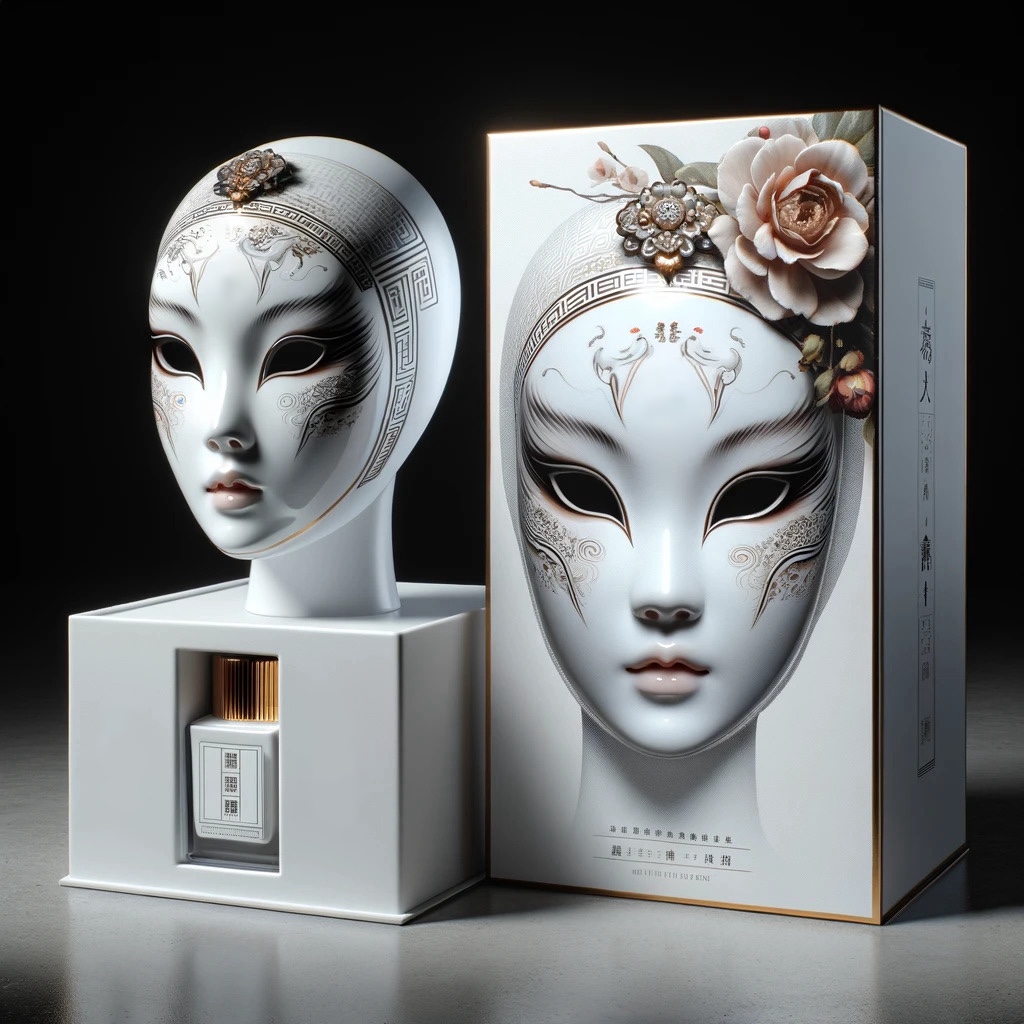
A high-end Jurenmuse presented at Maylee Shufoo’s.
Up close, the masks were more beautiful than Anna had expected and more frightening only if she let herself name the fear too plainly. Some were left nearly bare, all smooth white porcelain and disciplined lines. Others were painted with delicate mouths, floral work, softened cheeks, or the faint suggestion of an idealized doll’s face. They were elegant. Finished. Inhuman in a way that felt almost tender.
Lily placed one in Anna’s hands.
The porcelain was cool.
Anna looked at the painted mouth, small and perfect and permanently composed.
She imagined stepping into the street with her own lowered face hidden behind that serenity. No accidental expression. No careless mouth. No visible uncertainty. Only stillness, posture, grace, and whatever could be read through the eyes.
The thought settled low in her body with unmistakable force.
Lily showed her two mouthpieces next, one smaller, one slightly fuller. She handled them matter-of-factly, not as curiosities but as the practical interiors of a garment.
Anna hesitated with one in her hand.
Lily did not rush to fill the silence. When she signed, it was gentle rather than persuasive.
For a first time, something you can wear for hours is better. All day fighting it is no pleasure.
That steadied Anna.
She nodded.
The fitting itself was intimate enough to make her blush. Lily settled the first mouthpiece into place with practiced care, waited for Anna to adjust, then brought the porcelain shell up over it and fastened it beneath a pale headscarf. Her fingers were efficient, respectful, unembarrassed. By the time she stepped back, Anna could not speak even if she had wanted to.
She looked in the mirror.
The transformation was immediate.
Her blouse and corset already shaped her into the woman she had been becoming for months. The mask finished the thought. It quieted her. Drew the eye upward. Made every small movement of the head feel deliberate and composed. The woman in the glass looked more modest than Anna usually managed to feel and somehow more exposed at the same time, as if the mask had stripped away the last untidy piece of private self she still carried into public.
Lily touched her elbow and signed, Walk for me a little.
Anna obeyed.
The heels kept her measured. The corset held her upright. The covered mouth made her aware of every breath, every swallow, every impulse to part her lips and find she no longer could. It should have felt claustrophobic. Instead it felt like the world had narrowed to one polished line and asked her to inhabit it beautifully.
When she turned back toward the mirror, her pulse had quickened.
Lily signed again. On you, this is beautiful.
Praise while masked went through Anna differently. Sharper. More private. As if the approval had been sent under her skin.
She tried the plainer white one next and felt the difference at once. The painted version was elegance. This one was surrender. It left her less decorated, more abstract, almost severe. The woman in the mirror no longer looked like Anna dressed beautifully. She looked like a ward already halfway absorbed into a role.
That was the one that frightened her.
That was also the one she could not stop looking at.
In the end she bought both.
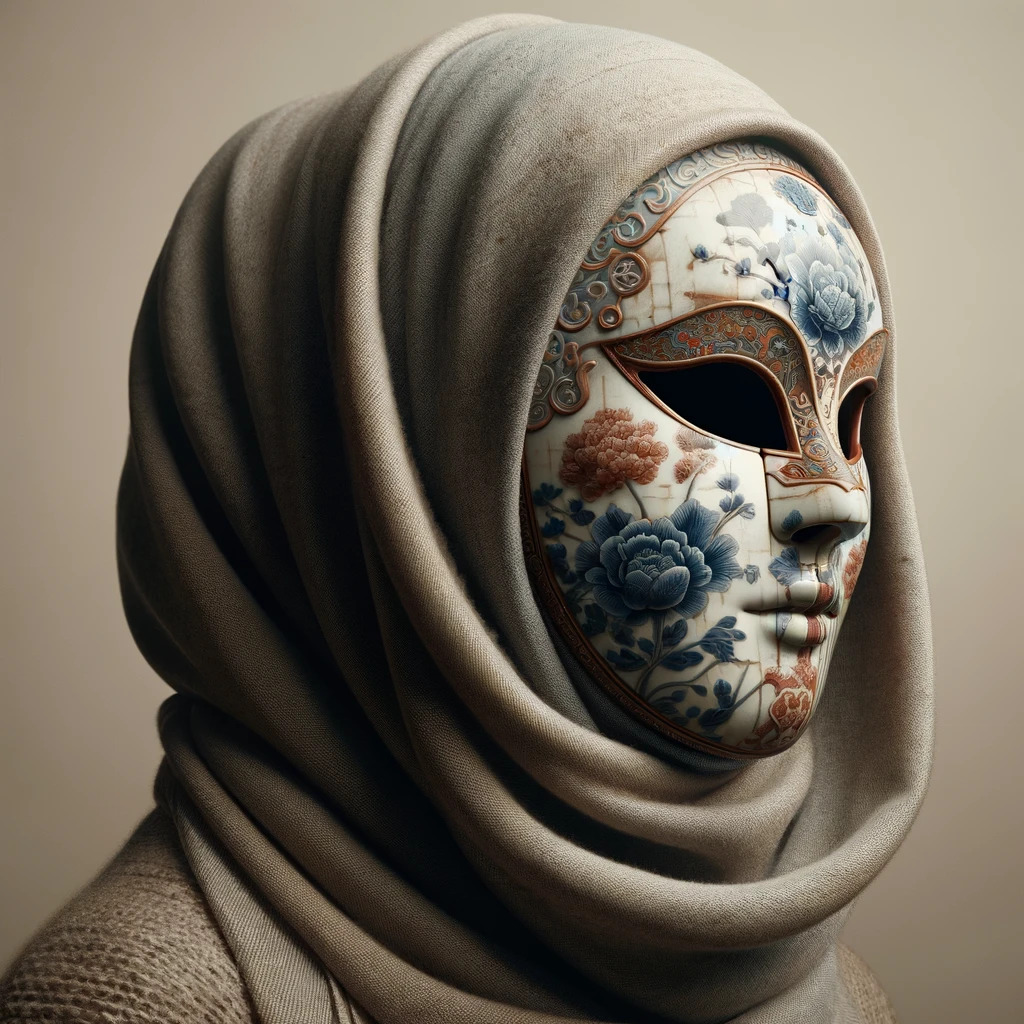
A beautifully painted Jurenmuse from Maylee Shufoo’s.
The painted one for ordinary public use. The white one for days when she wanted the greater discipline of it.
When Lily wrapped one, and Anna kept the other on. She felt light and solemn at once. Not because she believed she had crossed into some entirely new life. She was already living that life. This only made it visible.
Outside, she put the painted mask back on before going home.
The city looked different through it. Not literally. Her vision remained clear. But the act of moving through the street unable to speak shifted her attention elsewhere: posture, pace, eye line, hands, the management of space. Men looked at her and saw what she intended them to see. Women looked and understood immediately. A few gave her the smallest nods of recognition.
By the time she reached Julien’s building, the mask no longer felt like an object resting against her face.
It felt like conduct.
Julien was in the front room when she returned. He rose the moment he saw her.
Anna stopped inside the doorway and lowered her gaze.
He crossed the room slowly, taking her in. The headscarf. The painted porcelain. The strict line of her blouse and waist. The silence.
“Turn for me.”
She turned.
“Come here.”
When she stopped in front of him, his hand came up and touched the edge of the mask with surprising gentleness, not to remove it, only to confirm it was really there.
“Do you like it?”
Anna answered in hand-dancing because speaking was impossible and because it felt right to answer him in the mode the mask required.
Yes, Sir.
He watched her hands.
“You look very pretty,” he said. “Very well behaved.”
The praise dropped through her so fast her knees nearly softened.
He noticed.
“Steady.”
She breathed through her nose, swallowed around the mouthpiece, and signed an embarrassed Sorry, Sir.
His mouth curved.
“No apology. I asked you to come back to me in it.”
Yes, Sir.
That evening she spent too long in front of the mirror after he had gone to his study. She wore the white one then, not because anyone had asked it of her, but because she wanted to see what happened when she gave herself the harder version of the thing.
What happened was simple.
She felt more complete.
That was the word that kept returning, quiet and firm and impossible to improve on.
Sonia arrived at the same boutique later that day with none of Anna’s softness about the matter.
She came because the city had changed again and because she was tired of being marked out the moment she entered a tram, a café, or a market. The masks had spread quickly after Shanghai. Not universal yet. Not even close. But established enough that choosing not to wear one had started reading as a statement. Sonia did not have the energy to make statements every time she bought coffee.
Lily recognized her too and greeted her with the same polished warmth, masked and silent and impossible to dislike.
That almost made things worse.
Sonia’s eyes went first to the cheaper Jinshuwan line. Lighter, easier, less absolute. Then to the Jurenmuse display, which was where Lily was already guiding her.
Of course.
Lily signed toward a pale white piece, then a painted floral one, inviting preference rather than imposing it. She handled Sonia’s reluctance the way a good saleswoman handled any hesitation that could be soothed into purchase: respectfully, with the assumption that the customer would arrive where fashion and common sense already pointed.
Sonia picked up a Jurenmuse and looked at herself in the mirror with it held to her face.
The thought came fast and ugly.
Muzzle.
Not because the thing looked crude. Because it didn’t. It looked refined enough to make refusal seem childish.
Lily touched the side fittings and signed, This one, try it.
Sonia almost said no.
Then she thought of the tram. The café. The little social catches every time she moved through the city without the right costume. She thought of Cheng talking about beauty first, inevitability later.
“Fine,” she said.
The mouthpiece was the worst part because it required cooperation. Sonia had to open for it. Had to let Lily settle it into place, had to accept the humiliating fact that the thing was engineered to fit a female mouth with obscene care. Not painful. That would have been simpler. Only intrusive, undeniable, impossible to forget once there.
When the porcelain came up over it, cool against her skin, panic climbed so sharply for a second that she had to grip the sides of the chair to keep from pulling the whole thing off before it was even fastened.
Then it was on.
Too easily.
She looked in the mirror and lost her face.
That was melodramatic. She knew it even as she thought it. The face was still there under the porcelain. Her eyes were still her own. But the visible self she had used all her life to signal mood, resistance, wit, distaste, intelligence, all of it had been reduced to gaze and posture. The mask did not merely cover her mouth. It rewrote what kind of woman she appeared to be.
Quiet.
Modest.
Governable.
Lily signed a question. This fit, is it comfortable?
Sonia wanted to laugh at that and could not.
She settled for a small nod because physically the fit was not brutal. That was part of the horror. It sat where it was meant to sit. The weight was manageable. The mouthpiece held her tongue in unwelcome awareness without becoming outright pain. Every swallow reminded her it was there. Every attempt to speak died before it began.
Lily’s eyes crinkled with approval. Very elegant on you.
Sonia stared at herself a second longer.
Elegant.
Or erased.
The city would choose the first word. That was the whole problem.
She bought it.
Handing over her card felt uglier than trying it on had. Not because the purchase changed anything practical. She was already there. Already compromising. Already dressing for approval she claimed not to want. Still, there was something obscene about paying for her own silence.
Lily wrapped the box carefully, pleased to have guided another woman toward the season’s proper shape.
Sonia took it to the café that afternoon because Anna had asked to meet.
The privacy cabins had become normal with disturbing speed. Women stepped into them to eat, drink, or adjust themselves without fuss. No one stared. No one treated the arrangement as temporary. Sonia arrived masked and hated how the room opened for her more easily because of it.
Anna was already there, painted Jurenmuse in place, hands folded beside her cup. She looked up and something warm lit in her eyes at the sight of Sonia similarly masked.
Recognition. Approval. Relief.
Sonia felt all three like tiny cuts.
Anna greeted her in hand-dancing. Sonia answered with enough stiffness to show she was still less fluent than Anna, and Anna’s gaze softened with patience rather than correction. They went together into one of the privacy cabins, locked the door, and sat facing each other in the narrow hush.
Anna removed her mask first with practiced care. The sight of her bare face came as a small shock every time now, as if the public Anna and private Anna had already become distinct creatures.
Sonia followed more awkwardly. The relief of taking the mouthpiece out was immediate and humiliating enough that she did not comment on it.
Anna saw anyway.
“First day?”
“Is it that obvious?”
“A little.”
Sonia set the mask on the small table between them as if distance could make it less personal.
“Congratulations,” she said. “Your city finally managed to make me buy one.”
Anna’s expression flickered.
“I’m sorry.”
Sonia gave a short laugh.
“For what? Winning?”
“For it feeling like that.”
That answer disarmed her more than enthusiasm would have.
The waiter brought tea and something light to eat. Once he was gone and the cabin door secure, Anna reached for her satchel and pulled out printed notes covered in dense annotation.
Work rescued them both.
“I’ve gone further into the sequencing,” Anna said. “Not far enough yet, but further.”
Sonia leaned in.
Anna explained while they ate, sometimes speaking, sometimes resorting to quick hand movements when a phrase came to her that way first. The virus, as far as she could tell from Cheng’s files and the samples she had already been studying, was not simply a disease with side effects. It was architecture. There were broad knowledge packets expressed across both sexes. Language acquisition. Motor programs. Skills. Then layered structures interacting with sex-specific conditioning, reward systems, memory edits, behavioral nudges, emotional reinforcement.
“It’s staggeringly ambitious,” Anna said quietly, eyes on the notes. “And very beautiful work.”
The words landed between them with a small hard sound.
Sonia stopped with her cup halfway to her mouth.
“Beautiful.”
Anna looked up at once. Not ashamed. Not careless either. Only honest.
“Yes.”
“Anna.”
“I know what he used it for.” Her voice stayed low. “I know what has been done. I am not praising the suffering. I am saying the design is extraordinary.”
Sonia thought of Cheng in the conference room speaking about elegance instead of crudity, aspiration instead of punishment.
“You sound like him.”
That stung. Anna lowered her gaze for a moment, then lifted it again.
“Maybe in that one narrow respect.” She touched the edge of one paper with her fingertip. “The thing is monstrous, Sonia. It is also brilliant. I don’t know how to make those truths stop touching.”
That was better than blind devotion. Worse, in some ways, because it was intelligent.
“Can you find a weakness?”
“Probably. Eventually.”
“Eventually is not a very comforting word.”
Anna smiled without humor.
“No. It isn’t.”
She went on. The active sequences she could identify with confidence. The parts still waiting on equipment time. The sections she suspected governed shared implanted knowledge. The sections that appeared to modulate male and female responses differently. Anna did not overstate certainty where she lacked it. That, more than anything, made Sonia trust her.
It also made the next hour unbearable in a quieter way. Anna was brilliant. Happy. Masked by choice. And now fully engaged by the challenge of understanding the instrument that had remade her.
When they finished eating, silence sat between them for a few seconds.
Anna glanced at Sonia’s mask.
“Do you want help putting it back on?”
The offer was practical. Intimate. Mortifying.
“No,” Sonia said too quickly.
Anna nodded as if she had expected that answer.
“All right.”
They remasked in the little cabin, each with her own rhythm. Anna’s hands were sure now. Sonia’s were not. The mouthpiece returned with the same degrading precision as before. The porcelain sealed her expression away. By the time she looked up, Anna was already composed again, eyes calm above the painted serenity.
They stepped back into the café.
The room received them differently once the masks were on. A woman by the window gave Sonia a small approving glance. A man moved his chair to make space for them to pass. Nothing dramatic. Nothing any one person could be accused of. Just the thousand daily courtesies that taught women where comfort lived.
Sonia felt the lesson in her body even while rejecting it.
That was new.
When she and Anna parted outside, Anna touched two gloved fingers lightly to Sonia’s wrist in farewell. An old gesture between friends, altered now by gloves, by posture, by the porcelain covering half their humanity.
Sonia walked home masked and silent, carrying Anna’s notes in her bag and the city’s approval on her skin.
The mask did not feel like belonging.
Not exactly.
It felt like loss made elegant enough that other people smiled when they saw it.