Storycodes
Mf, Ff, BDSM, noncon, coercion, abduction, institutional, discipline, humiliation, bondage, corset training, glove bondage, gag, hobble skirt, ballet boots, inspection, caning, Victorian, historical, marriage, ownership, confinement, hypnosis, prayer machine, poisoning, widowhood,
A Victorian tale of restraint, revenge, and the perilous seduction of power.
In Victorian London and India, Seraphina endures punishment, widowhood, and scandal only to turn her enemies’ weapons into her own. Once a captive of corsets, boots, and veils, she rises to power as headmistress of Loch Thorne, reshaping the notorious reformatory into her vision of discipline and dignity. Yet with every corset laced tighter, every girl corrected into silence, she risks becoming the very figure she once sought to destroy. A darkly elegant story of revenge, control, and the uneasy boundary between survival and corruption.
EPUB
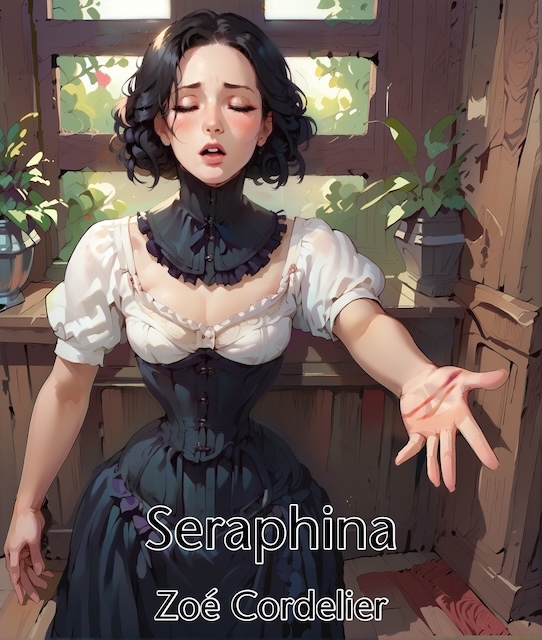
Read below, or click on the image for the EPUB download:
India
The humid air clung to Seraphina’s skin as she sprinted through the tangled jungle, the laughter of her childhood companions ringing in her ears. Her bare feet darted over roots and stones, her skirt hitched up in one hand, the other clutching a carved wooden toy—a gift from Raji, the boy who had taught her to climb trees and bait fishing lines. She lived for days like this: free, untamed, and blissfully ignorant of the strictures of British society her parents clung to like lifelines in this strange, hot land.
Her mother, Isabella, had tried once or twice to tame her. “A young lady must be presentable, Seraphina,” she’d said while pinning her unruly curls, only to have the child tear them loose moments later. Sir Alfred Lockewood, always impeccably dressed even in the oppressive heat, had been more lenient. “Let her run,” he’d said with a chuckle. “She’s happier out there than trapped under parasols and propriety.”
But happiness had a way of turning brittle under the weight of reality.
The day her parents died began like any other, with the rising sun painting the bungalow in shades of gold and red. Seraphina had been out in the clearing behind their home, showing Raji how to build a sling from scraps of leather. The sudden, frantic shouts of the servants brought them both to their feet.
“Miss! Miss Seraphina, come quickly!”
She ran toward the house, Raji on her heels, her chest tightening at the sight of smoke curling into the air. The front gate stood ajar, and the familiar grounds of the compound buzzed with chaos. British officers shouted commands as native soldiers swarmed the area, rifles at the ready.
Inside, the chaos was worse. Isabella’s voice, high-pitched and trembling, rang out from the sitting room. “Alfred, we must go! We must—”
“Stay here!” Sir Alfred barked, his pistol drawn. He turned to meet Seraphina as she burst through the doorway. “You!” he snapped, his usual warmth replaced with a tone she didn’t recognize. “Get upstairs and lock the door.”
“But—”
“Do as I say, Seraphina!”
The sharpness of his command froze her in place. She stumbled back toward the staircase, her heart pounding in her ears. At the top, she stopped, unable to resist peeking down as her father stepped outside, firing shots into the approaching mob.
Then she saw it: the flash of steel, the dark spray of blood as he staggered back into the doorway. Her mother screamed, rushing to his side, only to be dragged away by rough hands. Seraphina’s throat tightened as the scene blurred with tears. Her father fell, and her mother’s cry was abruptly silenced.
She didn’t remember fleeing the house. Someone must have pulled her away—Raji, perhaps, or one of the servants loyal enough to risk their lives. By the time she came to her senses, she was deep in the jungle, crouched in a thicket with a bloodied knife clenched in her trembling hand.
For weeks, she hid among the trees, surviving on roots and berries, avoiding every sound that hinted at pursuit. When British troops finally found her, she was a shadow of the carefree girl who had once roamed these woods. Her parents were gone, the bungalow a smoldering ruin, and the world she’d known had turned to ash.
They sent her to London, where her aunt awaited. Lady Agatha Thistledown’s letters were polite but cold, the tone of a woman burdened with a responsibility she hadn’t sought. Seraphina, numb and hardened, had no illusions about what awaited her.
India had taken her parents, her home, and her innocence. London would demand the rest. But she would not surrender easily.
London
The drawing room’s air, thick with lavender and powdered propriety, vibrated with the sound of fabric tearing. Lady Agatha Thistledown—a name Seraphina thought ridiculously pompous even before arriving in London—clutched her hands together so tightly her knuckles whitened. She stared, horrified, as her niece hacked at the whalebone corset holding her with a wickedly curved knife she’d pulled from who-knew-where.
“Seraphina Arabella Lockewood!” Lady Thistledown’s voice was shrill, trembling between indignation and disbelief. “Cease this barbarism at once!”
Seraphina, crouched in the middle of the room like a tiger poised to pounce, glared at her aunt. Her dark hair tumbled wildly over her shoulders, the carefully pinned curls undone within moments of her arrival. She jabbed the knife into another taut ribbon, the blade gleaming under the chandelier. The corset snapped and fell from her body.
“Barbarism?” she snarled, her voice cutting through the genteel air like the knife through silk. “This blasted thing is barbaric. You’ve got to be bloody insane to wear it willingly.”
Lady Thistledown gasped, her hand flying to her throat. “Language! Such filth—I won’t allow it under my roof!”
Seraphina snorted and muttered something in Hindi—likely a curse, though her aunt wouldn’t have understood. Not that she cared. She grabbed the corset and hacked again at it with the blade, for good measure. It had been less than an hour since they’d forced her into the damned thing, and already her ribs ached and her temper blazed.
“This isn’t India!” Lady Thistledown stamped her foot, the most unladylike gesture Seraphina had yet seen her perform. “You will comport yourself as a lady, or you’ll be confined to your room until you learn proper decorum.”
Seraphina paused, fixing her aunt with a glare sharp enough to pierce armor. “Confined?” she repeated, her tone dangerously low. “Do you think I’m some cow to be penned up? Try it, Aunt Agatha. Just try.”
The older woman faltered, retreating a step. “You—you are behaving like a savage!” she stammered. “And that blade—how dare you bring such a thing into my home? It’s—it’s indecent!”
Seraphina grinned—a flash of teeth that sent a shiver through her aunt. “Indecent, is it?” she said, flipping the knife expertly in her hand. “This knife has gutted fish and frightened off panthers. I’ll take indecent over suffocating, thanks.”
“Enough!” Lady Thistledown’s composure snapped, her voice rising above her usual measured hauteur. “You will stop this madness, or—”
“Or what?” Seraphina straightened, her torn corset dangling from her hand. The soft fabric of her chemise clung to her damp skin, her breath heaving in defiance. “You’ll marry me off to some stuffy lord with too much coin and not enough spine? Put me in another cage? I’d rather rot.”
Lady Thistledown’s lips pressed into a thin line, her face pale but for two spots of furious crimson on her cheeks. “You will be a lady,” she said, trembling with rage. “Even if it kills you.”
“Good luck with that,” Seraphina said, tossing the mutilated corset to the floor. The knife disappeared somewhere in her skirts with a fluid motion that spoke of years of practice. She crossed her arms, her chin high, daring her aunt to make another move.
The room fell silent except for the faint rustling of fabric as Lady Thistledown wrung her hands. The older woman’s mind raced—how to tame this wild creature thrust upon her care? Proper decorum had never faced a foe like Seraphina Arabella Lockewood.
Later on the same day, Seraphine spent her time outside in god knew what places. Meanwhile, the sitting room, with its pale green walls and collection of porcelain dogs, seemed an oasis of calm compared to the storm Seraphina had unleashed mere hours ago. Lady Thistledown sat stiff-backed on a settee, her teacup rattling slightly on its saucer. Across from her, Lady Prudence Ditheridge, a woman whose penchant for whispered scandals and practical solutions made her an invaluable confidante, leaned forward with an air of conspiratorial glee.
“My dear Agatha,” Lady Ditheridge began, her voice low and syrupy, “I could scarcely believe it when I heard of the girl’s… display.” She paused for emphasis, delicately brushing an invisible speck of dust from her sleeve. “But fear not. There is a solution, though it may require a touch of… fortitude.”
Lady Thistledown sighed, pressing a lace-edged handkerchief to her temples. “Fortitude? At this rate, I’ll require a saint’s patience and an iron will. You didn’t see her, Prudence—cutting at her corset like a madwoman! And the language. She speaks like a dockworker’s apprentice.”
“Indeed.” Lady Ditheridge nodded sagely, the small feather on her hat bobbing with each movement. “And this knife of hers—most unsettling. But do not despair. I have precisely the thing for such unruly behavior. Have you heard of The School for the Refinement of Wayward Ladies?”
Lady Thistledown raised a brow. “No, but the name alone promises miracles.”
“It’s tucked away on a remote island in the middle of Loch Thorne, up in the Scottish Highlands,” Lady Ditheridge explained, her voice dropping to a hushed tone. “Practically unreachable, save for a single ferry that runs once on demand. It’s run by the formidable Miss Ethelred Blackthorn—an iron-willed woman of unparalleled discipline.”
“Blackthorn, you say? If names mean anything…”
“She’s aptly named,” Lady Ditheridge continued, her eyes alight with morbid enthusiasm. “Miss Blackthorn takes on only the most… challenging cases. She has a reputation for turning hoydens, rebels, and other such undesirables into paragons of grace and obedience. Her methods are, shall we say, firm.”
Lady Thistledown shuddered delicately. “What exactly do you mean by firm?”
“I mean precisely what you think, Agatha,” Lady Ditheridge said with a knowing smirk. “Corset training so rigorous the girls weep, etiquette drills until dawn, and strict behavioral correction. But the results! By the time they emerge, they’re the toast of society—marriageable, polished, and with figures as enviable as their manners.”
Lady Thistledown’s expression softened into cautious hope. “Marriageable, you say?”
“Oh, indeed. Graduates of Loch Thorne are snatched up faster than tickets to the opera. Wealthy families send their most hopeless daughters there, knowing they’ll return as the embodiment of refinement. Why, just last season, the Earl of Weatherby married a Loch Thorne alumna. And what a transformation she’d undergone—before her schooling, she was rumored to have boxed her brother’s ears in public!”
Lady Thistledown nearly dropped her teacup. “And Miss Blackthorn succeeded with her?”
“Completely. She’s now the perfect countess, demure and obedient. Miss Blackthorn never fails.”
Lady Thistledown let out a long breath, her earlier despair giving way to cautious optimism. “Perhaps this is the answer. Seraphina must learn her place in the world, and if this school can accomplish what you claim…”
Lady Ditheridge nodded, leaning in conspiratorially. “I’ll write to Miss Blackthorn on your behalf. Be prepared, though. Once Seraphina is there, the process will not be… gentle.”
Lady Thistledown clasped her hands tightly in her lap, the image of Seraphina’s defiant face still fresh in her mind. “Gentle or not, Prudence, I’ll do whatever it takes. That girl will not ruin herself—or our family’s name.”
Lady Ditheridge smiled with satisfaction. “Then it’s settled. By the time Miss Blackthorn has finished with her, Seraphina will be the toast of London society—or perish in the attempt.”
The three weeks had been nothing short of a siege, Lady Thistledown thought grimly as she ascended the staircase with her retinue of footmen. The carpeted steps muffled their march, but the tension was palpable. She gripped the folded letter from Miss Blackthorn like a lifeline, the crisp paper promising salvation from the chaos that had engulfed her once-orderly home.
The first disaster had been the curtains. Seraphina, for reasons only she could fathom, had decided to dismantle the heavy velvet drapes in the drawing room to create what she called “a proper jungle canopy.” The resulting mess—a tangled web of fabric, fallen curtain rods, and shattered porcelain vases—had sent Lady Thistledown’s maid into a fit of tears and the butler into a rage.
Then came the incident with the garden. Seraphina had enlisted the stable boy to help her dig a series of “trenches” in the flower beds, declaring it an experiment in irrigation she’d learned from her childhood companions in India. The roses were ruined, the lawn gouged with muddy channels, and the gardener had nearly quit on the spot.
But the final straw—the event that sealed her fate—had been the dining room. Seraphina had stormed in during a luncheon with Lady Ditheridge and several other esteemed guests, wearing trousers she’d fashioned from an old set of curtains, her hair wild and unpinned. She’d sat at the table and plunked a mango on the fine china. This clearly meant she had been breaking into Lady Ditheridges hothouse, and helped herself. Seraphina proceeded to cut it open with one of her ever-present knives, the juice dripping onto the pristine white tablecloth.
“You are a menace!” Lady Thistledown had shouted then, slamming her hand on the table and startling her guests.
“Better a menace than a corpse in a corset,” Seraphina had shot back, unfazed, as she bit into the fruit.
Now, standing outside Seraphina’s bedroom door, Lady Thistledown steeled herself. She nodded to the footmen, who burst in like soldiers storming a battlefield. Inside, Seraphina was perched on the edge of the bed, her knife already in hand.
“Oh, for heaven’s sake,” Lady Thistledown snapped, striding in. “Drop it, girl. You’ve no chance against four men.”
Seraphina smirked, twirling the blade with practiced ease. “Took you long enough to come for me. Thought you might be enjoying the chaos.”
“Enjoying it? You’ve turned my home into a circus!” Lady Thistledown gestured to the footmen. “Take her things—pack everything. Leave nothing unchecked.”
As the footmen approached, Seraphina sprang to her feet, the knife flashing in her hand. “Touch my things, and you’ll regret it.”
“Oh, enough with the theatrics!” Lady Thistledown barked. “You’re going, whether you like it or not.”
Two of the footmen grabbed Seraphina’s arms while the others began ransacking the room. In her underwear, they found a blade sewn into the lining, its hilt cleverly hidden under a strip of lace. Another knife fell from a hidden pocket in her skirt, clattering to the floor.
“Is this really necessary?” Seraphina growled, struggling against the firm grip of the men. “You’re shipping me off like cargo.”
“Cargo doesn’t wield weapons,” Lady Thistledown said dryly. “And there’s more to find, I’m sure.”
When the trunk was opened, a footman pulled out a knife tucked between two slips, its edge glinting. Another emerged, hidden in the hollowed-out spine of a book. Two more were rolled into stockings, the fabric carefully stitched to keep the blades from falling loose.
By the time the search was complete, Seraphina stood bound at the wrists, glaring daggers—if not wielding them—at her captors. “You’re making a mistake,” she said, her voice low and venomous.
“The only mistake was thinking I could manage you myself,” Lady Thistledown retorted. “Now march.”
They hustled her down the stairs and out to the waiting carriage. Lady Thistledown, ever cautious, ordered a final inspection before boarding. A footman patted Seraphina down, discovering yet another knife strapped to her thigh with a strip of leather. The girl grinned wickedly as it was confiscated.
“You’re thorough, I’ll give you that,” Seraphina said as they shoved her into the carriage.
Lady Thistledown climbed in after her, ensuring the bonds were secure and the trunk locked tight. “If you attempt anything during this journey, I’ll see to it that Miss Blackthorn hears every sordid detail of your behavior.”
Seraphina leaned back against the seat, her defiance undimmed. “You’re in for a long ride, Auntie.”
Lady Thistledown settled into her seat, the letter from Miss Blackthorn still tucked safely in her pocket. “Not as long as you think, my dear. By the time we reach Loch Thorne, you’ll have no fight left in you.”
Loch Thorne
The small ferry cut through the icy waters of Loch Thorne, the rhythmic creak of the oars the only sound apart from the wind whipping across the desolate expanse. Seraphina sat bound and gagged, her eyes burning with defiance even as the chill bit at her cheeks. Lady Thistledown, wrapped in a heavy wool cloak, clutched the edges of her seat with a grim determination. She avoided her niece’s gaze, focusing instead on the looming silhouette of the island ahead.
The pier was stark, its damp wood slick underfoot as they disembarked. An arched wrought-iron gate stood at the end of the dock, the institution’s name, The School for the Refinement of Wayward Ladies, painted in austere black letters on a weathered white sign. The words felt heavy, like the very air of this forsaken place.
A waiting carriage—a simple two-horse affair with no adornments—stood ready beyond the gate. The driver, an expressionless man in a dark coat, tipped his hat as he took the reins. Lady Thistledown climbed in first, her skirts rustling against the leather seat. Seraphina was unceremoniously hoisted up after her, her bonds making no allowances for dignity.
The carriage rolled slowly across the gravel path, the crunch of wheels against stone matching the oppressive atmosphere of the island. Ahead, the reformatory loomed. Built from Craigleith sandstone—the same cold, gray stone as Edinburgh’s ancient heart—it was an unforgiving structure, its three stories framed by two severe side wings. The building exuded an air of control, its blank windows like unblinking eyes. Behind it, smaller outbuildings for the kitchen and servants huddled in its shadow, as if cowed by its presence.
The carriage halted before the main doors. A maid stood waiting, her silhouette stark against the heavy wooden entryway. Her dress was severe, her waist cinched so tightly it was impossible to ignore the rigidity of her posture. She curtsied deeply as they approached, her expression void of warmth.
“Welcome to Loch Thorne,” she said softly, her voice clipped and precise. She turned to Lady Thistledown and added, “Miss Blackthorn is expecting you.”
The maid led them through the imposing doors into a marble-floored hall. The cold seeped into the very air, the scent of polish and discipline woven into every stone. Lady Thistledown walked briskly, but her glance at the tapestries lining the walls betrayed her unease. Seraphina followed under guard, her bound hands still held tight by the footmen.
They stopped before a door at the far end of the hall. The maid knocked twice before pushing it open to reveal Miss Blackthorn’s study. The room was severe yet meticulously organized: shelves lined with books on deportment and discipline, a polished desk free of clutter, and a single chair positioned precisely before it.
Miss Blackthorn rose as they entered, and Lady Thistledown felt her breath catch. The governess was tall, her posture as unyielding as the stone walls surrounding them. Her dark hair was pulled into a flawless bun, a single streak of silver cutting through the midnight strands like a blade. Her dress, high-collared and jet black, left no doubt about the strictness of her character. The corset beneath it was no mere garment; it was a declaration, cinched so tightly that her every movement seemed measured by the demands of perfect control. Her pale face bore not a flicker of humor, her sharp features carved into an expression of uncompromising authority.
“Lady Thistledown,” Miss Blackthorn greeted, her voice smooth and icy. She inclined her head with a precise formality, her dark eyes locking onto her guest. “You are most welcome at Loch Thorne.”
“Miss Blackthorn,” Lady Thistledown replied, her voice steadier than she felt. “I trust you have received my correspondence.”
“Indeed,” Miss Blackthorn said. “We are prepared for Miss Lockewood.” She gestured vaguely toward Seraphina, still bound and gagged. For all the attention she paid the girl, she might as well have been luggage.
Lady Thistledown hesitated, but Miss Blackthorn’s unwavering gaze silenced any second thoughts. “She is… a challenge,” Lady Thistledown admitted.
“Challenges are my specialty,” Miss Blackthorn said coolly. She turned her attention back to the maid. “Prepare Miss Lockewood for intake. Lady Thistledown, would you care for tea while we finalize the arrangements?”
Lady Thistledown nodded, relieved to hand over her burden. “Yes, thank you. That would be… most welcome.”
As Seraphina was led away, Miss Blackthorn’s gaze didn’t follow. The maid led Seraphina, still handled by two footmen, through an icy hallway, the stone walls swallowing any warmth from the sparse lamplight. Seraphina stumbled forward under the unyielding grip of the footmen, her wrists still bound. The maid led them to a door, and opened it with a curt nod.
“Please leave her here, that would be all,” the maid instructed, stepping aside to allow the footmen to shove Seraphina inside.
The figure waiting within made Seraphina falter. The woman wore a maid’s uniform, but any resemblance to the delicate figure in the hall ended there. Broad-shouldered and solid, she stood like a monolith, her severe expression set into features as hard as the stone walls around them. Her dark hair was pulled into a functional braid, and her pale skin was marked by a faint scar tracing the edge of her jaw. The knife she held was thin and wicked, its sharp edge glinting as she turned it lazily in her hand.
“Ah,” the woman said, her accent thick and harsh, her vowels clipping the English like an axe splitting wood. “You are the little troublemaker. We begin.”
The woman stepped forward and uncermoniously cut off the straps of her gag. She then sliced through the bindings on her wrists with clinical precision. The relief was short-lived. With the same flick of her blade, the woman slashed the front of Seraphina’s dress, the fabric parting like silk under the blade.
“What the hell—” Seraphina began, but the words caught in her throat as the woman yanked the ruined dress from her shoulders with startling strength. The bindings followed, then her undergarments, until she stood naked in the frigid air, goosebumps prickling her skin.
The woman stepped back, her sharp eyes raking over Seraphina’s frame. “Thin. Wild. Bad posture,” she muttered, half to herself. Reaching for a tape measure, she quickly took several measurements, her hands moving with dispassionate efficiency.
Seraphina glared at her, her face burning. “You could have asked, you know.”
The woman didn’t respond. She turned to a row of cupboards, throwing them open with a series of quick, practiced movements. From within, she pulled out a bundle of garments: a coarse slip, a corset in drab gray, a narrow underskirt, and a charcoal wool dress so stiff and scratchy it looked as though it might stand on its own. Next came a pair of woolen stockings, high-heeled boots, kid gloves, a detachable stiff white collar, and a plain apron.
“Here,” the woman barked, thrusting the pile toward Seraphina. “You dress. Now.”
Seraphina raised her chin, her arms crossed defiantly over her chest. “You expect me to wear that? You must be joking.”
The slap came so quickly Seraphina barely registered the motion. The woman’s hand cracked against her cheek, snapping her head to the side. Tears sprang to her eyes unbidden, more from shock than pain.
The woman’s voice, low and dangerous, cut through her stunned silence. “I did not ask for talk. I gave order. You dress, da?”
Seraphina turned back to face her, her lips trembling. “You can’t just—”
The second slap landed harder, from the opposite side, leaving both her cheeks stinging and her vision swimming.
“No talk,” the woman growled, leaning in close enough that Seraphina could feel her breath. “You are not here to talk. You are here to obey. Now dress.”
Tears slid down Seraphina’s face, but she said nothing. Her hands, trembling with cold and rage, reached for the slip. The scratchy woolen slip clung to Seraphina’s skin, its coarseness a constant reminder of her situation. She shivered as she pulled the stockings up her legs, the thick material promising some relief from the icy air of the reformatory. They reached mid-thigh, to be held snugly in place by garters attached to the corset waiting ominously nearby.
The maid sat her down on a chair, for the boots that came next—high, stiff, and gleaming black leather. The Russian maid crouched before her, her rough hands pulling the laces tight with merciless efficiency. Seraphina winced as her arches were forced into an unnatural curve, the five-inch heels angling her feet steeply. The snug leather left no room for her to adjust; every movement of her toes felt locked into the rigid structure of the boots. The maid’s cold gaze flicked up to meet Seraphina’s.
“Stand,” she ordered.
Seraphina obeyed reluctantly, wobbling slightly as the boots made balance a challenge. The maid clucked her tongue. “You learn soon,” she muttered before moving on to the corset.
The garment itself was simple in design, but its effects were anything but. The maid fastened it around Seraphina’s waist, tugging the laces in passes, once, twice, each pass stealing more air from her lungs. There was a brief pause before the third and final pass. The maid braced her foot against Seraphina’s back, yanking the laces with such force that Seraphina gasped, her knees threatening to buckle.
The maid secured the laces with a knot pressed flat by a screw nut, tightening it between two small washers before sealing it with a blob of crimson wax. “Temporary corset,” she said flatly. “Proper one comes after first week.”
Seraphina’s chest heaved, her breath shallow and fast. She felt lightheaded, her vision swimming for a moment before she steadied herself. But there was no reprieve—the kid gloves came next, the maid tugging them over her hands and buttoning them tightly with a small buttonhook. The snug leather hugged her fingers, leaving her hands useless for any delicate movement.
Then came the hobbling underskirt, hooked to the corset with small clasps. It narrowed her stride to mere inches, each step now a deliberate, shuffling motion. Petticoats followed, their weight pressing down on her hips, and then the woolen school dress. The fabric was rough against her skin, warm but unbearably coarse. The high detachable collar was wrapped around her neck with a small strap, forcing her head upward. Seraphina realized with dawning horror that she could no longer look down or even turn her head without immense effort.
Her hair was next. The maid’s fingers worked with brutal precision, pulling Seraphina’s locks into a painfully tight bun that left her scalp aching. A stiff bonnet was secured over her head, tied tightly under her chin and buttoned to the high collar. The final indignity left her head locked in place, unable to move even slightly.
When the maid stepped back to inspect her work, Seraphina stood swaddled in layers of coarse wool, her movements slow, her breath shallow, and her head forced to stare straight ahead. The maid gave a curt nod, her satisfaction evident.
“You go now,” she said, gesturing to the door.
The maid from earlier awaited her return, her expression as serene as if Seraphina were dressed for tea rather than a waking nightmare. Without a word, she turned and led Seraphina back through the echoing halls to Miss Blackthorn’s office.
The walk felt endless, each shuffle of her feet a struggle against the unyielding corset and skirt. By the time they arrived, Seraphina’s breaths were shallow and her resolve had worn thin. The office door opened, and Miss Blackthorn rose from her desk, her dark eyes assessing the figure before her.
She said nothing to Seraphina, addressing only the maid. “Has she been properly prepared?”
The maid nodded. “Oui, Miss Blackthorn. She is ready.”
“Good,” Miss Blackthorn said, her voice cold and precise. Her gaze flicked briefly to Seraphina, but she might as well have been inspecting a mannequin. “I will take her to the dormitory myself. Her training begins at dawn.”
Miss Blackthorn stopped before Seraphina, inspecting her closely, her dark eyes noting every tightened seam, every painfully straight line forced by the uniform. She finally nodded to Lady Thistledown. “Already much improved,” she said with clinical approval. “I assure you, Lady Thistledown, we will take good care of her and produce the results you desire within the allotted time.”
Seraphina’s lips parted, a retort rising before she could stop it. “I’m not—”
Miss Blackthorn moved with unsettling swiftness, closing the distance between them in an instant. From somewhere unseen, she had produced a short, cruel-looking riding crop. The leather tip pressed sharply into the delicate spot between Seraphina’s jaw and neck, tilting her head ever so slightly upward in painful compliance, straining against the collar and the bonnet’s fastening.
“As a rule,” Miss Blackthorn said, her voice soft but brimming with menace, “a young lady will speak only when spoken to. You would do well to take this rule to heart.”
The cold leather bit into her skin, and Seraphina swallowed hard, her defiance faltering under the weight of Miss Blackthorn’s unrelenting gaze. She clenched her teeth, holding back the sharp words she so desperately wanted to hurl, and instead offered the smallest nod she could manage under the circumstances.
Satisfied, Miss Blackthorn withdrew the crop and turned back to Lady Thistledown, her demeanor reverting to its cold professionalism.
Lady Thistledown smiled, her earlier tension melting away. “I am confident she is in capable hands, Miss Blackthorn. I have no doubt she will become the refined young lady we both know she can be.”
She gathered her cloak, casting a final glance at Seraphina. “Goodbye, my dear. I look forward to seeing your progress.”
The door shut behind her with a heavy finality, leaving Seraphina and Miss Blackthorn alone in the suffocating silence of the office.
Miss Blackthorn moved back to her desk, picking up a ledger and inspecting it briefly. Without looking at Seraphina, she said, “Come.”
Seraphina obeyed reluctantly, shuffling behind the governess as she led her down a narrow, dimly lit corridor. The tight confines of her uniform made every step laborious, the boots forcing her feet into an unnaturally rapid rhythm of mincing steps, the hobbling skirt keeping her stride to mere inches. She was already sweating despite the chill of the building, her skin chafing against the coarse wool of the dress.
They stopped at a plain wooden door near the end of the corridor. Miss Blackthorn unlocked it and pushed it open, revealing a small, sparsely furnished room. Two narrow beds were positioned against opposite walls, each with a simple trunk at the foot. A single window high on the far wall let in a sliver of gray light.
Inside, a young woman sat on one of the beds, her hands folded primly in her lap. Her uniform was identical to Seraphina’s, though she wore it with practiced ease. Her hair was coiled and hidden neatly into a severe bun with a single honey-blonde strain escaping, and her pale blue eyes fixed on Seraphina with an expression of mild curiosity.
“This is where you will stay,” Miss Blackthorn said. “You will share this room with Miss Penelope Fairfax. She has been with us for six months and will serve as an example of proper behavior. Is that understood?”
Seraphina forced herself to nod, the collar biting into her throat as she did. Miss Blackthorn turned to Penelope.
“Miss Fairfax, this is Miss Seraphina Arabella Lockewood. See to it that she learns our ways quickly.”
Penelope rose gracefully, her movements smooth despite the restrictions of her uniform. “Yes, Miss Blackthorn.”
Miss Blackthorn cast one final, assessing glance at Seraphina before stepping out and shutting the door behind her. The sound of the lock clicking echoed in the small room.
Penelope offered a faint, polite smile. “Welcome to Loch Thorne, Seraphina,” she said, her voice lilting with an upper-class accent. “I imagine you’ll find things quite… different here.”
Seraphina sat heavily on her bed, the stiff corset forcing her to remain upright even in her exhaustion. “Different,” she muttered, her voice low with suppressed rage. “That’s one way to put it.”
Penelope’s smile didn’t falter. “Best to keep that to yourself,” she advised, her tone calm but firm. “Miss Blackthorn has a way of… correcting those who speak out of turn.”
Seraphina looked away, her jaw tight. She had no intention of playing by their rules, but for now, she would bide her time.
Loch Thorne, Evening
Sitting on the edge of the narrow bed, Seraphina fumbled uselessly at the buttons on her wrists. The tiny fastenings were impossible to grip, slipping from her gloved grasp every time she tried to pull at them.
“Bloody hell,” she muttered under her breath, her frustration bubbling over. Her fingers tugged at the gloves again, desperate for even the smallest relief.
Across the room, Penelope watched her impassively from her own bed, her hands folded neatly in her lap. “Don’t,” she said, her voice calm but with an edge of warning.
Seraphina’s head snapped up—or rather, tried to. The stiff collar and bonnet locked her head in place, forcing her to tilt her entire torso to meet Penelope’s gaze. “Don’t what?” she snapped.
“Don’t try to upset your uniform,” Penelope said simply, her tone patient as though addressing a stubborn child. “If you aren’t properly dressed for the dinner inspection, you’ll fail it. That means no meal and a correction.”
“Correction?” Seraphina scoffed, though her chest tightened at the word. “What’s that supposed to mean? Another slap, or do they have something worse in store?”
Penelope’s expression didn’t waver. “Worse. You’ll desperately want to avoid it. Trust me.”
Seraphina let out a string of curses under her breath, some in English, others in languages she’d learned in India. Her fingers almost curled into fists, until the smooth leather stopped her, creaking. She looked down at herself, and felt the high collar biting into her neck, the hobbling skirt locking her legs into short, shuffling steps, the gloves that rendered her hands nearly useless. Everything about her current state screamed restraint.
She stood, the stiff petticoats rustling as she moved, and shuffled toward the trunk at the foot of her bed. Her boots pinched with every step, the high heels forcing her to place each foot down carefully. Leaning over was impossible with the corset digging into her ribs, and she was forced to awkwardly kneel to examine the trunk. She fumbled at the latch, but her gloved fingers couldn’t grip it properly. Frustrated, she got back onto her heels and turned herself to look around the room.
The furnishings were sparse and cold, the walls painted in dull, uninspiring tones. The single window above the far wall let in a gray, watery light, but it was set so high that she had no chance of reaching it, especially not in her current outfit. She spotted another door on Penelope’s side of the room and shuffled toward it, her movements slow and jerky.
The door led to a small lavatory. A washbasin with a cracked porcelain edge, a simple loo, and a vanity stood crammed into the space. Another high window let in faint light, but like the one in the main room, it was unreachable. Seraphina ran her gloved hands along the edge of the vanity, searching for something—anything—that might help her remove her gloves, her collar, anything. But the buttons on her gloves were too small, the corset too tight, the collar too immovable. Her restricted range of motion made it impossible to even reach behind her back to fiddle with the buttons on the dress or her skirts.
She returned to the main room, silently fighting against the restrictions of her dress. Penelope’s voice broke the silence. “It’s meant to be like this.”
“What?” Seraphina snapped, her hands trembling with frustration as she gave up on the collar and sat heavily on the bed.
“The uniform,” Penelope said, her voice quiet. “It’s… portable bondage. Everything about it is designed to keep you in line. You’ll find no relief from it unless they allow it.”
Seraphina glared at her, anger and helplessness churning in her chest. “What the hell kind of place is this?”
Penelope tilted her head slightly, her bun pulling tightly against her scalp. “The One where they store you, until you manage to present yourself in a way that a man will marry you and take you with him.”
Seraphina’s lips pressed into a thin line. For the first time in her life, she felt entirely trapped—not just physically, but by the sheer weight of the institution around her. She glanced toward the locked door and swallowed hard.
Seraphina sat down again on the edge of the bed, fidgeting against her restrictions. She glared at Penelope, who remained the picture of calm composure, hands folded neatly in her lap as if she had been born into this peculiar nightmare.
“Well?” Seraphina demanded. “What’s the game here? What are the rules of this… charming establishment?”
Penelope raised an eyebrow, her lips twitching with the faintest hint of amusement. “The rules are simple. First and foremost: always be pretty and dainty. Miss Blackthorn believes a proper woman must be presentable and composed at all times.”
“Pretty and dainty,” Seraphina repeated, sarcastically. “How delightful.”
“That means,” Penelope continued, undeterred, “you will greet others politely, always with a curtsy. You will say thank you for everything you receive—whether it’s a gift or a punishment. And yes, with a curtsy.”
Seraphina let out a bitter laugh. “Thank you for beating me? For starving me? What else?”
Penelope’s calm gaze never wavered. “You are to be seen, not heard. Do not speak unless spoken to, and always be polite. And whatever you do, don’t cuss.”
“What are they going to do, wash my mouth with soap?” Seraphina sneered.
“That, or the gag,” Penelope said lightly. “Or the brank.”
“The brank?” Seraphina repeated, her brows furrowing. “What in God’s name is that?”
Penelope hesitated for a moment before explaining. “It’s… a metal gag. A punishment for particularly foul or defiant language. It locks over your head, and the gag is inserted into your mouth. Uncomfortable, to say the least.”
Seraphina blinked, the weight of Penelope’s words sinking in like a stone. She swallowed hard, but her defiance flared again. “They’re not going to break me with some ridiculous gag. I’ll manage.”
Penelope’s face softened, almost pitying. “There’s more. You’ll be inspected before every meal. Your uniform, posture, and demeanor must be impeccable. If you fail, you don’t eat.”
Seraphina stiffened. “What? They starve us?”
“And you’ll receive a correction,” Penelope added. “That’s for any infractions, not just meals. If your uniform is improper, your dress isn’t pristine, or you disobey… corrections follow.”
Seraphina’s mind raced, the unfamiliar terminology grating against her pride. “Corrections,” she muttered. “What are those? Whippings?”
Penelope sighed. “Not usually. Open defiance or severe infractions might earn a whipping, but most corrections are… restrictive.” She gestured vaguely at Seraphina’s uniform. “Improper dress earns correction dress. And trust me, it can always get worse.”
Seraphina frowned, tugging at the stiff collar around her neck. “Worse than this?” she scoffed. “What is this even supposed to be?”
“That,” Penelope said with a faint smile, “is the beginner uniform.”
Seraphina’s stomach twisted. The scratchy wool, the unyielding corset, the hobbling skirt, the immovable collar, the snug gloves that left her fingers useless—all of it was just the beginning? She shifted uncomfortably on the bed, the tight leather boots digging into her arches, her body aching from the constant strain.
“This place,” Seraphina said slowly, her voice tinged with incredulity, “isn’t just about rules. It’s a bloody prison.”
Penelope nodded, her expression turning somber. “It’s a reformatory. And they’ll reform you, one way or another. The sooner you learn the rules and follow them, the easier it’ll be.”
Seraphina stared at her, the fire in her chest dimming into something colder and sharper: determination. “We’ll see about that,” she muttered.
“What else do we do? Sit here in our prison cell, in silence?” Seraphina snapped in frustration.
“We have classes,” Penelope replied, her tone steady but without much enthusiasm. “Etiquette, conversation in English and French, dance, deportment, calligraphy, literature, needlework, and religion.”
“Nothing useful?” Seraphina scoffed. “And how am I supposed to do calligraphy or needlework with these?” She held up her gloved hands, the snug leather creaking with the movement. “I can barely grip my own skirts.”
“You will learn,” Penelope said, her expression unreadable. “We all do.”
Before Seraphina could fire back another complaint, the sound of a key turning in the lock echoed down the corridor. Penelope’s demeanor shifted immediately, her posture snapping into rigid perfection. She lifted a single finger to her lips, silencing Seraphina with an urgent, “Ssssh.”
The door swung open, and Miss Blackthorn’s dark silhouette appeared in the corridor. Without hesitation, Penelope shuffled out of the room, her head held high, her steps small and precise. Seraphina hesitated but followed, mimicking the shuffling motion and finding it maddeningly slow. Outside, all the girls stood at attention next to their doors, a silent line of identical figures in scratchy gray uniforms, their faces turned forward, their hands folded neatly at their waists.
Miss Blackthorn moved down the corridor with the precision of a general inspecting her troops. She stopped at each girl, her dark eyes sweeping over every detail of their appearance. “Dinner,” she said curtly to one. “Dinner,” to another. At the third, she paused, her gaze narrowing. “Your makeup is incorrect,” she said icily. “To correction.” The girl’s face fell, but she curtsied, “Thank you, Miss Blackthorn,” and turned toward the end of the hall without a word.
Seraphina stiffened as Miss Blackthorn approached her. She felt the governess’s eyes rake over her, lingering on her stiff collar, her perfectly buttoned gloves, and the polished leather of her boots. The silence stretched unbearably before Miss Blackthorn finally said, “Dinner.” She moved on without another glance, and Seraphina exhaled shakily.
When the inspection was complete, the girls began to shuffle in pairs down the corridor. Seraphina fell into step next to Penelope, her hobbling skirt and high heels forcing her into the same maddeningly short strides as the others.
The mess hall was as austere as the rest of the reformatory—long rows of plain wooden tables and benches, lit by flickering gas lamps. They took their seats without a word, their movements silent and orderly. Miss Blackthorn stood at the head of the hall, at the raised teachers table, her mere presence silencing even the faintest rustle of fabric. At her gesture, one girl rose from her seat, folded her hands, and began to pray.
“Bless us, O Lord, for these Thy gifts which we are about to receive,” she said, her voice clear and steady. The rest of the hall joined her in unison: “Amen.”
As soon as the prayer ended, the girls began to eat. The food was simple but surprisingly well-prepared—for English cuisine, at least. Roast beef, boiled potatoes, and steamed carrots sat on the plate before Seraphina, but the mere sight of it made her stomach twist. After years of flavorful, spiced Indian food, the blandness was unbearable. Not that it mattered; her corset restricted her appetite to mere nibbles anyway.
Eating proved to be its own ordeal. The gloves, snug and unyielding, made gripping utensils a clumsy struggle. Each movement required exaggerated care, and the rigid collar kept her head locked upright, forcing her to rely on her peripheral vision to see her plate.
Dinner was silent, save for the faint clinking of utensils. When the meal ended, Miss Blackthorn announced the evening options. “You may walk the grounds, read in the library, visit the chapel, or listen to Mademoiselle Artois reading in French. Choose wisely.”
Seraphina didn’t hesitate. She shuffled toward the exit, craving fresh air more than anything else. The grounds were enclosed on three sides by the looming reformatory, the fourth bordered by a tall stone wall. Within the yard was a small garden, its flowerbeds barren in the cold Scottish winter, some evergreen hedges marking the ways. The air was sharp and crisp, biting at her cheeks, but it was a welcome change from the stifling indoors.
She moved slowly, the hobbling skirt and high heels turning every step into an effort. Her vision remained restricted by the bonnet and collar, forcing her to look only forward. The limited view was frustrating, but the cold air soothed her raw nerves. For the first time that day, she felt a semblance of peace—though it was a fragile thing, overshadowed by the looming walls and the constant weight of her bindings.
Her breath puffed in the cold air as she shuffled along the paved paths, carefully staying on them to prevent sinking into the ground with the high heels of her boots. She held her arms folded neatly as she saw the other girls do, because even this small act of freedom was monitored. She couldn’t shake the oppressive sense of control that hung over every corner of this place, but for now, she let the fresh air fill her lungs as much as the corset allowed.
As the sun dipped below the horizon, the sharp clang of a bell echoed across the grounds, its metallic tone summoning the girls back indoors. Seraphina shuffled along with the rest, her steps constrained by the hobbling skirt and punishing heels. The brisk evening air gave way to the building’s oppressive chill and institutional scent.
Once back in their room, Penelope settled onto her bed with the practiced ease of routine. Seraphina remained standing, the rigid corset and stiff uniform refusing her any other option. Moments later, the door opened, and a robust maid stepped inside. She was a stout, ruddy-cheeked woman with arms like a blacksmith’s and a thick braid of dark hair coiled atop her head. Her accent was heavy, her words rolling like the low rumble of distant thunder.
“Aye, lassies,” she said, her tone brisk but not unkind. She turned to Seraphina. “I’m Morag, yer maid. I’ll keep ye in line, friendly-like, but mind this—there’ll be no tolerance fer unladylike carryin’ on.” She nodded firmly before adding, “Let’s be gettin’ ye ready fer bed, eh? Miss Blackthorn’ll have my head if yer late to sleep.”
Seraphina didn’t move, watching warily as Morag approached Penelope first. With quick, practiced motions, she unbuttoned Penelope’s gloves and, breaking the seal and losening the washers, unlaced her corset. Penelope exhaled softly, relief flickering across her features as she stepped out of the restrictive garment. “Yer turn next, new one,” Morag said, jerking her chin toward Seraphina.
The relief of being unbound from her corset was almost dizzying. Seraphina sighed as the laces came loose, the oppressive pressure on her ribs easing. Her gloves were removed with the aid of a buttonhook, and the hobbling skirt and stockings followed. She flexed her aching feet, marveling at the freedom, brief as it was.
“Off tae wash yerself, lass,” Morag ordered, nodding toward the door. “Clean yer face proper-like. No makeup left, mind ye.”
Seraphina complied, the cold water from the washbasin shocking against her skin. She scrubbed away the powder and rouge, her face left raw and chilled. When she returned, Morag had laid out her nightwear, and Seraphina’s stomach sank.
Night mittens were first, heavy padded coverings that curled her fingers into useless balls. Morag secured them tightly, buckling the straps with practiced efficiency. Next came the night corset, looser than the day version but longer, extending from her knees to her overbust. Morag laced it in two passes, humming softly under her breath as she pulled the laces taut.
“Ye’ll get used tae it,” she said as she knotted the laces and sealed the knot with the screw and the washers, and a final small dab of wax. “This one’s nothin’ compared tae yer trainin’ corset.”
Seraphina scowled but said nothing. She could feel the tension in the stays already making her movements slow and deliberate. The sleeping heels came next—shoes designed with no actual heels, forcing her feet into the same arched position as her day boots. Walking in them was impossible, not that the nightgown would allow much movement.
The long sack-like nightgown enveloped her completely, its narrow cut preventing her legs parting much even without the corset. Morag finished with a snug nightcap, tucking all of Seraphina’s hair inside before tying it securely under her chin.
Finally, she guided Seraphina to bed, placing her mittened hands on top of the heavy wool blanket before tucking it so tightly around her that Seraphina could barely breathe. “There now,” Morag said, stepping back to inspect her work. “Warm as a bairn in swaddlin’, aye?”
Warm wasn’t the word Seraphina would have chosen. She could hardly move. The corset kept her from turning, the mittens rendered her hands useless, and the heels ensured she couldn’t walk even if she got free.
Across the room, Penelope was already curled under her own cover, pliant and serene, her breath evening out in mere moments. Seraphina lay awake, every fiber of her body aching in protest. Sleep felt impossible, but exhaustion eventually overtook her in the small hours of the night.
Loch Thorne, Morning
The wake-up call came long before dawn, another sharp bell that jolted her from restless sleep. Morag returned, just as robust and brisk as the night before. Seraphina blinked groggily, her body stiff and sore from the unyielding corset and tucked-in covers.
“Up we go,” Morag said, hauling Seraphina upright with little ceremony. The sleeping heels and nightgown were removed, the mittens and the laces of her corset undone, until she was stark naked. Freedom was fleeting; the day uniform awaited: Slip and stockings went on first.
Morag laced her into her day corset, first pass. Stockings and boots followed, the heels just as steep and unrelenting as yesterday. Seraphina was sent to wash and apply her makeup, her gloves buttoned back on once she returned.
Penelope inspected Seraphina’s makeup with a critical eye, her own perfectly done. “A bit more rouge,” she said softly, dabbing at Seraphina’s cheeks with a practiced hand. “Miss Blackthorn will notice otherwise.”
Seraphina barely had time to adjust before Morag stepped in, her sturdy hands moving with brisk efficiency as she reached for the corset laces. “Time tae tighten these, lass,” she said, giving Seraphina a pointed look.
Seraphina stiffened, her already constricted ribs protesting. “I thought it was tight enough already,” she muttered carefully, biting back the sharper edge of her tone.
Morag chuckled, the sound deep and knowing. “Ach, tight enough fer a novice, maybe, but no’ fer inspection. Ye’ll handle it like a lady, now—silent and wi’ a smile.”
Before Seraphina could respond, Morag tugged the laces again, pulling them tighter in a second pass, and then in a third. The corset cinched in further, pressing Seraphina’s waist into a smaller curve, her breath growing shorter with each pass. She swallowed her protest, the corners of her lips twitching into a semblance of a smile despite the discomfort.
“Guid,” Morag said with a nod, securing the corset again with screw and washers, and sealing it with wax. “Discipline’s a kindness, ye ken. Ye’ll see it fer yerself someday.”
Seraphina said nothing, focusing instead on not swooning as the corset settled into its final, unyielding shape. Morag swiftly layered the underskirt, petticoats, and stiff woolen dress over the corset, each piece adding weight and restriction to the ensemble. The bonnet came last, its buttons locking her head upright once more.
By the time Morag stepped back, the uniform was complete, every detail precise. Seraphina felt as tightly packaged as she had the day before, the discipline etched into every line of her silhouette. Morag offered an approving nod before turning to Penelope.
“Ready fer inspection, the both o’ ye,” she said, ushering them toward the door. “Now off wi’ ye—an’ dinnae forget that smile, lass.”
Miss Blackthorn’s inspection was as exacting as ever, she moved through the line of girls with her unyielding gaze, her sharp eyes scanning every detail. When she reached Seraphina, her lips pressed into a thin line. Seraphina stood rigid, her hands folded at her waist, her face blank as the governess’s eyes scanned her from head to toe.
“Passable,” Miss Blackthorn said coldly. “Though your makeup requires improvement. See that it is corrected tomorrow.”
Seraphina bit the inside of her cheek but curtsied, murmuring, “Thank you, Miss Blackthorn.”
The girls shuffled in pairs to the mess hall, the procession silent. Breakfast was much like dinner: bland, unseasoned food that Seraphina couldn’t stomach in her corset, eaten in silence and with great difficulty due to her gloves. By the time the meal ended, her frustration simmered, but she could do nothing except shuffle out with the others.
The day’s first class was French. The girls sat in wooden benches, their postures dictated by the unyielding stays of their corsets. The teacher, Mademoiselle Vivienne Artois, delivered her lecture with clipped impatience, correcting any misstep in pronunciation with a sharp glare and an even sharper tongue.
When called upon, each girl was required to rise, step out from the bench, and deliver her answer before sitting again. Seraphina soon found the process exhausting; the combination of the hobbling skirt and tightly laced corset turned every movement into a calculated ordeal. By the time the lesson ended, her legs ached, and her breathing was shallow.
Calligraphy followed. Mr. Edward Penbridge, with his kind face and quiet manner, was a welcome change from the previous hour’s tension. He demonstrated elegant strokes on the board, his movements fluid and precise. “Grace,” he said softly, “is as much in your writing as in your posture.”
Taking notes, however, proved challenging. Seraphina’s gloves, snug and stiff, made gripping the pen awkward. She struggled to keep her strokes smooth, the ink smudging as her hand slipped across the page. Penelope leaned toward her and whispered, “Mind your gloves. They must stay clean at all times.”
Seraphina frowned but nodded, focusing harder. Yet, despite her efforts, a smudge of ink spread across the pale leather of her glove, unmistakable.
Mr. Penbridge approached and tutted softly, shaking his head. “Miss Lockewood,” he said, his tone gentle but firm, “what is done is done. The correction will help you to remember for next time. Report to Miss Blackthorn after class.”
Her stomach twisted at the words. She tried to protest, but his kind expression remained unmoved. “Go on,” he said, and she nodded reluctantly.
The trek to Miss Blackthorn’s office was the longest journey Seraphina could remember, though it was only a few corridors away. Her heart pounded against the confines of her corset, each breath shallow and tight. She had roamed jungles, barefoot and fearless, chased off panthers with little more than instinct and a blade. Yet here, surrounded by cold stone and stifling uniforms, she felt something alien creeping into her chest: fear.
She knocked on the door with her mittened hand, the sound faint but crisp in the stillness. From within, Miss Blackthorn’s voice rang out, calm and commanding.
“Enter.”
Seraphina straightened her shoulders, gathering what composure she could under the circumstances. She would not be cowed by an old, unmarried matron running a glorified prison for young women in the frigid north of the British Isles. With a deliberate movement, she opened the door and stepped inside, her chin high and her steps as poised and regal as the restricting uniform would allow.
Miss Blackthorn sat behind her desk, her dark eyes cold and assessing. Seraphina stopped a few paces before her and curtsied just enough to satisfy decorum. “Miss Blackthorn,” she began, her tone measured, “Mr. Penbridge asked me to report to you on account of this.” She lifted her gloved hand, the ink smudge dark against the pale leather. “It seems unreasonable to expect gloves to remain clean when performing calligraphy in gloves such as these.”
Miss Blackthorn’s lips pressed into a thin line. She rose from her chair, her corseted figure a striking pillar of authority. “The punishment for soiled gloves is three on the open hand.”
Seraphina stiffened but held her ground. “Miss Blackthorn,” she said, her voice firm yet polite, “I do not believe that, as a lady, I am meant to work with tools that are unsuitable for the purpose. Surely there must be gloves designed for such tasks, ones that allow for calligraphy without the inevitable risk of…”
“Enough.” Miss Blackthorn’s voice cut through the air like a blade. She stepped forward, her dark gaze fixed on Seraphina’s face. “You will learn to handle the tools you are given and still be a lady, always. There are no exceptions.”
Seraphina’s jaw tightened as she curtsied again, this time slower, deliberate. “As you say, Miss Blackthorn,” she replied, her voice steady but with a defiant edge. Inside, her resolve hardened. She had tried to reason with this woman, to work within her rigid framework, but it was clear there would be no compromise.
This meant war.
Miss Blackthorn rang a small silver bell, its sharp tone summoning a maid. As the maid entered, Miss Blackthorn turned to Seraphina with an air of cold efficiency. Taking a buttonhook from her desk, she began unfastening the buttons on Seraphina’s soiled gloves, her movements precise and almost mechanical. Once removed, she handed the gloves to the waiting maid.
“Fetch a fresh pair,” Miss Blackthorn ordered. The maid curtsied and left the room.
Miss Blackthorn’s sharp gaze returned to Seraphina. “Extend your hand.”
Seraphina’s heart pounded, but she refused to let her fear show. With a deep breath to steady herself, she stretched her hand forward, the fingers trembling only slightly. Miss Blackthorn picked up a slender willow cane from her desk and positioned it over Seraphina’s palm.
The first strike came swiftly, a sharp sting radiating through her hand.
“One,” Seraphina counted clearly, her voice steady. “Thank you, Miss Blackthorn.”
The second landed, sharper than the first, and her palm burned with pain.
“Two,” she said, her voice unwavering. “Thank you, Miss Blackthorn.”
The third strike bit cruelly against her skin, her fingers instinctively twitching from the sting.
“Three,” she finished, her voice even. “Thank you, Miss Blackthorn.”
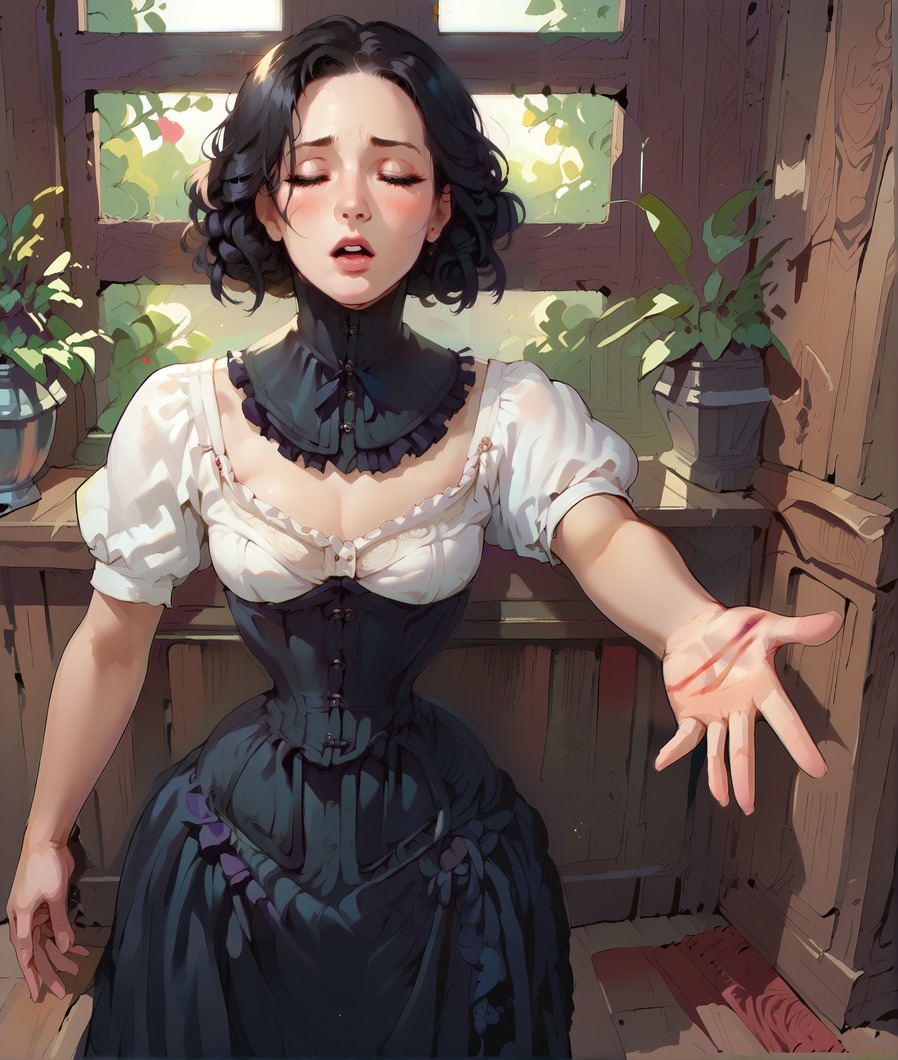
Tears pricked at the edges of her vision, but she held them back, forcing her mind to another place. She remembered a time in the jungle when she had stepped barefoot onto a thorny vine, its sharp barbs slicing deep into her skin. Raji had helped her pull them out, one by one, while she had gritted her teeth and bit back cries of pain. This was nothing compared to that, she told herself.
The maid returned, a pristine pair of gloves folded neatly on a silver tray. Miss Blackthorn took them, slipping them over Seraphina’s hands with a measured care that contrasted sharply with the punishment she had just delivered. She fastened each button with the buttonhook, ensuring every detail was perfect before stepping back.
“You will take more care to present yourself as a lady at all times,” Miss Blackthorn said, her tone clipped.
“Of course, Miss Blackthorn,” Seraphina replied, curtsying deeply. Her lips curved into a polite smile, though her eyes betrayed nothing but icy defiance.
“Return to class.”
Seraphina curtsied again and turned, moving toward the door with a poise that could rival royalty. She left the office, her steps slow and measured, every inch of her outward appearance regal. Inside, however, her thoughts simmered with violent fantasies that she entertained in exquisite detail.
At lunch, the quiet hum of silverware against plates filled the mess hall. Seraphina sat stiffly, her corset pressing relentlessly against her ribs, her gloved hands gripping her utensils with precision. As the meal continued, her fingers worked deftly, guiding the blade of her knife to slip between the cuff of her blouse and her fresh glove. Her movements were deliberate, subtle enough to escape notice.
The blade pressed lightly against her skin—not with intent to harm but as a reminder that even in this prison, she could still find ways to reclaim a sliver of control.
Loch Thorne, first week
The days at Loch Thorne passed with a grinding monotony. Seraphina fell into the rigid schedule of classes, inspections, and mealtimes, her corset shaping both her posture and her movements into the perfect image of Victorian propriety. Her nights were no better—bound in night stays that stretched from her knees to her overbust, her hands useless in mittens, and her legs immobilized by her sack-like nightgown. She had tested the limits of her night mittens and sleeping heels but quickly realized their design left her utterly helpless. Escape during the night was impossible.
During the brief moments between one corset and the next, while Morag bustled around preparing her next layer of restraint, Seraphina felt the closest thing to freedom. These windows were fleeting, lasting mere minutes, but they reminded her that her body was still her own, even if the institution sought to control it completely. Yet, of all the figures at Loch Thorne, Morag earned her respect, if not affection. The Scottish maid’s brusque kindness and hard-won patience did not deserve the violence brewing inside Seraphina. No, Morag would not be the target of her rebellion.
Seraphina’s mind turned constantly to the problem of her gloves. The kid leather bound her hands almost as surely as her night mittens, rendering anything requiring fine dexterity a challenge. She knew she would need to free her hands first, and then her corset and underskirt, to move with any measure of independence. The woolen dress, while heavy and coarse, was tolerable in the freezing Scottish climate, and the heels and petticoats served to keep her skirts from dragging in the mud.
So, she waited. She observed. Every buttonhook, pin, and stray tool became a potential means of escape. She managed to slip a buttonhook into the stuffing of her mattress during one of Morag’s lacing sessions, where it rested next to the knife. If she could get her hands on a hat pin, it would be invaluable—but the only proper hat pins she had seen belonged to Mrs. Everstone, her stern and humorless Etiquette teacher. Seraphina would need to watch carefully for an opportunity to acquire one without drawing suspicion.
Outwardly, Seraphina was a model of Victorian ladyship. She curtsied with perfect grace, her makeup flawless, her posture immaculate. She responded with soft politeness, thanked her instructors with demure bows of her head, and never gave a hint of defiance in her tone. But her eyes, cold and sharp, betrayed none of the submission her body language suggested. Beneath the surface, she was a coiled spring, waiting, watching, planning.
Miss Blackthorn noticed.
Years of experience with wayward girls had taught her to recognize rebellion in all its forms. Most girls fought openly, raging against their restraints until they were broken into meek submission. But Seraphina presented no such outward struggle. Her pliancy was perfect—too perfect. There was no outburst, no tantrum, no crisis that could be thwarted to bring about the final breaking point. Her obedience felt like a veneer, thin and calculated, masking something far more dangerous.
Miss Blackthorn studied her with the precision of a predator sizing up its prey. Seraphina was not a tame cat, nor a girl who had been broken into compliance. She was a tigress, lying in wait, her sharp mind calculating every step, her claws ready to strike when the moment came. She had seen this before in girls who thought themselves clever, but none quite like Seraphina. The fire in her eyes, the silence in her rebellion—it was disquieting.
She would not let her guard down. Seraphina was not just obstinate; she bore all the hallmarks of true danger, and Miss Blackthorn was determined to keep her from turning her plans into action.
Loch Thorne, two months later
The morning began with a familiar rhythm: inspections, classes, and the monotonous grind of the reformatory. Seraphina’s outward demeanor was flawless as always, her curtsies deep and graceful, her posture impeccable, and her words soft and polite. Inside, however, her mind churned with plans and calculations. Over two months, she had quietly amassed an arsenal of small, useful tools—knives, hatpins, buttonhooks, and anything else she could acquire. She stashed them carefully, moving items from her mattress to the solarium, the garden, and other discreet places unlikely to be traced back to her. It was a delicate game, and she played it with patience.
The arrival of a visitor disrupted the usual routine. A coach pulled up to the loch, its black exterior gleaming in the weak Scottish sunlight. From it emerged a tall man in his late thirties, his posture as straight as the line of his pressed military coat. Major Sebastian Hartwell carried himself with the quiet authority of a man accustomed to command. His dark hair was streaked with silver at the temples, and his mustache was immaculately groomed. A sharp, angled jaw and weathered complexion spoke of years spent in the colonies, his piercing blue eyes scanning his surroundings with practiced precision.
Major Hartwell stepped into the boat waiting at the pier, his polished boots clicking softly against the wood. The oarsman rowed him across the loch, the rhythmic sound of the oars breaking the stillness. Upon arriving at the reformatory, he was greeted with the restrained decorum reserved for visitors. His purpose was clear: to see his younger sister, Elizabeth Hartwell, one of the girls under Miss Blackthorn’s strict supervision.
The meeting was brief but tense. Elizabeth, pale and nervous, was summoned to the parlor, where Major Hartwell delivered disturbing news from home. After only an hour, it was decided—Elizabeth would leave the reformatory immediately, her presence required by her family. The announcement caused a ripple of speculation among the girls, though none dared voice it aloud.
For Seraphina, the commotion presented an opportunity. She slipped away unnoticed, making her way to one of her hidden stashes. In the small, rarely-used solarium, she retrieved a knife she had hidden behind a loose stone in the wall. With practiced efficiency, she sliced through the tight leather of her gloves, freeing her hands. She moved quickly, cutting through the fabric of her hobble skirt to give herself a wider range of movement. The bonnet and the collar, which locked her head upright, was the next to go, the blade making short work of it.
Her corset, unfortunately, had to stay—without it, her dress would not fit, and removing it would cost her precious time. Likewise, the high-heeled boots were necessary; without them, her skirts would trip her, and she’d be unable to walk. She adjusted what remained of her attire and slipped silently out of the solarium with quick movements.
Reaching the small boat docked at the shore, Seraphina untied it and climbed in, the oars clattering faintly as she pushed away from the pier. Rowing in her corset was an ordeal, each pull of the oars compressing her ribs and forcing her breath into shallow gasps. The frigid wind stung her cheeks, and her arms burned with the effort, but she pressed on, her eyes fixed on the distant shore.
By the time she landed, her breath came in ragged, wheezing gasps. She dragged the boat onto the rocky shore at a secluded spot far from the usual landing place, her legs trembling with exhaustion. But before she could take a single step, hands seized her from behind. She struggled, kicking and twisting, but her captors were prepared.
A rough hand stuffed a rag into her mouth, and a strip of cloth was tied tightly around her head to keep it in place. Her wrists were wrenched behind her back and bound with coarse rope, the fibers biting into her skin. A thick bag was pulled over her head, plunging her into darkness.
“Got her,” one of the men muttered, his voice gruff.
Without ceremony, she was hoisted back into the boat and rowed across the loch, her struggles futile against their strength.
Miss Blackthorn stood at the reformatory dock, rigid with fury as the boat approached. The girls whispered behind their hands, scandalized by the spectacle of a bound and gagged Seraphina being dragged ashore in full view of the Major and Elizabeth.
Once inside her office, Miss Blackthorn removed the bag from Seraphina’s head. Her anger was palpable, her cold demeanor more terrifying than an outburst. She stood before Seraphina, who had been unceremoniously dropped into a chair, her bindings and gag still in place.
“You dare cause such a scene,” Miss Blackthorn said icily, her voice low and controlled, “on a day when we have a visitor. Such behavior is beyond insubordination—it is an affront to this institution.”
Seraphina glared up at her, the defiance in her eyes undiminished despite her restraints. Miss Blackthorn leaned in closer, her expression one of restrained fury. “I see now that you require a lesson in humility, Miss Lockewood, one you will not soon forget.”
Miss Blackthorn’s icy glare remained fixed on Seraphina as she reached for a small silver bell on her desk and rang it sharply. The chime echoed through the office, crisp and commanding. Within moments, two maids entered—Morag, her sturdy frame and sharp Scottish tongue instantly recognizable, and the broad, stone-faced Russian maid, introduced only as Tatiana when Seraphina first arrived.
“Take her to the dressing room,” Miss Blackthorn ordered coldly. “We shall teach her the consequences of such disgraceful behavior.”
The maids curtsied before stepping forward. Seraphina, still bound and gagged, was hauled unceremoniously to her feet. They marched her down the hallway, their footsteps heavy against the stone floor. In the dressing room, a single lacing bar hung ominously from the ceiling.
Loch Thorne, “Dressing Room”
With practiced efficiency, Morag and Tatiana untied Seraphina’s wrists, though they kept the gag firmly in place. They removed her ruined clothing, peeling away the layers of her dress, underskirts, and corset until she stood in only her thin slip. Seraphina’s cheeks burned with humiliation, but her protests were muffled by the cloth in her mouth.
The maids guided her beneath the lacing bar and secured her wrists to it with thick leather straps. Tatiana turned the crank with slow precision, raising the bar until Seraphina’s arms were stretched above her head. The tension forced her to stand tall, her shoulders strained, and her balance wavered as they removed her shoes. When the bar was pulled even higher, her toes left the ground, and she was forced to balance precariously on tiptoe, her muscles trembling with effort.
From a wooden chest, Tatiana withdrew the punishment corset. It was an imposing garment of black leather, double-boned and reinforced with steel. Its length was alarming, covering the body from just above the knees to the base of the jaw, where an integrated neck corset curved upward like a dark, unyielding collar. It gleamed ominously in the lamplight, its multiple sets of laces and straps promising absolute restriction.
Working together, the maids slipped the corset around Seraphina’s body, pulling it into place and closing the heavy steel busk at the front. Even unfastened, the neck corset forced her head into an upright position, her chin lifted and her posture regal. The garment clung to her like a second skin, its weight pressing heavily against her frame.
Tatiana and Morag began tightening the primary laces around her torso. The pressure was immediate and overwhelming, forcing the air from Seraphina’s lungs in a sharp gasp. It felt like being caught in the crushing embrace of a bear; her ribs compressed, her waist narrowed, and her breath came in short, shallow bursts. The high, structured cups of the corset pushed her breasts upward, emphasizing her figure in a way that felt both stifling and deliberate.
They paused, stepping back to give her a moment of reprieve. Seraphina panted against the gag, her chest heaving as she tried to draw in air. But there was no escape from the unyielding pressure of the corset.
“Time for the boots,” Morag said grimly, retrieving a pair of black leather ballet boots from a nearby shelf. The shoes were monstrous, forcing the feet into an en-pointe position with impossibly high heels and stiffened shafts that extended up to the knees. Tatiana held Seraphina’s leg steady while Morag worked, sliding her foot into the first boot and pulling the laces taut. The leather encased her foot and lower leg completely, rigid at the ankle and holding her foot in perfect alignment with her shin. The second boot followed, laced with the same unyielding precision.
Once secured, the boots left her utterly dependent on the bar for balance. Her feet felt locked in place, the brutal arch of the heels forcing every muscle in her calves to strain with effort. The sensation was alien and excruciating, her toes bearing the full weight of her body with no hope of relief.
“She’ll not be strayin’ far in these,” Morag muttered, stepping back to survey their work.
Tatiana smirked faintly, her stern face betraying the smallest flicker of satisfaction. “Da,” she agreed, her accent heavy. “Now she learns.”
Seraphina’s breaths came quick and shallow, her body trembling under the combined weight of the corset and boots. Despite the pain and humiliation, her mind refused to yield.
The second round of lacing began with the same ruthless precision, but this time there was no hint of reprieve. Tatiana’s strong hands worked the laces of the corset’s primary section, pulling it tighter and tighter until Seraphina felt as though her torso had been carved from the leather itself. Her waist compressed further, the stays biting into her ribs with unrelenting force, and her breath became a shallow, staccato rhythm.
When Tatiana shifted to the lower lacing, Seraphina’s heart sank. Starting at the base of the corset, just below her hips, Tatiana pulled the laces upward, drawing the stiff leather around her thighs and knees. Each pull forced her knees closer together, eliminating any possibility of taking a normal step. The tension left her unable to bend her legs; she would be hobbled, forced to endure the unforgiving ballet boots and their merciless en-pointe position. Morag leaned in, tying the laces of the boots to the hem of the corset, securing them with a double knot that promised no release.
Seraphina gasped quietly against the gag, her balance increasingly precarious. Standing on her toes, her legs quivered with the effort of holding her weight, her calves burning as the strain intensified.
“Now fer the neck corset,” Morag muttered grimly, stepping back as Tatiana began pulling the upper laces with deliberate care. The integrated neck corset, which had already been snug, tightened further with each pass. The leather stretched her neck into an unnaturally upright position, forcing her chin slightly upward. The tension along her throat was immediate, but it was the upper edge of the corset that truly sealed her fate. The high seam pressed into her jawline, and any attempt to tilt or turn her head sent sharp, biting pokes into her skin.
Seraphina froze, her breaths shallow and quick. The realization dawned on her like a cold wave: she could not move her head, not even slightly, without pain. Speaking would be possible but excruciating, the upper rim of the neck corset promising to bite at her every word. Her throat burned as she tested it, murmuring a faint sound that cost her more than she had anticipated.
She swallowed hard, her mind racing. Miss Blackthorn would know. The woman would force her to speak, to answer in full, polite sentences as was required of a lady. And Seraphina would have no choice but to endure the pain, her voice soft and strained with every word.
The lacing bar descended slowly, releasing Seraphina’s arms and shoulders from their suspended tension. But the relief was fleeting. The moment her feet bore her full weight again, the excruciating pressure of the ballet boots made itself known. She wobbled precariously, her legs trembling as she fought to balance on the impossibly high heels. Morag and Tatiana steadied her on either side, their firm grips keeping her upright as she struggled against the pain radiating from her toes to her calves.
“Stand straight, lass,” Morag said, her tone brisk but not unkind. “The pain’s part o’ the lesson.”
Seraphina tried to adjust, the rigid neck corset preventing her from even glancing down to assess her footing. Her breaths came shallowly, the tight confines of the punishment corset compressing her ribs with every gasp. She stood stiffly, feeling trapped not only by the bindings but by her own body, betrayed by its limits.
Morag retrieved a pair of long, black leather gloves from a nearby table. They gleamed in the dim light, their structure suggesting they were far more than mere accessories. Tatiana held Seraphina steady, her iron grip unyielding, while Morag slid the gloves onto her arms.
The gloves reached past Seraphina’s elbows, ending just below her shoulders, where they were buttoned tightly and secured to the punishment corset. Their design was unforgiving; boning ran through the gloves, stiffening them so that Seraphina’s elbows could not bend. Worse still, additional rigid supports ran from the wrist to the fingers, locking her hands into a neutral, lifeless pose. Her fingers could not flex, her palms could not grip—her hands were rendered as useless as the carved wooden appendages of a marionette.
Tatiana removed the gag, pulling the rag from her mouth with the same efficiency she had displayed throughout the ordeal. Seraphina coughed softly, her throat sore from the pressure of the neck corset. Tatiana used the cloth to wipe away the spittle from her lips, her expression impassive as though this were no different from scrubbing a floor.
As the maids worked, the full extent of her bindings began to dawn on Seraphina. Her arms were rigid and useless, her hands decorative but inert. Her head was locked upright, the collar of the corset biting painfully at her jaw if she so much as thought of tilting it. Her torso was compressed and unyielding, and her legs, bound from knees to ankles, allowed only the smallest of steps. She could not sit, could not bend, could not raise her voice without sharp pain. And if she fell, she would be utterly helpless.
The finishing touches came swiftly. Morag and Tatiana dressed her in the reformatory’s standard uniform: petticoats, a stiff black woolen dress, and a pristine detachable white collar fastened snugly around her neck. Over her stiffened hands, they pulled a pair of regulation white gloves, completing the illusion of decorum. To finish her, her face was painted in the required makeup. Outwardly, she looked no different than any other young woman in the institution—proper, refined, every detail immaculate. But beneath the layers of fabric and propriety, Seraphina was almost entirely immobilized.
The maids finally fixed the bonnet to her head, buttoning it into place so that it aligned perfectly with the high collar of her corset. The snug straps around her chin left her head as rigid as ever, her limited field of vision reinforcing her inability to look down or to the side.
Tatiana stepped back, her critical eye assessing their work, while Morag gave a short nod of approval. “Right,” Morag said briskly. “Let’s take her tae Miss Blackthorn.”
Loch Thorne, “In Punishment”
With Morag on one side and Tatiana on the other, they led Seraphina from the dressing room. Her minuscule steps made the progress painfully slow, her knees locked too tightly together to allow for anything more than a shuffle. Each step sent another wave of pain from the ballet boots, her toes bearing her entire weight as she tottered forward.
Seraphina kept her head high—more from necessity than pride—her expression a mask of forced calm. Inside, her anger simmered, but her body’s limitations rendered her fury impotent. With every step closer to Miss Blackthorn, her resolve tightened like the stays of her corset. They could bind her, restrain her, and humiliate her, but they would not break her.
When Seraphina entered Miss Blackthorn’s office, her painfully careful steps and the slow shuffle of her toe-locked ballet boots announced her arrival as much as the creak of the door. Morag and Tatiana stood behind her, silent as sentinels, as she made her way to the center of the room. Miss Blackthorn looked up from her desk, her icy gaze sweeping over Seraphina with a faint hint of satisfaction. On the two chairs before the desk, the Major and Elizabeth Hartwell sat, their expressions markedly different—Elizabeth’s subdued and wary, the Major’s politely curious.
“Well,” Miss Blackthorn began, her tone glacial, “you certainly know how to make an impression, Miss Lockewood. The dear Major here wished to ensure that you returned safe and unharmed from your little excursion… with his boat.”
The Major rose to his full height, his military bearing evident in every line of his posture. He bowed slightly, his gaze fixed on Seraphina with polite interest. “Major Sebastian Hartwell, at your service,” he said formally. “And you, I presume, are Miss Lockewood.”
Seraphina knew better than to deviate from her role. With her head locked in position by the unrelenting neck corset, she could not lower her gaze, so she focused on presenting the perfect curtsy. The movement required shifting all her weight onto one toe, and the ballet boot bit cruelly into her arch as she dipped. Pain flared through her calf and foot, but her expression betrayed nothing.
The Major stepped forward and took her stiffened hand, his touch warm against the unyielding leather of her glove. He paused, his thumb brushing briefly over the boning embedded within. His eyes flicked downward, his brows rising in polite surprise, though his lips curled into an appreciative smile. “Exquisite,” he murmured, lifting her gloved hand to his lips and pressing a chaste kiss to the surface. He straightened, still smiling, and added, “Miss Lockewood, your posture and figure are nothing short of immaculate. I trust you are none the worse for wear after your… adventure.”
Seraphina smiled as sweetly as her situation allowed, her lips curving in a polite yet empty expression. Her jaw ached from the pressure of the collar, and every word came at the cost of sharp jabs from the upper rim of the neck corset. “You are most kind, Major Hartwell,” she replied, her voice soft and measured. “I assure you, I am quite well. Thank you for your concern.”
The Major’s gaze lingered on her face, his sharp blue eyes catching the faintest tension at the corners of her mouth. He seemed to notice the collar for the first time, its edge pressing cruelly against her jawline and holding her head in its rigid, regal position. His smile deepened, his admiration evident. “Such discipline,” he remarked, almost to himself. “It is rare to see such grace and countenance maintained under what must be extraordinary… demands.”
Seraphina’s smile tightened. “I endeavor to meet the expectations placed upon me,” she replied, her tone still polite but edged with the faintest strain.
“An admirable quality, Miss Lockewood,” the Major said warmly. “One that reflects most favorably upon you.”
Miss Blackthorn’s sharp voice cut through the moment. “Indeed,” she said, her tone cool. “Miss Lockewood’s education here is rigorous, but such standards are necessary to produce results.”
The Major inclined his head toward Miss Blackthorn. “I can see that the results are exceptional, Miss Blackthorn. You are to be commended.” His eyes flicked back to Seraphina, his smile still present but now tempered with something speculative. “I look forward to seeing what further progress you achieve, Miss Lockewood.”
Seraphina curtsied again, the pain from her toe-locked position flaring anew. “You are too kind, Major Hartwell,” she said softly, keeping her voice steady despite the sharp bites of the collar’s edge. “It was a pleasure to make your acquaintance.”
Miss Blackthorn turned her gaze to Seraphina, her tone cool but edged with a faint undercurrent of triumph. “Thank you for your poise, Miss Lockewood. You may return to your duties.”
To the maids, her words were a command. Morag and Tatiana immediately stepped forward, each taking a position at Seraphina’s side. With their steadying hands on her arms, they began guiding her out of the room, her minuscule steps slow and faltering. Seraphina’s posture remained perfect—rigidly upright and unyielding—but her thoughts churned with anger and frustration as she was led back to class.
The punishment corset revealed its full cruelty as the hours dragged on. Every aspect of it was designed to enforce relentless, breathless elegance. The shoulder straps, fastened behind her back, pulled her shoulders down and back, forcing her chest forward and exaggerating her already emphasized posture. The pressure on her ribs and abdomen never relented, making each breath a shallow, gasping effort.
The neck corset was the crowning indignity. Its high collar locked her head in a fixed, regal position, rendering her unable to turn or tilt her head. She couldn’t look down to see where her feet were stepping, couldn’t glance at her hands when they rested uselessly in front of her, frozen in their stiffened gloves. Even speaking was an ordeal—the high edge of the collar bit sharply into her skin whenever she tried to form words, and the restricted airflow made her voice faint and strained.
Sitting was impossible. The lower lacing of the corset, cinched tightly from her bum to her knees, held her legs in an unbending line. The ballet boots forced her to balance on her toes, their punishing design ensuring that every step sent searing pain through her feet and calves. Relief was a distant, unattainable dream. She was utterly at the mercy of the corset and boots, locked into an elegant torment that allowed for no escape.
Her hands were equally useless. The rigid boning in her gloves immobilized her fingers and wrists, leaving her unable to grip or manipulate anything. She couldn’t lift, carry, or even steady herself if she stumbled. Her hands were purely decorative now—mute symbols of submission, stripped of utility.
The realization came slowly and cruelly: all she could do was stand, posed and poised, silent and helpless.
Her dependence on Morag grew rapidly. The robust maid became her only lifeline, guiding her through the day with brusque efficiency. Morag fed her spoonfuls of food, held cups of water to her lips, and led her from one place to another with a steady hand on her arm. Seraphina hated it—the indignity of being treated like a child, reliant on someone else for every basic necessity.
Free time, once an escape to the garden or the library, became another humiliation. With no means to move independently, Seraphina was placed in a corner of her room, her neck tethered to a wardrobe hook by a short chain. The tether forced her to remain upright, staring at the blank walls. The sense of helplessness was overwhelming. She couldn’t turn her head, couldn’t shift her posture, couldn’t even look down to distract herself. She was as immobilized as a doll stored between play.
The chain at her neck felt like a leash, a humiliating symbol of her complete subjugation. The isolation of the corner magnified the humiliation, leaving her alone with her thoughts, trapped in her binding and her own mind. Her back ached, her feet throbbed, and every shallow breath reminded her of the corset’s crushing embrace.
“How long?” she wondered silently, her eyes fixed on the unyielding corner. “How long does Miss Blackthorn intend to keep me like this? Can I endure?”
The hours stretched endlessly, her helplessness gnawing at her pride. For now, all Seraphina could do was endure, waiting for an opportunity, for some crack in the unrelenting facade of the reformatory’s control. Until then, she remained locked in her bindings, staring at the corner, her anger burning like a cold, steady flame.
Night fell, and with it came the now-familiar ritual of preparation. Morag’s presence was both a relief and a dread. Relief, because she would remove the punishment corset that had tortured Seraphina’s body all day. Dread, because what awaited was another layer of confinement, one that offered no reprieve.
As the last laces of the punishment corset were undone, Seraphina exhaled a shallow breath, her torso aching from the strain. Morag worked quickly, lacing her into her standard night corset, which extended from her knees to her chest. It was looser than the day corset but still far from comfortable, its boning ensuring she remained upright and restrained.
Next came the leather mittens, encasing her hands and fingers, curling them into useless balls. Morag buckled the straps tightly, ensuring they would not slip, and checked the bindings at Seraphina’s wrists. Then, wordlessly, she guided Seraphina to the bed.
Laid out on the bed was the leather cocoon, its polished surface gleaming faintly in the dim lamplight. It was an all-encompassing garment, lined with stiff boning and reinforced seams. Morag helped Seraphina lie down, the maid’s practiced efficiency leaving no room for hesitation. The cocoon was drawn up around her, layer by layer, the laces pulled tightly to compress her body further into its confines. The integrated hood enclosed her head completely, silencing her as the final ties were secured.
Seraphina lay in complete stillness. The leather pressed against her skin from every angle, its unyielding embrace immobilizing her entirely. Her arms, pinned at her sides, couldn’t so much as twitch. Her legs, locked in place by the stiffened lower section, were as unmovable as if they were bound with iron. The hood muffled every sound, even her own breathing, until the silence was so profound it felt like a weight pressing against her ears.
At first, her mind turned to escape. She envisioned breaking free, tearing through the bindings, seizing revenge on Miss Blackthorn and the maids who had participated in her subjugation. The images were vivid and detailed—her hands breaking through the mittens, a knife slicing through the leather, her body free and strong again.
But the silence, the stillness, began to warp her thoughts. Without sensation or movement to anchor her, her mind drifted. The visions of revenge blurred and softened, replaced by images of submission. Of kneeling before Miss Blackthorn, her voice soft and compliant, her posture perfect. She saw herself curtsying, smiling with genuine warmth, thanking the woman for her discipline.
Then, unexpectedly, the dreams took another turn. The Major’s face appeared, vivid and commanding. She saw his piercing blue eyes, his polite smile, the way he had admired her composure. The image of him kissing her gloved hand lingered, morphing into something far more intimate. She imagined his hands, strong and steady, removing her gloves, his voice low and warm, praising her for her obedience. The dreams became heated, adult, arousing—emotions she had never felt with such intensity before.
Her body responded instinctively, but the cocoon held her utterly still. Her mittens, pinned to her sides, prevented her hands from moving. The tightness of the leather, the compression of the corset, the immobility of her legs—all conspired to deny her even the smallest physical reaction. The sensations built in her mind but remained locked within, unattainable, leaving her trapped between the dream and the unyielding reality of her bindings.
Time ceased to have meaning. Awake, asleep, dreaming, hallucinating—it all blurred together in the sensory deprivation. Her breaths were shallow and steady, her thoughts circling endlessly through escape, submission, and desire. The Major’s face haunted her, a new and unexpected obsession taking root in the depths of her mind.
Loch Thorne, “A Week in Punishment”
The week dragged on with merciless monotony, each day and night blending into a continuum of agony and deprivation. Seraphina remained locked in her punishment corset and ballet boots, her every breath constrained, her every movement a study in pain. The corset’s relentless embrace crushed her ribs and compressed her lungs, leaving her perpetually breathless. The high collar bit into her jawline, forbidding her the slightest tilt or turn of her head, while the stiffened gloves rendered her hands little more than decorative appendages. She was trapped, not only by her bindings but by the unyielding monotony of her circumstances.
The nights were worse. Encased in the leather cocoon, silenced and immobilized, she drifted in and out of fitful dreams and hallucinatory visions. The sensory deprivation twisted her thoughts, blurring the line between reality and imagination. The Major’s face haunted her still, but now his visage mingled with shadowy images of escape and revenge. She plotted endlessly, her mind a battlefield of defiance that refused to yield.
The human mind, fragile yet indomitable, has a way of adapting to even the most grueling conditions. For Seraphina, the pain and humiliation did not break her spirit; instead, they forged it into something sharper, harder, and infinitely more dangerous. Her emotional spectrum narrowed as the days wore on. Joy, fear, love, and hope—these emotions dissolved like mist in the face of her unrelenting reality. What remained was a distilled clarity: patience and vengeance.
Outwardly, Seraphina became the perfect vision of a broken Victorian lady. Her curtsies were graceful, her posture immaculate, her demeanor meek and compliant. She murmured thanks when corrected, curtsied when praised, and held her poise with the elegance of a doll. But behind the mask of submission, her mind worked tirelessly.
Pain, once her tormentor, became background noise. It was always there, gnawing at her ribs, her calves, her throat, but she learned to push it aside, to focus on the engine of cold hatred that drove her forward. Every moment of suffering sharpened her resolve. The deprivation, the humiliation, the complete helplessness—all of it became fuel for her plans.
She thought of Edmond Dantès, the Count of Monte Cristo, the prisoner who endured years of imprisonment only to rise as an avenger with meticulous precision. Seraphina replayed her own revenge in excruciating detail, refining it with every passing hour. Every humiliation she endured became a step in her mental preparation, every moment of helplessness a catalyst for her eventual retaliation.
Miss Blackthorn and the staff began to believe they had succeeded. Seraphina’s outward behavior was flawless; she appeared every bit the obedient ward. But Miss Blackthorn remained uneasy. There was no breaking point, no sobbing capitulation, no outward sign of surrender. Seraphina was too quiet, too composed. It was as though she had moved beyond resistance into something darker, something colder.
And that was exactly what Seraphina wanted them to think.
The deprivation had honed her hatred into a tool, stripped of impulsive emotion and refined into methodical intent. She didn’t lash out, didn’t waste her energy on futile resistance. She waited, patient as a predator in the shadows, biding her time until the moment came when her captors would falter.
The transformation was complete. Seraphina Lockewood, the rebellious girl who had once roamed the jungles of India, was gone. In her place stood a woman forged in the fires of suffering, her hatred a weapon, her patience unyielding. And when the time came, she would not hesitate. She would make them pay. All of them.
The week finally ended, and with it, Seraphina’s time in the punishment corset and its cruel accompaniments. Miss Blackthorn’s decision to relent was not made lightly. She sat in her office, gazing out the window at the gray Scottish sky, her fingers drumming lightly on the polished wood of her desk. Her own memories resurfaced unbidden—she, too, had once stood in the rigid torment of such bindings, albeit only for a day. She remembered the unrelenting pressure of the corset, the agonizing bite of the neck collar, and the maddening helplessness of immobilized limbs. It had left her trembling and tearful by nightfall. One day had been enough to carve a deep understanding of its severity. Seraphina had endured a week.
With a curt command, Miss Blackthorn ordered Morag and Tatiana to return Seraphina to her regular uniform. The maids moved efficiently, unlacing her from the punishment corset and peeling away its layers. When they guided her back into the familiar slip, corset, and woolen school dress, Seraphina showed no outward reaction, though the regular uniform now felt like a mere annoyance rather than the prison it once had been.
The days resumed their monotonous routine, but Seraphina moved through them with effortless grace. She followed every rule of the reformatory, curtsied at the right moments, spoke only when spoken to, and maintained perfect posture. Her instructors praised her as an exemplary student, a model of Victorian refinement. But behind the polite smile and perfect manners, her resolve simmered quietly, waiting.
As the months passed and the year drew to a close, anticipation grew among the girls at Loch Thorne. The grand ball, the pinnacle of their reformatory experience, approached with the promise of glimmering chandeliers, elegant waltzes, and the possibility to charm future husbands. Seraphina, like her peers, felt the excitement thrumming beneath the surface. However, while others dreamed of dazzling ballrooms and whispered of potential suitors, her mind was fixed on other plans.
The preparation for the ball was rigorous, each day a medley of lessons designed to mold the girls into paragons of Victorian womanhood. Waist-training was a constant presence, the corsets cinching ever tighter, their stays reminding the girls of the posture and poise expected of them. But there was more to their training than the physical constraints of their attire. The girls learned to dance, flirt, and conduct themselves with the grace befitting ladies of society.
Deportment classes with Miss Blackthorn herself were a study in discipline. Her presence alone was enough to silence the room, her eyes scanning for the slightest deviation in posture. She demanded the girls stand tall, their spines straight and their chins held high. Slouching, what little their uniforms allowed, was met with a swift correction, her voice unyielding as she reminded them of the virtues of dignity and elegance. Under her watchful gaze, the girls learned to move with a fluid grace.
In dance class, Mr. Grayson’s quick temper and punctilious nature drove the girls to perfect their steps. His cane tapped rhythmically on the floor, a metronome guiding their movements as they practiced the waltz, the quadrille, and other dances. With only themselves as partners, the girls learned to perform their moves, their skirts swishing in time with the music.
Etiquette lessons with Mrs. Everstone were equally exacting. The widowed vicar’s wife took delight in pointing out infractions, her remarks cutting through the room like a knife. The girls learned the nuances of social interaction, from the proper way to hold a teacup to the delicate art of conversation. Every curtsey, every nod was scrutinized, the girls striving for the seamless elegance expected of them.
Mademoiselle Vivienne Artois presided over conversation classes in English and French, her standards as high as her patience was short. Enunciation had to be perfect, grammar flawless. Her disdain for errors and her sharp tongue were a constajt a reminder that words carried weight and power. Under her tutelage, the girls learned to speak with sophistication.
Through it all, Seraphina outwardly joined in the enthusiasm of her peers, discussing gowns and dances with the same demure excitement. She mastered the art of the coy smile, the flirtatious glance, all while her mind remained firmly on her own objectives. As the ball approached, she felt the weight of expectation, of the roles they were preparing to play, but her resolve remained untouched. The grand ball would be a culmination of her time at the reformatory, but for Seraphina, it was merely a step in her own carefully laid plans.
The Langham Hotel, London
The journey to London was a spectacle in itself. The girls, dressed immaculately in their traveling uniforms, were ushered into coaches that carried them to the nearest railway station. From there, they boarded a train bound for the capital, their presence drawing stares and murmurs from fellow passengers. Upon arrival in London, they were conveyed to the grand Langham Hotel, a gilded monument to Victorian opulence. The girls were awestruck by the marble floors, the soaring ceilings, and the chandeliers that sparkled like captured starlight.
Each girl’s ballgown had been sent ahead to the hotel, and soon the rooms were filled with the soft rustle of silk and the quiet buzz of anticipation. Seraphina’s gown stood out among the others, a testament to her unique heritage.
The gown was crafted from rich emerald silk, its luxurious fabric shimmering under the light. The bodice was intricately embroidered with gold thread, forming delicate patterns that echoed the intricate motifs found on Indian textiles. Tiny gold beads and sequins were sewn into the design, catching the light with every movement. The neckline was modest yet flattering, framed by a gentle scoop that highlighted her collarbones without revealing too much skin.
The sleeves of the gown were fashioned from sheer chiffon in a deep, complementary shade of emerald. They flowed gracefully from her shoulders, ending just above her wrists, where they were cinched with gold bangles locked around her wrists. The sleeves added a touch of ethereal elegance to the otherwise structured gown.
The skirt of the gown was a triumph of Victorian design, featuring layers of silk and tulle that cascaded to the floor in a sweeping train. Subtle pleats at the waist added volume, allowing the skirt to move with a fluid grace.
Around her waist, a sash of gold silk was tied in a neat bow at the back, its ends trailing down the length of the skirt. The sash was embroidered with tiny elephant motifs.
The gown was completed with a headpiece that blended Victorian and Indian influences—a gold diadem set with emerald stones, with delicate chains draping elegantly over her hair.
Seraphina only had a moment to admire its beauty, because the day was spent in elaborate preparations for the evening’s event. The girls were awoken at dawn, their excitement undeterred by the hour. Breakfast was a hushed affair, followed by a flurry of activity. Hair was styled into elaborate updos adorned with pearls and jeweled combs, and faces were powdered and rouged to perfection. Seraphina sat still as the maids worked on her, her posture as flawless as ever, her hands resting lightly in her lap.
By mid-afternoon, the girls were dressed in their gowns. Petticoats and crinolines swished as they moved, their skirts sweeping against the ornate carpets of the hotel corridors. Seraphina’s gown fit her perfectly, the corset beneath sculpting her figure into an elegant silhouette. She glanced at herself in the mirror, noting how the Indian-inspired details set her apart from the other girls. For a moment, her lips curved into a faint smile—not of pride, but of satisfaction. Every detail of her appearance was impeccable. Every element of her poise and composure spoke of a young lady ready to take her place in the grand ballroom.
As evening approached, the air bristled with anticipation. When the carriages arrived to transport them to Almack’s Assembly Rooms, the girls stepped out into the crisp London air, their gowns glinting like jewels under the gaslights. Seraphina moved with measured steps and a steady gaze. Tonight, she would embody the perfect Victorian lady. But she had a plan, and tonight was the first step to set it in motion.
The grand entrance to the ballroom was glittering in the light of lamps and crystals. The gaslight chandeliers cast their golden glow over Almack’s Assembly Rooms, illuminating polished floors and walls adorned with ornate frescoes. As Seraphina entered the grand ballroom of Almack’s Assembly Rooms, she radiated a captivating elegance that drew every eye. The emerald silk of her gown shimmered under the chandeliers, the gold embroidery catching the light with every step. She moved with deliberate grace, a poised figure in the sea of finely dressed guests. Her entrance was timed to perfection, allowing her to take in the room as others took in her presence.
Her eyes scanned the crowd with subtle purpose, seeking the familiar face of Major Sebastian Hartwell. When she finally spotted him, standing near a group of other guests, her lips curved into a faint smile. He was engaged in conversation with Elizabeth, his expression polite but his gaze flickering now and then to the entrance, as if he sensed her presence. His dark military coat contrasted starkly with the brightness of the ballroom, his demeanor composed but his gaze alert, flicking over the crowd like a practiced scout.
Seraphina’s lips curved into a faint, almost imperceptible smile. She began to descend, her movements slow and deliberate, ensuring every head turned in her direction. The corset and her gown forced her to take short, measured steps, and the layers of silk and brocade swayed with calculated elegance. Her gloved hands rested lightly on the banister, her head held high, her eyes cool and aloof. She was the epitome of refined Victorian grace, but her mind was already at work.
Reaching the floor, she cast a brief glance toward the Major before shifting direction. Instead of heading directly toward him, she swerved gracefully and approached Elizabeth, her expression warming just enough to convey polite interest.
“Elizabeth,” Seraphina said, her voice soft but clear. “What a pleasure it is to see you here. I trust you’ve been enjoying yourself this evening?”
Elizabeth, surprised but pleased, returned the greeting. “Seraphina, you look absolutely stunning. This gown is exquisite. You must tell me where you had it made.”
Seraphina acknowledged the compliment with a graceful nod, her eyes sparkling with genuine charm. “Thank you, my dear. I must say, you look lovely as well. It’s been such a long time since we last spoke.”
As the two women fell into conversation, Seraphina positioned herself subtly, ensuring her profile was angled toward the Major. The cinched waist of her gown, the upward lift of her shoulders, the delicate tilt of her head—everything about her pose spoke of effortless allure. She didn’t so much as glance in his direction, but she could feel his attention on her like a physical presence.
Major Hartwell, standing just outside their circle, watched with an expression of intrigue. Elizabeth, noticing his interest, decided to bring him into the fold. She glanced at him and then back at Seraphina, a conspiratorial smile lighting her features. “Oh, how rude of me,” she said. “Seraphina, you remember my brother, Major Hartwell?”
Seraphina turned slowly, her movements measured and regal. “We met only briefly, but I remember the Major well,” she said, her tone polite but detached, as if he were of passing interest and had not been present when she was caught. She extended her gloved hand, the gesture just enough to invite propriety. “Good evening, Major Hartwell.”
The Major took her hand, his blue eyes locked on hers as he bowed slightly and pressed a kiss to her glove. “Miss Lockewood,” he said, his voice edged with curiosity. “You’ve made quite the entrance. I dare say you’ve stolen the room.”
Seraphina inclined her head just enough to acknowledge the compliment without revealing any satisfaction. “How kind of you to say,” she replied, her tone even. Then, turning back to Elizabeth, she continued their conversation, leaving the Major to linger on the periphery, clearly intrigued by her reserved demeanor and subtle grace.
As the evening wore on, Seraphina decided to further test the Major’s resolve. She excused herself from the dance floor and made her way to the refreshment table on the edge of the ballroom. As she reached for a glass of chilled champagne, she allowed the glass to slip from her fingers, the delicate stem shattering as it hit the floor.
Startled by the noise, the Major was at her side in an instant, offering assistance. “Are you hurt?” he asked, concern lacing his voice.
Seraphina shook her head, a soft laugh escaping her lips. “Not at all, Major,” she replied. “But it seems I’ve made quite the mess.” He bent to help, his movements swift and sure as he gathered the glass shards. Their hands brushed briefly, and Seraphina met his gaze with a cool but inviting smile.
Seraphina ensured her dance card filled steadily. Suitors clamored for her attention, drawn by her poise and beauty, and given the nature of the male attendants, her impossible waist. she accepted each request with polite efficiency. By the time the Major found an opportunity to ask her for a dance, she offered a small, apologetic smile.
“I would be delighted, Major,” she said, glancing down at her card. “It appears I can fit you in… here.” She pointed to a single remaining slot, ensuring he would have to wait.
The Major smiled, unfazed by the challenge. “I shall look forward to it.”
Between dances, Seraphina stepped out onto the balcony to catch a breath of fresh air. The chill of the evening was a welcome respite from the warmth of the ballroom, and the faint scent of London soot mingled with the fragrance of roses blooming in the courtyard below. She stood near the railing, her gloved hands resting lightly on its edge, her figure outlined by the soft glow of the gas lamps.
As anticipated, the Major followed. He paused at the threshold, watching her for a moment before stepping forward. “Miss Lockewood,” he said, his voice low and almost teasing. “You escape the ballroom at the height of the festivities?”
She turned slowly, her movements deliberate, her expression calm and composed. “I find the air out here far more agreeable, Major,” she replied, her gaze drifting to the night sky. “The company inside can be… overwhelming.”
The Major chuckled, a sound rich with humor. “And yet, I imagine you’ve been the cause of quite a bit of that overwhelming company.”
Seraphina tilted her head slightly, allowing the collar of her gown to emphasize the elegant curve of her neck. “Perhaps,” she said, her tone cool and measured. “But surely you didn’t follow me out here to escape the crowd.”
The Major took another step closer, his gaze unwavering. “Perhaps not.”
Seraphina let a faint smile play on her lips before turning back to the view of the London skyline. “In that case,” she said lightly, “I trust you’ve come prepared to entertain me.”
The Major stepped closer, his polished boots clicking softly on the stone of the balcony. He rested his hands on the railing, his gaze steady and thoughtful.
“India,” he said after a moment, his voice rich with memory. “It’s where I’ve spent the better part of my career. A land of contradictions—chaos and beauty, hardship and splendor.”
Seraphina’s head turned slightly at the word, a genuine flicker of interest breaking through her composed exterior.
“India?” she echoed, her voice measured but tinged with curiosity. “I grew up there. My father was stationed there as well, until…” She paused, her expression darkening just enough to hint at the memories she kept close.
The Major caught her tone and nodded solemnly. “Until?” he prompted gently.
Seraphina looked back to the courtyard, seemingly lost in thoughts. “Until my parents were killed during an uprising,” she said quietly. “It forced me to return to England, where I now live under the care of my aunt and uncle. A different world entirely.”
The Major’s brows furrowed, sympathy flickering across his face. “I am sorry,” he said earnestly. “India can be… merciless. It has a way of demanding everything from those who live there.”
Seraphina turned to him fully, her expression softening. “It does, but it also gives. I miss it more than I can say. There’s a life there I don’t think I’ll ever find here.”
The Major’s expression shifted, his interest deepening. He hesitated before speaking, his tone more personal now.
“One of my concerns, I admit, is that any lady I meet here might balk at the idea of living in the colonies. It’s not an easy life, and many find the idea intolerable.”
Seraphina’s lips curved into a more genuine smile, her poise melting slightly as she replied. “On the contrary, Major, the idea of returning to India is not intolerable. It’s enticing. I’ve missed it terribly.”
The Major straightened slightly, as though buoyed by her words. “Have you?” he asked, his blue eyes searching hers. “Then perhaps I may have an ally in you yet.”
Seraphina tilted her head, the soft curve of her smile remaining. “Perhaps you might.”
The conversation flowed effortlessly from there, the Major sharing stories of his time in the colonies—skirmishes on the frontier, encounters with tiger hunters, and the monsoon rains that transformed the world into a lush, verdant haven. Seraphina listened with genuine interest, her carefully crafted facade becoming harder to maintain.
The Major studied her intently, growing more resolved in his intent. When he finally spoke again, his tone carried newfound determination. “Miss Lockewood,” he said, “if I may be so forward, I would like to formally seek your uncle’s permission to court you—should you be interested, of course.”
Seraphina paused, the weight of his words hanging in the air. For a fleeting moment, she allowed herself to savor the feeling of triumph, her plan unfolding perfectly. Then she smiled, genuine warmth lighting her expression. “I would be most interested, Major,” she said softly. “Indeed, I would.”
The Major’s smile broke through his composed facade, revealing his pleasure. “Then I shall make haste in making my intentions known.”
The remainder of the evening passed in a whirlwind. When the Major claimed their dance, Seraphina moved across the floor with an almost ethereal grace. The corset that once confined her now became her ally, sculpting her into the epitome of refined elegance. The Major’s hand at her waist, his steady presence, felt less like a restraint and more like an anchor to something new, something exhilarating.
As the music swelled and the ballroom spun around them, Seraphina allowed herself, for the first time in months, to feel something beyond anger and resolve. She felt triumphant. And perhaps, just perhaps, she felt the faintest flicker of something else—a hope she hadn’t dared to name before.
Thistledown House, London
The morning light streamed through the tall windows of Thistledown House, casting a soft glow on the richly appointed drawing room.
Lord Henry Thistledown sat in his armchair, sipping his morning tea and reading the Times when the butler entered and announced the arrival of Major Sebastian Hartwell. The Major stepped into the room, his military bearing and polished boots cutting a striking figure against the serene scene.
“Major Hartwell,” Lord Thistledown said, setting his paper aside and rising to greet him. “To what do I owe the pleasure?”
The Major bowed slightly, his composure firm but with an undercurrent of nervous energy. “My lord, I come with a most earnest request,” he began. “It concerns your ward, Miss Lockewood.”
Lord Thistledown raised an eyebrow, gesturing for the Major to take a seat. “Go on,” he said, his tone measured.
The Major sat, his posture ramrod straight, and carefully chose his words. “I have developed a deep admiration for Miss Lockewood during the time I have spent in her company. Her grace, her composure, her figure, …, her intelligence, She is, in short, a remarkable woman. I would like your permission to court her, with the intention of marriage.”
Lord Thistledown regarded him over the rim of his teacup, his face unreadable. The Major hesitated before continuing, his voice softer now. “I must also admit that I am in something of a bind regarding the timing of such an arrangement. My duties in the colonies call me back soon, and I fear…”
Before the Major could finish, Lord Thistledown’s expression shifted, a flicker of something like relief crossing his face. He leaned back in his chair, setting his teacup down with a quiet clink. “Say no more, Major,” he said, his voice lighter now. “You’ll find no obstacle here. In fact,” he added with a wry smile, “Lady Agatha has been urging me to find a solution to our current situation with Miss Lockewood. Let us say that the two ladies do not… suit.”
The Major blinked, momentarily taken aback by the unexpected candor. “I see,” he said carefully. “That is… helpful to know.”
Lord Thistledown waved a hand dismissively. “Indeed, indeed. Between you and me, Major, a quick resolution to this matter would please everyone involved. I take it you are in favor of an accelerated schedule?”
The Major, sensing the shift in tone, allowed himself to relax slightly. “That would be ideal, my lord. I would be honored if we could agree upon terms swiftly.”
Lord Thistledown leaned forward, his demeanor now almost jovial. “Splendid. Let us discuss the financial arrangements, then. You’ll find me a most reasonable negotiator.”
The conversation that followed was brisk and efficient. Lord Thistledown outlined the terms of Seraphina’s dowry in smooth, well-rehearsed detail, and the Major, eager to avoid delays, accepted them without hesitation. By the time he rose to leave, both men were in excellent spirits—Lord Thistledown pleased to have disposed of his troublesome ward so cleanly, and the Major encouraged by how swiftly the matter had advanced.
After seeing the Major out, Lord Thistledown made his way to Lady Agatha’s sitting room. He found her embroidering by the window, her lips pressed into a thin line as she worked.
“Good news, my dear,” he announced, his tone light. “Major Hartwell has formally requested permission to court Seraphina, and I have agreed. They’ll be wed before he returns to the colonies.”
Lady Agatha’s hands stilled, and she looked up, her expression softening for the first time in days. “Thank heavens,” she said with a sigh. “That girl is impossible. This is the best solution for everyone.”
“Quite,” Lord Thistledown replied with a smile. “I thought you’d be pleased.”
His next stop was Seraphina’s room. He found her seated by the window, a book in her lap though she wasn’t reading. She turned as he entered, her posture perfect, her expression calm.
“Seraphina,” he began, his voice adopting a paternal tone. “I have excellent news. Major Hartwell has requested to court you with the intention of marriage. I have agreed to the arrangement.”
Seraphina inclined her head slightly, her face revealing nothing of the emotions stirring beneath. “I see,” she said softly. “And what does this arrangement entail?”
“The Major is set to return to the colonies soon,” Lord Thistledown explained. “The marriage will take place quickly, within the month. Afterward, you will accompany him to India.”
Her lips curved into a faint smile, the barest hint of satisfaction flickering in her eyes. “A most agreeable arrangement, my lord. Thank you for your efforts.”
Lord Thistledown seemed pleased with her response. “Good, good. I trust you will make all necessary preparations. You’ll find the Major an excellent match.”
“Of course,” Seraphina replied, her tone smooth. “I shall do what is required.”
As Lord Thistledown left the room, Seraphina turned back to the window, her hands folding over the book in her lap. Her reflection in the glass revealed the faintest glint of triumph in her eyes. The first step in her plan was complete.
Thistledown House, London
The Major’s recommendations arrived by letter, addressed to Lord Thistledown’s butler in a sharp, military hand. Within the hour, a messenger was dispatched to summon Mrs. Delphine Pryor, the seamstress of choice for half the titled families between London and Bath.
Mrs. Pryor arrived the next morning, her dress impeccably tailored, her gray-streaked hair drawn into a crisp coil at the back of her head. She had the bearing of a woman who suffered no foolishness and held strong opinions about boning, fabric weight, and the correct distance between collarbone and brooch.
She was ushered into the blue drawing room where Seraphina waited, seated near the window with her gloves off and her posture fixed in the proper, unyielding lines expected of an engaged woman.
Mrs. Pryor curtsied lightly. “Miss Lockewood,” she said, without warmth or malice. “I’ve been given your fiancé’s outline for the gown. I thought it best we go over his specifications together.”
Seraphina nodded, folding her hands in her lap. “Of course, Mrs. Pryor. I’m eager to hear what the Major has in mind.”
The seamstress produced a neatly folded sheet of paper from her satchel and adjusted her spectacles. “I’ll begin with the foundation garments, as that appears to be his chief concern.” She paused. “The corset must be reformatory-grade: double-boned, high-bust, over-hip, long-line. It will lace from both ends, with shoulder straps and internal stays.”
Seraphina’s expression did not shift, but she inhaled slowly. “Very well,” she said, evenly. “Go on.”
Mrs. Pryor nodded approvingly and continued. “There will be an integrated neck corset, reinforced with internal wires, to maintain posture. The Major was quite specific that the head should be held upright, and movement kept to a minimum.”
Seraphina nodded again, her hands unmoving. “Expected.”
“The gloves will be sewn directly into the sleeves of the bodice,” Mrs. Pryor said, glancing at her. “Boned. Decorative only. You won’t be able to move your fingers.”
This time, Seraphina allowed a beat of silence before replying. “So the gown assumes I won’t need my hands.”
Mrs. Pryor permitted herself a dry smile. “That is the assumption, yes.”
Seraphina tilted her head ever so slightly. “Continue.”
“The skirt will be bell-shaped, with additional structure under the hips. The Major prefers a sweeping train, so I’ll add one that requires two attendants for movement.” Mrs. Pryor tapped her pencil against the paper. “Shoes: five-inch heel. Steel shank. Decorative sole. Designed for short steps and permanence of posture.”
“Of course,” Seraphina murmured. “A bride should not run.”
Mrs. Pryor’s lips twitched. “Indeed not.”
There was a pause as she consulted the last line of the page. “And finally,” she said, voice flat, “the veil is to be double-layered. The outer veil is opaque silk; the inner is mesh. You’ll be able to see light, but not much else, unless the outer veil is lifted. That will, of course, require assistance given the gloves.”
Seraphina let that sit in the air between them. She looked out the window, her back straight, her jaw set. She felt the edges of the room press in.
So this would be her future. The wedding would not mark the end of the discipline. It would confirm it. There would be no relief when she crossed that threshold into marriage. The Major’s tastes were not a quirk. They were a structure. A system.
He wanted a woman trained by Mrs. Blackthorn, shaped and shod and silenced.
Seraphina turned back to Mrs. Pryor, her voice quiet but certain. “Then let us begin with emerald silk. I’ll select the embroidery myself. Gold thread. Indian motif.”
The seamstress looked up, eyebrows raised.
“If I am to be what he wishes,” Seraphina said, “then I will be perfect. And unmistakably myself.”
Mrs. Pryor gave a short nod. “As you wish, Miss Lockewood. I’ll have swatches delivered by Thursday. You’ll need to be fitted in stages.”
“Schedule them,” Seraphina replied. “I won’t flinch.”
Mrs. Pryor tucked the list back into her satchel. “You’re braver than most girls I’ve dressed for men like him.”
Seraphina’s expression didn’t waver. “I don’t intend to stay a girl.”
The seamstress inclined her head. “No. I don’t suppose you do.”
And with that, she left.
Seraphina remained at the window for a long time. She traced the lines of her reflection—posture, poise, restraint.
If the Major wanted a doll, he would have one. And she would let him dress her, train her, parade her to India itself. Because once she stood on that sun-scorched earth again, once her feet touched home—
She would remember how to walk without permission.
The fitting sessions were exacting, but Seraphina endured them with practiced calm. Mrs. Pryor arrived with each stage of the gown, adjusting the structure to meet the Major’s specifications. Only her time at the reformatory made the prolonged corseting and fittings bearable.
The corset, long-line and double-boned, was laced until her waist vanished beneath its rigid shape. An integrated neck corset held her head perfectly upright—unyielding, but less cruel than Miss Blackthorn’s designs. The bodice followed, sleeves tight and seamless with boned gloves that left her hands purely ornamental.
The skirt, grand and voluminous, bore gold embroidery and peacock feathers—her one indulgence. Five-inch heels forced her steps into short, deliberate glides. A veil, thick and obscuring, completed the ensemble—a vision of submission in silk and satin.
Veil pulled back, she studied herself in the mirror: beautiful, unmoving, untouchable. Every stitch whispered of control. But she held her expression steady. This gown was not a prison. It was a tool. One more role to play, until the stage changed.
As the wedding day approached, Thistledown House moved with the careful urgency of a military campaign. Servants bustled from morning until night, their hands smoothing silks and polishing silver, while Lady Agatha issued orders with clipped efficiency, ensuring every candle, carriage, and seating chart met her expectations.
Seraphina, meanwhile, drifted through it all like a living mannequin. She spoke only when addressed, nodded when required, and maintained the demure, unshakeable calm of the woman she had been shaped to become. To any onlooker, she was already the Major’s ideal bride: elegant, composed, and visibly restrained by her attire in every hour of the day. And this, she knew, was precisely what he wanted.
The gown was more than a dress—it was a performance piece. Seraphina had chosen its details carefully, not for herself, but for the audience it was meant to impress. The gold embroidery traced patterns borrowed from Indian textiles, peacock feathers curling delicately along the hem, a subtle echo of her roots beneath the weight of Western obedience. But it was the silhouette that mattered most to the Major.
She had seen the way he looked at her in her discipline corset when they first met at Loch Thorne, and then again, at the ball—the hunger in his gaze. Not for her body, but for its discipline, the corset-sculpted waist, the rigid neck, the towering heels that kept her balance frail and perfect. His admiration was not for the woman, but for the shape imposed upon her.
The day arrived with pomp and reverence, the wedding held in a chapel as lavish as any ballroom. The heavy veil draped over her head left her nearly blind, her world reduced to blurred light and muffled sound. Two maids stepped before her, trailing petals down the aisle, while two more followed, adjusting her train with silent efficiency as she was led forward by her uncle’s arm. She could barely feel the floor through her heels; she could not lift her head to look at the crowd. But that was the point.
This, too, was part of the Major’s ideal: the helpless elegance, the passive procession. She was meant to be looked at, not to see. To be guided, not to move freely.
The ceremony blurred past her like a dream half-remembered. The priest’s voice was steady and grave, but Seraphina barely registered the words. She stood still, posed and breathless, held in place by the tight embrace of her corset and the unyielding angle of her neck brace. When prompted, she whispered her vow—soft, obedient, barely audible beneath the veil.
And then the Major stepped forward.
With slow, deliberate care, he lifted the veil from her face, folding it back like the cover of a reliquary. His expression betrayed nothing so simple as affection. What flickered across his face was reverence, satisfaction—pride in what he had claimed, and how perfectly she fit the mold. His lips met hers, a kiss more ceremonial than tender, though a brief pressure of dominance lingered at the end. She did not flinch.
Around them, the guests applauded—civil, refined, restrained. Seraphina remained perfectly still, as she had been trained. Regal, silent, untouchable. The Major took her gloved hand in his, and they turned to face the congregation as man and wife. And though she did not move, did not speak, Seraphina’s thoughts burned bright behind her still expression.
He had gotten exactly what he wanted.
So had she.
The banquet was a blur, her ability to eat or drink severely restricted by the dress and corset. She stood stiffly, the angle of her half leaning, half sitting position dictated entirely by the gown’s structure. She could only nibble on the lightest of morsels, her gloved hands rendered ceremonial rather than practical. Yet outwardly, she remained serene, the perfect Victorian bride. The Major seemed to delight in the attention they received, his hand occasionally resting on hers in a gesture of possession.
As was the custom, the couple departed early, their exit marked by a wave of cheers and applause from the guests. Seraphina was assisted into the Major’s chambers, her every movement dictated by the limits of her gown. The maids, who had been a constant presence throughout the day, helped to undo the most cumbersome elements of her attire: the elaborate train, skirt and petticoats were removed, along with the tiara and veil. The gloves, integrated into the bodice, required delicate unbottoning. Seraphina noticed the way the Major lingered over the removal, his fingers brushing against the gloves almost reluctantly, as though he would have preferred her to remain encased in them.
What remained was still a masterpiece of restriction: the corset, neck corset, stockings, and towering heels. Seraphina stood before him, her posture unyielding, her breath shallow. She could not move her head or torso, the neck corset holding her in a regal pose that accentuated her figure. The Major’s eyes roamed over her appreciatively, his satisfaction palpable.
“You are exquisite,” he murmured, his voice low with desire, not “I love you.” His hands traced the contours of her waist, the boning of the corset rigid beneath his touch. “Simply perfect.” A prized possession, not a partner.
He guided her to the bed with careful guidance, and began to ravish her as she had anticipated. Seraphina’s upbringing in India had prepared her for this moment better than any English girl could have been. She knew well the principles of the Kama Sutra, and the Major’s actions confirmed what she had suspected about his preferences. His touch was skilled, his attention thorough, and while his passion was consuming, he remained surprisingly caring, ensuring her pleasure alongside his own.
Yet despite his efforts, Seraphina could not ignore the limitations imposed by her attire. The corset, laced to its absolute limit, prevented her from arching or moving her torso. The neck corset held her head in place, denying her the freedom to tilt or turn. The stockings and heels forced her legs into a strained position, and her arms, though unbound, felt leaden after a day of restriction.
She did her best to respond, her mind drifting between the sensations he evoked and her frustration at being so utterly confined. Her breaths came in shallow gasps, both from the exertion and the unrelenting constriction. The act itself was not unpleasant—far from it. The Major’s skill was undeniable, and there were moments when her frustration gave way to fleeting pleasure. Yet she could not shake the feeling of being a doll, manipulated for his desires, her own autonomy rendered decorative.
When it was over, the Major held her close, his hands stroking her hair as he murmured praise. Seraphina lay still, her mind racing even as her body succumbed to exhaustion. This was his idea of intimacy—her beauty restrained, her movements controlled, her pleasure secondary to the vision he had crafted. It was a revelation that did not surprise her but solidified her resolve.
She would play the role of the obedient wife as skillfully as she had the obedient ward. She would give him exactly what he wanted, all while waiting for the moment when she could take back the control he so clearly relished. For now, she rested in his arms, silent and composed, her thoughts a tapestry of patience and revenge.
Voyage to India
The Major introduced her new personal maid the day after their wedding. A slender, bright-eyed young woman with smooth brown skin and a confident air stepped forward, bowing respectfully.
“This is Amara,” the Major explained. “She will attend to you from now on. She has served me faithfully in the colonies and knows my expectations well.”
Amara smiled warmly at Seraphina and said something in a familiar, lilting cadence that immediately caught her attention. It was Hindi, and the sound of it brought an ache of nostalgia for the home she had left behind.
“I am honored to serve you, Memsahib,” Amara repeated in English, her voice tinged with pride.
“Do you speak Hindi?” Seraphina asked, slipping into the language with ease.
Amara’s face lit up, her smile widening. “Yes, Memsahib. It is my native tongue. To find you speak it as well–how wonderful!”
The connection between them was instant, though Seraphina quickly learned that Amara’s loyalty to the Major was unyielding. The maid had detailed instructions on how Seraphina was to be dressed at all times. Amara explained these to her with an almost apologetic tone, as though she wished the restrictions were less severe but dared not defy her master.
“Memsahib,” Amara said gently one morning, as she laced Seraphina’s corset with precision, “you must always wear your corset to these standards. The Sahib insists.”
“And the gloves?” Seraphina asked, raising an eyebrow.
Amara nodded. “Always, Memsahib. And heels, never less than five inches. When you go outside, there is to be a veil with your dress, and a cape with a stiffened hood for extra modesty.”
The restrictions were severe, a continuation of the life Seraphina had endured at the reformatory. Her first thought was to bribe Amara, to find some way to lessen the burden of her wardrobe. But as she studied the maid’s cheerful but steadfast demeanor, she realized it would be a mistake. Amara was loyal to the Major, and pushing her too soon could damage the trust Seraphina needed to build. Instead, she resolved to be patient, playing the obedient role while she observed and waited for the right opportunity.
Just a few days later, Seraphina found herself bundled and shipped off with the Major, along with an impressive number of trunks–clothing the Major hat commissioned for her–on a ship bound for India. The voyage was long, and her days on board were stifling. Her cabin, though luxurious by most standards, felt small and cramped with the weight of her gown, corset, and ever-present gloves. She spent most of her time inside, where she could at least remove the cape and veil.
Being outside on deck became an ordeal after their passage through the Suez and the weather warmed. The heat of the sun, combined with the restrictive layers of her clothing, made every moment outside feel like a punishment. Her heels clicked against the wooden deck, and the stiffened hood of her cape trapped the heat against her neck. The veil further obscured her vision, and the corset squeezed her ribs relentlessly.
The Major, however, was unrelenting in his standards. He expected her to appear impeccable at all times, no matter the discomfort. Seraphina knew better than to protest or raise his suspicions. She had long since learned the art of silence, her face a mask of poise even when her thoughts churned with frustration.
The Major’s interest in Seraphina during the day was perfunctory at best, his attention primarily focused on her adherence to his exacting dress standards. As long as her corset was laced to perfection, her gloves smoothed and buttoned, her heels high, and her veil properly in place, he left her largely to her own devices. She spent most of her time in the cabin reading novels she had smuggled aboard or enduring the oppressive heat on deck, gazing out over the endless expanse of sea. The wind whipped around the ship, but its touch never reached her through the layers of her restrictive clothing.
When she once dared to loosen her corset slightly to find relief from the unrelenting pressure, the Major’s reaction was swift and unyielding. He had her laced back into the corset immediately and added a neck corset as punishment, its rigid collar forcing her chin upward and locking her head into an elegant but agonizingly stiff pose. His voice, low and firm, left no room for argument. “My standards are not negotiable, Seraphina. You will meet them at all times.”
The nights, however, were an entirely different matter. The Major took an active interest in her then, ensuring she remained gloved, corseted, and in stockings and heels, her figure laced to the very limits of refinement. It was clear her silhouette drove him to distraction, and while Seraphina attempted to guide him through some of the more intricate constellations of the Kama Sutra, his preferences were unwavering.
His hands gripped her narrow waist with reverence, and he bent her over the edge of the bed, his movements deliberate yet consuming. A tergo was his preferred position, allowing him to admire the elegant curve of her spine and the exaggerated swell of her hips beneath the corset. Seraphina, for her part, found his endurance and attentiveness commendable–he always ensured she reached her climax. Still, the limitations of her bindings frustrated her; she could neither move freely nor draw in deep, gasping breaths to fully release her pleasure. Her satisfaction remained tinged with frustration, another reminder of her captivity.
After weeks at sea, the ship finally docked at Madras, its bustling port alive with the sounds and smells of colonial India. Seraphina caught glimpses of the vibrant chaos from her carriage window as they departed the docks: Ox carts jostling for space alongside horse-drawn carriages, vendors calling out their wares, and the distant hum of temple bells mingling with the cries of seabirds.
The heat was oppressive, the air thick with humidity that clung to her like a second skin beneath the layers of her dress. Her corset squeezed her ribs mercilessly, and the cape with its stiffened hood trapped what little airflow there might have been. The veil further stifled her, obscuring her vision and adding yet another layer to her suffocating attire. She longed to tear it all off and feel the warm Indian breeze on her skin, but she knew better than to defy the Major’s standards–he would know, and he would make it worse.
Their destination was a grand house in the European quarter of the city, a sprawling estate that stood in stark contrast to the crowded streets they had passed through. The Major’s home was a two-story mansion of whitewashed stone, its wide verandas shaded by columns and adorned with hanging ferns. The gardens were lush and meticulously maintained, with bright bursts of hibiscus and bougainvillea climbing trellises. The carriage pulled into the gravel driveway, and liveried servants appeared at once to assist with their luggage.
Inside, the house was cool and airy, designed to combat the heat of the Indian climate. High ceilings, tiled floors, and ceiling fans gave the rooms an illusion of relief from the sweltering air outside. The decor was a mix of British refinement and colonial sensibilities–heavy wooden furniture upholstered in pale fabrics, brass fixtures polished to a gleam, and Indian textiles draped over divans and tables.
Seraphina was led to her quarters, a spacious suite with a large canopy bed, French windows that opened onto a private balcony, and a dressing room already stocked with garments that met the Major’s standards. Amara was waiting for her there, her smile bright despite the oppressive heat.
“Welcome home, Memsahib,” Amara said warmly, helping her out of the cape and veil but leaving the corset and gloves in place, as per the Major’s instructions.
Seraphina managed a polite nod, though her mind churned with thoughts. The house was beautiful, no doubt, but it was another gilded cage, another stage on which she would play the obedient wife while she bided her time. She sat stiffly on the edge of a divan, her posture dictated by the corset, and gazed out at the garden beyond the French windows.
This was India, her homeland, a place she had longed for. But the freedom she had associated with it felt as distant as ever.
House in Madras
The Major took Seraphina on an unexpected tour of the house and gardens, his demeanor notably softer than it had been during the voyage. He seemed proud of his home, his voice carrying a warmth and enthusiasm that contrasted sharply with his usual sternness.
The first remarkable space he led her to was the sunroom, an expansive, airy space lined with tall, arched windows that framed the lush garden outside. The tiled floor gleamed in soft cream and blue patterns, and wicker furniture with embroidered cushions was arranged in inviting clusters. Hanging ferns and pots of fragrant jasmine softened the room, their greenery spilling over polished brass stands. The sunlight filtering through the windows made the room glow, and an intricately carved marble fountain stood in the center, its gently trickling water filling the air with a soothing melody.
“This was my mother’s favorite place,” the Major said, his voice quieter as he gestured around. “She believed the light here was good for the soul.”
The second place was far more exotic–a private study, tucked away at the back of the house. The room was dimly lit, its walls lined with bookshelves that groaned under the weight of leather-bound volumes. A massive carved desk stood in the center, its surface cluttered with maps, papers, and curiosities from the Major’s travels. On one wall hung an ornate tapestry depicting a hunting scene, the figures rendered in vibrant reds and golds. But the centerpiece of the room was what the Major called a Himalayan prayer machine.
The contraption was made of dark, polished wood, its surface carved with intricate patterns that swirled like tendrils of smoke. At first, it appeared to be a closed cabinet, but with a practiced hand, the Major opened it like a Christian altar, revealing its dazzling interior. Several golden cylinders, encrusted with glittering gems, spun smoothly within, their surfaces engraved with swirling designs.
“I found it on a survey expedition near the Tibetan border. Odd little village. I doubt it’s on any official map.” He turned one of the cylinders, discreetly looking away from the device. “It is amazing. Watch,” he said.
The machine emitted a low, monotonous hum that reverberated through the room. The cylinders caught the sunlight streaming in from a nearby window and scattered it into a cascade of ever-changing, multicolored patterns. The light danced on the walls and ceiling, shifting and shimmering like a living mosaic. The machine’s hum rose and fell like distant chanting–or maybe it was just in her head.
Seraphina found herself transfixed. The hum of the prayer machine resonated in her chest, and the mesmerizing patterns seemed to pull her thoughts into their endless spiral. She didn’t realize how long she had been staring until she felt the Major’s fingers under her chin, tilting her face upward.
Her gaze snapped back to his, and she blinked, disoriented. His expression was softer than she had ever seen it, his blue eyes holding hers for a moment before he leaned down and kissed her gently on the lips. Her lips parted in surprise, not resistance–her thoughts still caught in the slow spiral of color. The Major’s kiss landed softly, but her awareness didn’t return until it had already passed. When he pulled back, he lingered, studying her face as though searching for a reaction.
Seraphina’s heart raced, but she kept her composure, her expression carefully neutral. She hadn’t expected this, not from the man who had treated her as little more than a doll to dress and display. For a moment, she wondered if the prayer machine had affected him as it had her–if its strange hum had opened a crack in his disciplined exterior.
The Major straightened, his usual demeanor returning as he closed the prayer machine with a quiet click. “It’s remarkable, isn’t it?” he said, his voice steady but still carrying a hint of something softer.
“Yes,” Seraphina replied, her voice calm despite the lingering warmth of his kiss. “It’s… captivating.”
Seraphina’s days in Madras settled into a predictable, almost meditative rhythm. Mornings began with Amara dressing her in the Major’s prescribed attire: the reformatory-standard corset laced to perfection, stockings, gloves, heels, a full gown, and, if leaving the house, a cape and veil. Breakfast with the Major was quiet but cordial, the meal taken in the shaded dining room, where ceiling fans turned lazily above, stirring the warm, humid air.
If the Major worked from home, Seraphina accompanied him to his study, where he would inevitably open the prayer machine for her. The hum and glittering patterns quickly drew her into their spell, her thoughts dissolving into the kaleidoscope of light and sound. Only when the Major gently lifted her chin and kissed her–and he always did this when the machine had run its course–would she tear herself away, her thoughts both scattered and sharpened by the strange intimacy of the gesture.
The bustling markets around the Kapaleeshwarar Temple were a world apart from the serene confines of the Major’s estate. The temple itself stood majestically, its brightly colored gopuram towering over the scene, carved with intricate depictions of gods, goddesses, and mythical creatures. The air was thick with the scent of jasmine and incense, mingling with the tang of spices and the earthy aroma of fresh produce.
The market buzzed with life, vendors shouting to advertise their wares as people jostled for space in the narrow, winding lanes. Stalls overflowed with offerings: baskets of vibrant fruits–mangoes, guavas, bananas; mounds of turmeric, cumin, and saffron in golden and orange hues; silken saris in every imaginable color, their threads glinting in the sunlight; and rows of intricately carved wooden idols and brass lamps. Strings of fresh jasmine and marigolds hung from vendor awnings, their fragrance carried on the occasional breeze.
Seraphina, veiled and swathed in her formal cape, was a striking figure among the locals. Heads turned as she passed, her tall, corseted form and heavily layered attire standing out amidst the flowing, lightweight fabrics of the women around her. Amara walked at her side, cheerful and chatty, guiding her through the chaos with practiced ease.
Seraphina made it a point to linger at stalls that sold items of particular interest. She noted the availability of herbs, powders, and tinctures, making polite inquiries under the guise of seeking remedies for minor ailments. Her sharp eyes cataloged the layout of the market: Where certain goods were sold, which vendors seemed discreet, and where specialized items could be acquired.
Amara’s cheerful demeanor made her a natural negotiator, and Seraphina frequently allowed her maid to purchase small items for herself–an embroidered scarf, a packet of sweets–earning her favor. “You are most kind, Memsahib,” Amara would say, her smile wide as she tucked the purchases into her basket.
Returning to the house, Seraphina would retreat to the coolest room–a shaded space on the ground floor with marble floors that retained a faint chill. She shed her cape and veil, savoring the relative freedom from their oppressive weight, and settled onto a divan to read. The climate, while still stifling, was manageable here, the quiet punctuated only by the occasional chirp of birds or the soft rustle of a breeze through the garden outside.
Writing was a more frustrating endeavor. Her gloves, ever-present and stiffened, made handling a pen a clumsy task. Still, she persisted, the act of putting ink to paper a small rebellion against her restrictions. Her handwriting had adapted over time, the once-flowing script now precise and measured to accommodate her limitations.
The Major’s departure came with little fanfare, his routine reconnaissance mission taking him away for a week. Seraphina, watching him ride off from the shaded verandah, felt relief, and a little trepidation. The weight of his presence was momentarily lifted, leaving her freer than she had been since her arrival. Yet, the absence of his command left her unmoored, the boundaries she despised now disturbingly absent.
Seeking a semblance of control, she approached Amara and requested her help in designing a more traditional Indian lehenga choli outfit for herself. The Major had permitted her to do that, to her surprise. She envisioned flowing, vibrant silks and the loose elegance of traditional Indian attire. But when the time came to actually craft the outfit, something in her rebelled.
Seraphina began with her corset, her fingers tightening the laces with practiced ease. The thought of being uncorseted–of feeling the soft, uncontrolled expanse of her waist beneath the silk–sent a shiver of discomfort through her. The corset, laced to its usual reformatory standards, provided the familiar compression and rigid support she couldn’t seem to abandon. Over this she fitted the choli, its heavy Bengali silk vibrant with color and pattern. But rather than the soft, flowing fabric she had first imagined, she was compelled to make alterations that were anything but traditional.
The choli featured a high, stiffened collar, doubling as a neck stretcher. Reinforced boning hidden beneath the intricate embroidery ensured her head remained perfectly upright, her neck elongated in an elegant yet unyielding posture. The collar’s rigid edge was concealed beneath decorative beading, but its functional design was unmistakable as it held her head with regal precision.
The sleeves, long and fitted, extended to her wrists, where they buttoned tightly. More unsettlingly, she felt she had to insist on sewing the upper sleeves to the body of the blouse, restricting the movement of her arms from the elbows upward. The constriction felt… necessary, though she couldn’t articulate why. Beneath the blouse, she donned leather gloves that were boned at the wrist and so tightly fitted they felt like a second skin.
Her lehenga, a full-length skirt of luxurious silk, was fitted over layers of petticoats. The hem skimmed the ground, its weight requiring the lift provided by her standard five-inch heeled boots. Within the skirt, subtle panels tugged at her knees, forcing her legs to move in a restrained, graceful shuffle. Despite the discomfort, the restriction felt like an anchor against the chaotic unease that threatened to rise whenever she considered abandoning such limitations.
For her dupatta, she chose a semi-transparent fabric, fine but weighted at the edges with delicate beadwork that ensured it draped perfectly. It veiled her face just enough to obscure her vision, the world beyond its edge a softened blur. To keep it secure, she concealed a stiffened hood beneath the drape, wired and lightly boned to hold the dupatta in place regardless of movement.
Finally, she adorned herself with jewelry: a wide, choker-style necklace of gold and pearls that covered the seam where the choli’s neck collar met her skin, and heavy gold armlets at her wrists, their design both decorative and suggestive of restraint. Her boots, though hidden beneath the lehenga, were adorned with tiny ghungroo bells, their soft chimes accompanying her every step like a subtle announcement of her presence.
When she stood before the mirror, the sights both captivated and unsettled her. The outfit was stunning, a blend of Victorian restraint and Indian opulence, but its design betrayed her supposed yearning for freedom. The collar held her head high, the gloves and sleeves immobilized her arms, the skirt hobbled her steps, and the veil clouded her vision. She felt bound, restrained, confined.
Yet when she tried to imagine loosening these elements–removing the collar, freeing her arms, or wearing flat sandals–an inexplicable wave of panic welled within her, accompanied by a sense of wrongness so profound it made her hands tremble. It was as if her body and mind rejected the idea outright, the thought of unrestrained freedom too alien to endure.
Amara entered the room and gasped softly, her expression a mixture of admiration and surprise. “Memsahib, you look… divine. Like a queen.”
Seraphina managed a smile, though her reflection filled her with unease. “Thank you, Amara,” she said softly, turning to take a step. The bells at her ankles chimed with every careful movement, each sound a reminder of her self-imposed captivity.
She didn’t understand what was happening to her. She yearned for freedom, yet every attempt to embrace it left her retreating into a cage of her own making. It wasn’t just the Major’s standards binding her anymore–it was something deeper, something she couldn’t name. As she moved through the house, her thoughts churned, the chime of her steps echoing like a question she had yet to answer.
The next morning, Seraphina awoke with the same pull she had felt every morning since arriving at the Major’s house. Even without his presence, her steps guided her to his study, the chime of her ghungroo bells echoing softly in the quiet halls. Dressed in her restrictive Indian ensemble, she moved carefully, each shuffle of her knees dictated by the panels sewn into her skirt, her arms barely able to lift in their confining sleeves.
With deliberate effort, she reached the Himalayan prayer machine, maneuvering with difficulty to open its carved wooden doors. The cylinders gleamed in the morning sunlight as her gloved hands turned them, their hum swelling to fill the room. The lights refracted through her veil, muted and kaleidoscopic, casting ever-shifting patterns onto the walls.
The effect was immediate, lulling her into a trance-like state. She sank onto a nearby chair, her posture rigid as always, and let her thoughts drift into the swirling light and sound. Time became meaningless. When she finally blinked back to awareness, the cylinders were still, the hum long gone. The room was quiet, the sunlight higher now, signaling the late morning hour. She glanced down and saw a dark stain on her blouse–a trace of spittle that had escaped her while she was lost in thought. A faint blush of embarrassment rose to her cheeks.
“Amara,” she called softly.
Her maid entered promptly, her sharp eyes catching the stain. “Memsahib, what happened?” she asked, concern flickering across her face.
“Nothing,” Seraphina replied with measured calm. “Please clean this for me.”
Amara dabbed at the spot with a cloth and murmured something about tea before leading Seraphina out to the markets. The heat outside was stifling, her layers of silk and boning insulating her like a furnace, but Seraphina hardly noticed. The thought of wearing anything looser, anything lighter, sent a ripple of unease through her. Improper. Indecent. The words and concepts echoed in her mind, unbidden but absolute.
The markets around Kapaleeshwarar Temple teemed with life as always. The vibrant stalls overflowed with fruits, spices, and fabrics, the air filled with the calls of vendors and the mingling scents of incense and jasmine. Seraphina, veiled and swathed in her elaborate outfit, stood out starkly among the locals, her every step accompanied by the soft chime of her bells.
It was here that Seraphina began to set the next stage of her plan into motion. Her meticulous trips to the market, her careful observations of the stalls and their offerings, had led her to a Vaidhyar, a traditional healer named Govindan, whose reputation for discretion and potent remedies was whispered among those in need of unconventional solutions.
Seraphina had learned of Govindan through a conversation overheard in the market weeks earlier. Two women, standing near a stall of spices, had spoken in hushed tones about a certain “Chaturanga Sudha,” a substance said to solve the insurmountable. With careful inquiries cloaked in curiosity about herbal remedies, Seraphina had pieced together enough information to find him.
This morning, as Amara bowed her head in prayer at the Kapaleeshwarar Temple, Seraphina excused herself to explore a nearby lane. Govindan’s shop was a humble, nondescript space tucked between stalls selling turmeric and brassware. Inside, the air was thick with the scent of dried herbs and burning camphor. Bundles of leaves hung from the ceiling, and rows of clay jars lined the walls, each labeled with neat Tamil script.
Govindan was a thin man with sharp eyes and a calm demeanor, his hands busy grinding something into powder as Seraphina entered. He looked up, his expression unreadable, and inclined his head.
“Memsahib,” he greeted, his voice low and steady. “How can I assist you?”
“I have heard you provide remedies,” Seraphina said, her voice soft but deliberate. “I seek… discretion.”
His eyes narrowed slightly, but he nodded. “You are looking for Chaturanga Sudha.”
She nodded. “Yes.”
Without further question, Govindan turned to a small locked cabinet and withdrew a tiny flask. The liquid inside was a rich amber-gold, its viscosity catching the dim light. He placed it on the counter, his movements precise and deliberate.
“This is Visha Prabha,” he said, his tone calm. “It is potent. Irrecoverable. Five days, no more, and the symptoms will mimic cholera. Use it wisely.”
Seraphina reached into her purse and handed him a folded note of rupees. Govindan took it without a word and slipped the flask into a small silk pouch, which he handed to her. She tucked it into the folds of her dupatta, her gloved fingers brushing the cool fabric as she concealed it.
“Thank you,” she said, her tone measured.
Govindan inclined his head again, his face impassive. “May it bring you peace.”
Seraphina returned to Amara by the temple steps, her expression serene despite the storm of thoughts swirling within her. As they walked back through the market, her bells chiming softly with each step, she felt the weight of the small pouch hidden beneath her veil.
The next stage of her plan had begun.
The day Seraphina applied the Visha Prabha to the Major’s chai was unremarkable in its routine. The house staff bustled about their tasks, Amara attended to her mistress with cheerful efficiency, and the Major himself sat at breakfast, reading correspondence and sipping his beloved spiced tea. Seraphina, poised and serene, ensured his cup was refilled. The amber liquid swirled as it poured, the faint scent of cardamom and cloves masking the toxin’s floral undertone.
By mid-afternoon, the first symptoms appeared. The Major complained of stomach cramps and nausea, dismissing them at first as the result of too much rich food the previous night. By evening, his condition had worsened. He grew pale and clammy, his brow damp with sweat as waves of vomiting and diarrhea wracked his body. The staff rushed to fetch Amara and Seraphina, who both appeared at his bedside, the picture of concern.
“Sebastian,” Seraphina said softly, her gloved hand resting lightly on his forehead, “you must rest. Amara, bring water, quickly.”
Amara returned with a pitcher and began dabbing at the Major’s face with a cool cloth. Seraphina, ever composed, insisted on personally preparing another cup of his favorite chai, her movements precise as she poured the tea and stirred it with care. When she brought it to him, her voice was soothing, almost tender. “Here, darling. This will help you feel better.”
The Major, too weak to argue, drank the tea with trembling hands. The act of caring for him, of gently coaxing him to sip the very poison she had prepared, filled Seraphina with a strange sense of calm. She attended to him diligently, her presence constant, her demeanor patient and loving.
The disease progressed rapidly. The Major’s once-strong body withered as dehydration set in, his skin losing its color and elasticity, his eyes sunken and glassy. Violent spasms gripped him, leaving him gasping for air between fits of retching. The smell of sickness permeated the room despite the efforts of the staff to keep it clean.
An English doctor arrived within two days, his face grim as he examined the Major. “Cholera,” he declared, his voice heavy. “We must do what we can to keep him hydrated, though it may already be too late.”
Seraphina maintained her role perfectly, a devoted wife desperate to save her husband. She sat by his bedside, holding his hand in hers, her gloves immaculate despite the chaos. Amara worked tirelessly at her side, ensuring the linens were changed, the room aired, and the pitcher of water never ran dry. Seraphina continued to serve him chai, her voice soothing as she whispered reassurances he would never live to see fulfilled.
The Major succumbed within a week. His final hours were marked by unbearable pain, his body wracked with convulsions and fever. Seraphina sat with him until the end, her hand resting lightly on his as his breath grew shallow, then ceased altogether. When the doctor declared him gone, she closed her eyes for a moment, letting a single tear slide down her cheek.
Victorian mourning enveloped her almost immediately. The Major’s death necessitated strict observance of custom, and Seraphina found herself clad in heavy black gowns trimmed with crepe. A high, stiff collar replaced her neck corset, its unyielding structure a familiar comfort. The bodices were tightly fitted, and the skirts weighed her down with layers of somber fabric. A veil of fine black lace obscured her face, and gloves, now black instead of white, covered her hands.
Though the Major’s absence should have brought her freedom, Seraphina found herself unable to relinquish the restraints. Whenever she attempted to loosen her laces or remove a layer of mourning dress, a wave of unease swept over her, leaving her breathless and disoriented. She quickly abandoned the effort, resigning herself to the bindings that felt both necessary and inexplicably right.
In the mornings, she sought solace in the Himalayan prayer machine, her veiled figure seated before it like a penitent before an altar. With great effort, she opened the contraption, her stiff arms maneuvering the cylinders into motion. The hum filled the room, vibrating through her ribs, and the glittering patterns of light danced across the walls.
She stared at the shifting colors, her thoughts fragmenting and reforming in time with the mesmerizing display. The Major’s face flickered in her mind, then dissolved into a kaleidoscope of memories and plans. The hum soothed her, the light enveloped her, and for a few moments, the weight of mourning–of guilt, of resolve–seemed to lift.
When the cylinders stilled, and silence returned, Seraphina rose, her movements slow and deliberate. She adjusted the veil over her face, its soft lace brushing against her skin, and turned to leave the room. Though the Major was gone, the bindings remained, her mourning as much a part of her as the revenge she had carried out.
House in Madras
The months following the Major’s death unfurled with the relentless formality of Victorian mourning customs. Seraphina found herself enveloped in layers of deep mourning attire, her figure now constantly swathed in heavy black fabrics well suited to the restrictive clothing she had grown accustomed to. Her corsets remained tightly laced, her posture impeccable, and her movements measured by the confines of her attire. A thick veil obscured her features, casting her world in a dim, muted light.
Seraphina was occupied with the responsibilities of organizing the Major’s burial and managing the affairs of the estate. The house in Madras, though a gilded cage, ran smoothly under the diligent attention of the household staff. Meanwhile, the legal process of obtaining probate for the Major’s assets commenced, both in England and India.
A trusted family solicitor, Mr. Edwin Hawthorne, handled the proceedings in England. He was a seasoned barrister known for his discretion and efficiency. In India, a local executor, Major Arthur Collins–an old comrade of the Major–managed the estate’s legal affairs. Both men were sympathetic to the plight of the young widow, struck so cruelly by fate so soon after her marriage. Their efforts ensured that the proceedings moved as quickly as the bureaucracy allowed, though the process still stretched over several months– especially the legendary Indian bureaucracy took its time to run its course.
Throughout this period, Seraphina found herself inexplicably drawn to the Himalayan prayer machine in the Major’s study. Its hum and lights captivated her, offering a strange sense of peace and support through these trying times. She developed a routine, visiting the study at least once a week, though more often every other day or every three days, as the pull of the machine grew stronger. When too much time passed without a session, she felt a restless unease, an increasing need to return. Though she couldn’t comprehend why she felt such a compulsion, the connection was undeniable. The Major, through the machine, exerted a hold on her that persisted beyond the grave.
The War Office provided a widow’s stipend, and the Major’s family—though distant—ensured she received a modest allowance. These sources of income allowed Seraphina to maintain a comfortable life without dipping into her inheritance, which she guarded with deliberate care. That capital was reserved for a singular purpose: to bring ruin to those who had twisted her into an obedient, veiled, and silent dress puppet— the Thistledowns, and Mrs. Blackthorn.
During this time, her days were filled with the formalities of mourning and the endless paperwork required to secure the Major’s assets. Once the grant of probate was finally obtained, she gained the legal authority to liquidate the estate in India. She discreetly sought a buyer for the Madras mansion, insisting on a fair price despite the murmurs among the local expatriate community.
The transaction took time, but it was eventually completed. The sale produced substantial funds, which she transferred to accounts under her sole control. With the house emptied, her luggage and remaining personal effects were moved to the Hotel d’Angelis—a respectable and well-appointed establishment catering to European travelers in Madras.
So the day came when Seraphina stood alone in the drawing room, draped in black. Her mourning gown swept silently across the polished floor as she faced the assembled household staff for the final time.
“You have all served with dedication,” she said, her voice calm and clear. “I am grateful. With the house sold, I must release you from your duties. Each of you will receive a letter of recommendation, and a final bonus as a token of thanks.”
There were murmurs of appreciation, nods of understanding. One by one, they departed—some with bowed heads, others with lingering glances.
Only Amara remained, standing quietly at the back, her gaze fixed on Seraphina.
“I want you to stay with me,” Seraphina said, turning to her. “I’ll need your help.” Amara inclined her head. “Of course, memsahib.”
Seraphina attempted to shed her mourning garments, but the moment her fingers touched the corset strings, her hands began to tremble. The act of unlacing it left her breathless–not with relief, but panic. The thought of removing her veil or gloves filled her with an inexplicable dread.
Within minutes, she had dressed herself again, the tight fabric pressing in, restoring something that felt dangerously close to calm.
“Why do I feel like this?” she asked aloud, her voice hollow in the now silent house.
Amara, as ever, appeared soundlessly beside her. “Perhaps it is the prayer machine, memsahib. The light, the sound–it is not a natural thing.”
Seraphina said nothing at first. Her thoughts drifted to the carved wooden cabinet in the study–the Himalayan prayer machine, with its humming cylinders and hypnotic cascade of light. It had become a fixture of her days, like the corset, the gloves, the veil.
“I don’t know,” she said at last. “But I can’t stop.”
Amara only nodded, her expression unreadable. “Then I will stay and help you.”
But help changed nothing. Over the following months, Seraphina remained tethered to the prayer machine. The ritual had become compulsive–daily at first, less frequently later, she felt an undeniable need to sit before it, to let its kaleidoscopic light wash over her, to hear the low, vibrating hum. The machine demanded her attention as surely as her wardrobe demanded her restraint.
The idea of loosening her laces, of dressing without constraint, brought on not relief but suffocating anxiety. Panic followed even the thought of letting go. The habit had burrowed so deep it had become a law of her body.
Together, she and Amara began to understand that the machine had shaped this transformation–that it was not grief or discipline alone, but something engineered. The machine had conditioned her, insidiously, to live by the Major’s preferences. It did not matter that he was gone. His desires remained, encoded in her body like script carved into stone.
Even in death, he held her.
Voyage to England
It took ten months from the Major’s passing until Seraphina and Amara could finally board a steamer of the British India Steam Navigation Company, bound for Marseilles. She traveled not only as a widow seeking revenge, but also as a woman fully confined in the life her aunt, Mrs. Blackthorn and the Major had built for her.
Her restrictive garments–corseted, veiled, gloved, and laced–were no longer just burdens, but they were also part of her. The need for the prayer machine had lessened–it called to her now only every few weeks–but the conditioning held fast. It no longer needed to be reinforced. It had become permanent.
Of all she might have brought from India, she packed only what mattered: her wardrobe–trunks upon trunks of tightly cut gowns, bonnets, corsets, gloves–and the prayer machine itself, unable to give it up, so it stayed, carefully crated and sealed.
Aboard the steamer, where the ceaseless expanse of ocean mirrored the isolation of her mourning, Seraphina kept mostly to herself as custom demanded from a widow. Her private cabin was her refuge, a space where she could retreat from the world and manage the compulsions that had taken root in her mind. When she ventured out, her mourning attire was meticulously styled, adhering strictly to the reformatory standards ingrained in her. The heavy black gown and tightly laced corset encased her, the weight of the fabric a constant reminder of her constraints. Over this, she wore a cape, its dark folds enveloping her like a shroud, while a bonnet and veil completed her somber ensemble.
Seraphina avoided the vibrant social life aboard the ship. Society demanded that shunned the laughter and clatter of deck games, the conviviality of dinners, preferring the quiet of her own company. The only exception she could make was for the captain, a man of understanding and kindness, who extended invitations to his private table, where she dined with him and his wife.
Seraphina adjusted her veil as she entered the captain’s dining room. The low murmur of conversation surrounded her, a gentle balm against the silence of her cabin. Captain Moore stood to greet her, a warm smile on his weathered face. Beside him, his wife, Eleanor, extended a hand.
“Seraphina, it’s lovely to see you,” Eleanor said, her voice kind.
Seraphina nodded politely, taking her seat at the table. “Thank you for having me.”
The meal passed with light conversation. Seraphina listened to tales of distant ports and nautical adventures. She sipped her soup delicately, responding with appropriate remarks when addressed. Eleanor’s gentle questions drew Seraphina out, engaging her in talk of England and the changes she anticipated on her return.
“You must be eager to see London again,” Eleanor remarked, offering a sympathetic smile.
“Yes, though it seems daunting,” Seraphina replied, her fingers brushing the edge of her veil.
Captain Moore nodded, his expression understanding. “You’ll find your way, I’m sure of it. You have strength, Mrs. Hartwell.”
The evening ended with Eleanor promising to lend Seraphina a book, a gesture of friendship that warmed the young widow’s heart. These occasions offered the rare human contact, a reminder of the social grace she could still wield effortlessly when needed.
As the steamer eased into the harbor of Aden, Seraphina stood at the rail, the heat already rising in waves off the basalt shore. The port shimmered with dust and sunlight, a scatter of low white buildings clustered against the jagged hills beyond. Dhows and harbor boats rocked gently near the quay, their sails furled, while darker-hulled steam launches hissed as they moved cargo and passengers to and from the anchored vessels.
She had informed the ship’s purser the night before of her intent to send a telegram upon arrival. As such, a junior officer, Mr. Travers, a well-mannered midshipman in crisp tropical whites–was assigned to escort her to the telegraph office near the quay.
The launch bumped softly against the pier. Seraphina stepped ashore carefully, her black crepe skirts gathered slightly in one gloved hand. The soles of her heeled boots clicked sharply on the sun-baked stone of the landing. Her veil, a gauzy cloud of black netting, softened the harsh glare of the tropical sun, but not the heat. The corset beneath her gown pressed firmly against her ribs, and the high collar trapped the warmth like a chimney pot.
Around her, the harbor bustled with colonial life. Gurkha guards patrolled in pairs. Laborers in light cotton shirts hauled crates from the docks to the bonded warehouses nearby. A pair of Arab boys sat on the steps of a shipping agent’s office, watching the disembarking passengers with bright, curious eyes. The scent of coal smoke, brine, and sweat hung thick in the air.
She walked steadily, the junior officer just ahead, clearing a path through the bustling people on the quay. The Post & Telegraph Office, marked by a painted wooden sign, stood near the edge of the port compound, its low colonnaded façade shaded by a canvas awning. Inside, the air was marginally cooler. A fan turned lazily overhead, and a clerk in shirtsleeves stood behind the counter, wiping his brow.
The officer tipped his hat to the man. “Message for England.”
The clerk looked up, took in Seraphina’s figure–her mourning dress, gloves, the veil–and offered a polite nod. “Yes, ma’am. Just here, if you please.”
She stepped forward, her posture impeccable despite the sweat gathering at the base of her neck. “I wish to send a telegram to London.”
The man slid a blank form and pencil across the counter. “One shilling and sixpence for the first ten words, ma’am. One penny for each word after.”
Seraphina retrieved a small notecase from her reticule and counted out the coins with gloved fingers. She paused, then wrote:
“To: Mr. Edwin Hawthorne, Carey Street, London. Arrival within fortnight STOP Kindly arrange discreet lodgings STOP Shall call upon arrival STOP Hartwell.”
The clerk read it back to her slowly, confirming each phrase, then nodded. “That’ll go with the three o’clock signal dispatch, ma’am. Should be in London by nightfall, their time.”
“Thank you,” she said, her voice soft behind the veil.
As she turned to leave, the officer offered her his arm. The sun outside struck her like a furnace, but she kept her head high. Behind her, the clatter of the telegraph key had already begun.
The journey continued, with the ship pressing northward to Suez. It would continue its journey to Marseilles via Port Said, and would linger in port at Suez before continuing, so Seraphina chose a different route. The ship slowed as it approached Suez, and along the low, dusty banks, minarets and palm trees shimmered in the heat haze. Seraphina stood on the shaded deck beneath her black parasol, her gloved hand resting on the railing. Beads of sweat trickled down her spine, caught by the linen lining of her bodice, and the damp edge of her veil clung to her cheeks.
When the ship finally dropped anchor near the quay, the same Mr. Travers, who had escorted her ashore in Aden, appeared again to assist her. He offered a crisp salute, then guided her carefully down the gangway where the chaos of the port awaited. Steam and camel dung, the shouts of men, the hiss of coal-fired engines, and the sharp tang of salt and spice in the air. The heat was thicker here, and the very dust seemed to cling.
A squad of sailors had already been dispatched to manage her luggage, the dark trunks marked with the Hartwell name heaved down onto carts. Seraphina moved slowly, flanked by Amara, her face hidden behind the thick veil of mourning, her posture a perfect column of black crepe and restraint.
At the rail terminus, the platform was a blur of movement. A hundred voices competed–European travelers shouting in English and French, local porters calling out offers in Arabic, the rhythmic bark of train whistles piercing through it all. Steam rose from the waiting locomotive, curling white and ghostly above the polished brass of its boiler.
A representative from Thomas Cook, neatly dressed and holding a ledger, stepped forward from the crowd. “Mrs. Hartwell?” he asked, bowing slightly. “Your carriage has been prepared.”
The midshipman handed her over with a deferential nod. “Godspeed, ma’am.” Seraphina inclined her head beneath her veil. “Thank you, Mr. Travers.”
With practiced efficiency, the Cook agent guided her through the bustle. Her private first-class compartment gleamed in the Egyptian sun, its lacquered wood panels and pale green upholstery offering a vision of cool repose amid the heat. A pair of ceiling fans spun gently from the overhead brass rail, and a white-jacketed porter held the door as Amara stepped in behind her.
The moment Seraphina settled onto the velvet bench, her shoulders relaxed by the barest degree. The sound of the outside world faded. The thick glass windows dampened the din of the platform. Amara removed Seraphina’s outer veil and straightened her collar with practiced fingers.
At last, the locomotive gave a long whistle, and with a judder, the train lurched forward. The rush of movement pushed air through the corridor, and for the first time in hours, a true breeze stirred the heavy folds of Seraphina’s gown. She leaned back and allowed her gloved fingers to rest in her lap. Her boots remained pinched, her corset unyielding–but still, the breeze felt like reprieve.
The service was impeccable. A tray arrived shortly after departure bearing chilled water, slices of lime, and delicately wrapped sandwiches. The uniformed porter offered them silently, his gaze never lingering. Seraphina accepted a glass with a faint nod, and drank slowly.
Cairo came into view hours later, the city rising from the desert in domes and minarets. The train slowed for the stopover–another convenience arranged by Cook. From her shaded window, she glimpsed crowded marketplaces, carriages drawn by white horses, the faint outline of the citadel in the smoky distance. But she did not disembark. It was enough, for now, to rest, to breathe, to move forward. Alexandria awaited.
The sea beyond Alexandria was a brilliant, ceaseless blue as Seraphina stood once again at the rail, her black veil tugging gently in the sea breeze. The steamer, a British India vessel on express service to Southampton, pulled away from the harbor with the deep, sonorous call of its whistle. Below, the harbor fell away in layers of sandstone buildings, pale minarets, and the distant shimmer of the sea wall. Her trunks were stowed and her own berth arranged to her liking–though little of her attire could be altered, even at sea.
In the heat of the lower Mediterranean, her mourning ensemble was once again a trial. The shade of her bonnet provided little relief; her sleeves clung damply to her arms beneath her gloves, and the bodice of her gown, tightly shaped over her cinched waist, held every breath in check.
She spent most of her time inside the saloon or in her private cabin, the shutters drawn and fans turning slowly. When she did emerge to take air, it was in the early morning or late evening, when the sun hung lower and the breeze off the water cooled the decks.
Days passed like this, slow and dreamlike, until the ship passed Gibraltar and pushed northwards into the Atlantic. There, the sea changed. The color dulled from sapphire to slate. The wind stiffened and grew colder, carrying with it a rawness that clung to the skin. Seraphina stood on deck again, gloved hands resting on the painted rail, her shoulders wrapped in her mourning shawl. The breeze caught the hem of her skirts and teased her veil outward in a soft arc. For the first time in weeks, the constrictions of her dress felt tolerable. Her corset still pressed in hard around her ribs, her neck collar remained stiff and upright–but the oppressive weight of heat had lifted.
The sea darkened day by day, and the ship rolled more heavily in the Atlantic swell. Rain came often, brief but insistent, slapping across the deck and sending passengers scurrying inside. Seraphina remained still, weathering it under the canopy, eyes fixed on the horizon, letting the rhythm of the voyage carry her thoughts forward.
When at last the ship arrived at Southampton, it was under a low sky mottled in iron gray. The port was bustling and wet, the cobbles slick with rain, the air sharp and smelling of coal smoke, wet wood, and brine. The chill crept under her skirts and gloves the moment she stepped ashore, but she welcomed it. After years in India, and months wrapped in black, she found comfort in the gray. The cold felt clean. An ending, or perhaps a beginning.
The LSWR station was only a short drive from the docks, and her transfer had been arranged in advance. Porters loaded her trunks onto the platform as she and Amara were escorted to a reserved carriage at the front of the train. The interior was warm and quiet, the seats upholstered in burgundy velvet, a faint scent of wax polish in the air. The windows were fogged with condensation, and beyond them the countryside passed–hedgerows, bare-limbed trees, damp fields striped with plough marks, the odd stone cottage drifting by like memories. Seraphina sat still as the train pulled north toward London, her hands folded in her lap, her veil drawn down.
Hours later, the city appeared–first in chimney stacks and clusters of factory roofs, then in the denser thicket of buildings, the brick lanes streaked with soot and coal dust. London was colder than Southampton, grayer still, and grimy with a thousand fires. The clouds hung low over the skyline.
London
The train hissed into Waterloo with a long exhale of steam. Outside, carriages and hansoms rolled through puddles. Seraphina stepped down with Amara at her side and a porter already reaching for her trunks. Mr. Hawthorne awaited her arrival. He stood tall and dignified, dressed in a dark coat with a discreet mourning band on his arm, a gesture of respect for her loss. A maid accompanied him, her presence a subtle acknowledgment of the social proprieties that governed their interactions. As Seraphina and Amara disembarked, her movements measured beneath the layers of her mourning dress, Mr. Hawthorne greeted her with a polite bow.
“Mrs. Hartwell,” he said, his voice warm but formal. “It’s a pleasure to see you safely returned to England.”
Seraphina inclined her head, her veil obscuring her features but not the poise that radiated from her. “Thank you, Mr. Hawthorne. Your assistance has been invaluable.”
He had arranged for a closed carriage, part of the hotel service, to convey her to The Marlborough Hotel in Bloomsbury. The ride through the bustling streets of London was a swift one, the city a blur of stone and smoke beyond her veil. Porters attended to her luggage with quiet efficiency upon their arrival, and she was soon shown to a room with a view of the garden.
The hotel was newly built and modern, even if the decorations in her room were a bit on the spartan side. Nevertheless, it was well-heated against the chill of the English climate and comfortable. A large wardrobe stood against one wall, ready to house her extensive wardrobe. A writing desk, situated near the window, would serve as her command center, a place from which she could pen letters and coordinate the next steps of her plans. The en-suite washroom, a welcome luxury, offered a measure of privacy, and the attached maid’s chamber was a great convenience.
As she moved to the window, her gaze drifting over the garden below, Seraphina allowed herself a moment of reflection. Her first objective upon returning to London was clear: The downfall of Lady Agatha Thistledown and her husband, Lord Thistledown. They had taken her freedom and thrust her into the reformatory, where her life had been molded to their desires. She intended to ruin Agatha’s life, and she already knew how.
During her travels, Seraphina kept herself informed through the latest issues of the Pall Mall Gazette and, more importantly, the Illustrated London News. The latter, with its richly illustrated society gossip, offered insights into fashion, society, and trends. It was through these pages that Seraphina learned about the rising stars of London society and those whose fortunes were on the decline. One such figure was Kemal Bey, a diplomat of the Ottoman Empire known for his charm and captivating presence. Born into a once-prominent family in Istanbul, Kemal’s fortunes had waned due to his family’s financial mismanagement. His increasingly precarious financial situation had embroiled him in several scandalous situations, making him the perfect tool for her plan against Agatha.
Seraphina contacted a discreet private investigator recommended to her by Mr. Hawthorne, a man named Matthew Pike. Pike was a former member of the military police in the British Army, honorably discharged after a bayonet injury in Sudan. He now ran a private inquiry office in Lambeth. While described to her as a good man, he was also recommended for his ability to handle rougher situations. When he met with Seraphina, he greeted her with a respectful “ma’am,” striving to maintain a veneer of upper-class English, though his speech occasionally slipped into more familiar tones.
“Mr. Pike,” Seraphina began, “I require a file on Kemal Bey, the Ottoman diplomat. I need detailed information on his current circumstances and a way to contact him discreetly.”
Pike nodded, his gaze sharp and focused. “Of course, ma’am. I’ll gather what I can. Give me a few days.”
True to his word, Pike returned with a dossier on Kemal Bey. He reported that Kemal was indeed in a precarious financial situation, burdened by debts and desperately seeking ways to improve his fortunes. He had been gambling on horse races, hoping for a windfall to pull him out of his financial woes. His situation made him susceptible to influence–just the opportunity Seraphina needed.
“Kemal Bey is in deep, ma’am,” Pike explained, his voice low. “He’s charming, no doubt, but he’s got creditors breathing down his neck. He’s been trying his luck at the racetracks, putting his coin on the ponies, trying to win big. It’s a risky game, but he’s got little choice.”
Seraphina listened intently, her mind already formulating the next steps. “And contact? How do I arrange a meeting without attracting undue attention?”
Pike handed her a slip of paper with an address and a time. “He’s often at that café, ma’am. You’ll find him there most afternoons, nursing a coffee and a racing form. Approach him then, and you’ll have your chance.”
Ascot
While Pike’s information was useful, Seraphina resolved to pursue a more direct strategy. She intended to approach Kemal Bey herself–but on her terms, and with her timing. Ascot presented the perfect opportunity. She was confident he would be there, gambling on horses in a last-ditch effort to chase solvency. He would be easy to spot, his face known to her from his frequent appearances in the Illustrated London News.
Before setting out, she penned an elegant, anonymous note on cream-laid paper, the ink drying quickly in the warm spring air. The message was concise:
“Mr. Bey, it has come to my attention that we may share mutual interests. I propose we meet at noon in the British Museum, by the Assyrian Lamassu statues, to discuss a matter of some importance.”
For her incognito visit, Seraphina abandoned her mourning attire in favor of a more discreet ensemble. Yet even out of black, her style remained strict and refined. She wore a gown of light green faille, its surface matte and modest, trimmed only with subtle piping at the seams. The tight bodice was laced as tightly as it would go, shaping her into a wasp-waisted silhouette that moved with deliberate grace. The skirt was slim, tapering just enough to demand mincing steps; each stride was short and composed. Her posture collar, rigid and high, cradled her jaw and lifted her chin, allowing no downward glance. A wide-brimmed hat veiled her face in fine black netting, its edge falling far over her shoulders.
The Royal Ascot grounds were a vivid spectacle of Victorian England at its most theatrical.
The wealthy and titled moved through the enclosures like costumed players, their laughter bright beneath the white marquees. The gentlemen wore morning coats in black or dove gray, the better sort pairing them with silk top hats and ivory-handled walking sticks. Some wore carnations in their buttonholes and smoked Turkish cigarettes in slender ivory holders. Their conversation flowed easily–from bloodlines of horses to politics at Westminster–spoken in clipped tones over silver flasks of brandy or champagne served in cut crystal.
The women, their dresses ablaze with color and ruffles, swirled in an ocean of silk, lace, and tulle. Parasols bloomed like flowers against the afternoon sun. They clustered near the grandstand and paddock rails, whispering names of favored jockeys and laughing softly behind gloved fingers. Feathered hats rose like architectural marvels above their heads, some teetering with absurd hauteur.
Outside the Royal Enclosure, however, the social palette darkened. Here, tradesmen, clerks, and milliners rubbed shoulders with betting touts, hawkers, and pickpockets. Ragged boys with ink-smudged faces shouted the latest odds, while stout women sold penny broadsheets listing race entries from baskets slung over their arms. Vendors offered meat pies, roasted chestnuts, and gin cups with cracked ice. The lower classes congregated around the rails, craning to catch a glimpse of the thoroughbreds or cheering with almost superstitious devotion as the horses thundered past.
In one corner, a knot of cockney bookmakers barked out odds, their flat caps bobbing as they shouted over one another. Beside them, a nervous young man in a cheap morning coat fumbled a few coins onto a race stub and hurried away, eyes wide.
Children darted between skirts and boots, some with baskets of violets for sale, others pilfering coins when they thought no one was looking. The scent of horses, cigar smoke, and hot pastry clung to the air.
Seraphina moved among them like a ghost–veiled, composed, and utterly apart. She kept to the periphery of the grandstand, her veiled gaze sweeping across the crowd. It did not take long to spot Kemal Bey.
He was dressed with the studied elegance of a man striving to project affluence–his chocolate-brown cutaway coat just a little too worn at the seams, the camel-coloured waistcoat brushed clean but fraying at the edge, and a dove-gray cravat, crumbled and straightened. A modest rosebud adorned his buttonhole, and a silver watch chain swung from his waistcoat with the casual flair of someone hoping it might distract from the threadbare quality of their outfit.
He leaned against the rail, a folded racing form in one hand, his eyes fixed intently on the betting boards. The concentration etched across his face was too grave, too purposeful, for a gentleman meant merely to be enjoying an afternoon’s leisure.
From her vantage, Seraphina observed as he entered into a terse exchange with one of the bookmakers. The bookmaker was a bald man with a reddish complexion and no eyebrows, a man known as The Egg to Mr. Pike, and mentioned helpfully in his reports as one of Mr. Bey’s creditors. He stood behind a makeshift chalkboard and spoke in brusque, impatient tones.
Kemal reached into his coat pocket, produced a handful of banknotes, and hesitated. The sum was evidently insufficient. After a glance around to ensure no one of consequence was watching, he withdrew a card and scribbled something on it–an IOU, by the look of it–then signed it with a flourish. The bookmaker accepted the note with evident relish, his grin thin and wolfish, before handing over the betting slip.
Kemal took it as though it were a banknote, folding it into his hand with visible care. He turned, his eyes scanning the racetrack with the desperation of a man who had staked more than he could afford. Seraphina, her veil concealing the intensity of her interest, moved with the crowd, keeping a measured distance behind him.
She glanced at the bookie’s chalkboard. The odds had shifted. The outsider’s numbers had shortened considerably–evidence of a large wager placed at the last moment. She allowed herself a small, inward nod. A risky bet. Foolhardy, even. The kind of gamble one made when there were no safe options left.
The race was announced, and the crowd surged toward the railings. Kemal stood near the front, his body rigid with anticipation. Seraphina lingered a few paces behind, her posture serene, her gloved hands folded at her waist. She did not watch the track; she watched him.
As the thunder of hooves erupted and the racers tore past in a blur of motion, she could see the line of his shoulders grow taut. His breathing changed, shallow and quick. And when the favourite surged ahead in the final furlong and crossed the finish to raucous cheers, she saw him sag–his spine bowed, the betting slip crumpled in his fist.
The moment was perfect.
Seraphina stepped forward without haste. Her gloved hand reached out, light and deliberate, and came to rest upon his forearm. He turned, startled–his expression flushed with disappointment, eyes wide with confusion and fear.
She slipped the envelope into his hand. Her voice, low and precise beneath the veil, followed like a blade.
“Tomorrow,” she said softly, her tone firm, with the faintest edge of command. “By the Lamassu. Be there.”
Before he could respond, before he could even fully process her presence, she had stepped back into the crowd–swallowed by parasols, hats, and colour–leaving only the faintest trace of perfume and paper in her wake, leaving Kemal with nothing but the note and the promise of the next day’s meeting.
British Museum
The following day, Seraphina instructed Amara to dress her in precisely the same attire she had worn to Ascot. She wanted Kemal Bey to recognize her silhouette and the unique constraints of her form. Her thick veil remained in place, ensuring her identity would remain hidden.
Arriving at the British Museum ahead of their meeting, Seraphina took time to familiarize herself with the Assyrian collection. She found a niche that offered a clear view of the Lamassu statues, allowing her to observe Kemal’s arrival without being seen. The museum’s hushed atmosphere, with its echoing footsteps and distant murmurs, provided the perfect backdrop for their clandestine encounter.
A few minutes before noon, Kemal Bey entered the room. He glanced around, his demeanor cautious as he positioned himself near the imposing Lamassu bull. When Kemal turned, searching for a sign of his mysterious benefactor, he found her standing just behind him–poised, veiled, and utterly unreadable. She might have stepped out of the shadows themselves, her presence silent yet commanding, as if she belonged not among the living but among the ancient stone sentinels of Assyria that loomed around them.
“Mr Bey,” she said quietly, her voice calm but unmistakably firm through the fine mesh of her veil. “I trust you received my message.”
Kemal inclined his head, studying her with a guarded expression. “Indeed,” he said. “And you have my attention. Though I must confess, I am still unsure whether I should be intrigued or alarmed.”
Seraphina did not flinch. “I can offer you one thousand five hundred pounds,” she said without preamble, her tone precise, her posture impeccable. “It will be enough to settle your debts and remove you from The Egg’s reach. I propose an advance of ten percent–enough to keep your name off his list, and buy you time.”
Kemal’s eyes narrowed. The number was no small sum. Still, his hesitation was immediate, his thoughts clearly racing.
“And in return?” he asked slowly, already suspecting the answer.
“You will seduce Lady Thistledown,” Seraphina said, her voice even. “And you will ensure that you are discovered. The disgrace must be public. Her ruin must be absolute.”
Kemal drew a sharp breath and turned away for a moment, one gloved hand pressed to his lips as if to keep the words from spilling. He began pacing–a short, agitated loop in front of the Lamassu.
“That would end her, yes,” he said at last, almost to himself. “But it would end me as well. No respectable embassy would touch me after such a scandal. My position in London would become untenable. I’d be left with nothing but exile and debt.”
“You would be free,” Seraphina replied, her voice low, persuasive but unyielding. “Free of your creditors. Free of the whispers. You could leave this city behind. Begin again–in Istanbul, or wherever your name has not yet reached. With your dignity intact. With your future paid for.”
Kemal stopped pacing and turned back to her, the tension in his frame visible even beneath his well-cut coat. “Even so, it’s not enough,” he said slowly. “Not for that. You’re asking me to leap from a high window without knowing what’s below.”
“Two thousand,” Seraphina said crisply. “In full. When the Lady is compromised and the scandal is published.”
He let out a soft, humourless breath. “That barely covers what I owe,” he said. “And what then? I crawl back to Constantinople in disgrace, with no post, no patron, and no prospects?”
“You’ll be free of the worst of them,” Seraphina said calmly. “You’ll walk away from The Egg with your skin and your name. That is more than most men manage.” She paused. “Two thousand five hundred,” she said, the tone of finality in her voice.
Kemal shook his head, slowly. “It’s not enough. I’ll need more than just my debts paid. I’ll need to live. I’ll need to eat, and work, and dress like a man not entirely fallen.” He paused, looking at her from beneath his lashes. “Three thousand five hundred.”
Seraphina tilted her head slightly, considering him from behind the veil. Then, with no further expression, she turned slightly–enough to suggest she was preparing to leave.
Kemal’s voice cracked with urgency. “Three, then,” he said, the words leaving his mouth in a rush. “Three thousand. Not a penny less. And I’ll do it.”
She paused, still turned half away, then looked back at him through the gauze of her veil. For a long moment, neither of them moved.
Then Seraphina reached into her reticule and withdrew three tightly bound packets of banknotes, each precisely folded and tied. She held them out. “Ten percent,” she said. “Three hundred pounds. Enough to buy silence and a stay of execution from your creditors. The remainder when the scandal breaks. When the Lady falls.”
Kemal accepted the envelope, the notes suddenly weightier than gold. His jaw worked silently. He looked down at the packet, then slipped it into the inside pocket of his coat.
Without another word, Seraphina inclined her head once and turned, her footsteps soft as she disappeared between the shadows of the towering Assyrian statues.
Kemal stood alone in the gallery. The great stone Lamassu watched him in silence, their eyes fixed and unreadable, guardians of a long-dead empire. He reached into his pocket and felt the paper crinkle–the money, the promise, the price. He looked up at the carved kings and whispered, half to himself, half to them.
“So be it.”
Then he turned and walked away.
Later that day, Seraphina convened with Matthew Pike, engaging his services to keep a watchful eye on both Kemal Bey and The Egg, the ruthless, bald bookie Kemal Bey owed his life and soul to. Pike, ever resourceful, agreed to the task, a standard operation in his line of business.
A week passed before Pike reported back, his findings confirming Seraphina’s expectations. He had observed Kemal paying off The Egg, the transaction conducted with a subtle air of urgency. Additionally, he had witnessed a clandestine meeting between Kemal and Lady Thistledown at a café. They had appeared quite taken with one another, their laughter and Kemal’s charm evident even from a distance.
Another week later, Pike’s reports indicated further developments. The initial signs of an affair between Kemal and Lady Thistledown were becoming increasingly clear. Their meetings had grown more frequent, the nature of their interactions unmistakably intimate.
Seraphina, receiving these updates, felt a sense of satisfaction. Her plan was unfolding as intended, each piece falling into place with precision. The scandal that would ensnare Lady Thistledown was nearing its precipice, and Seraphina remained confident that her strategy would yield the desired outcome.
Pub in Lambeth
In preparation for her intricate scheme, Seraphina had engaged Matthew Pike to make contact with some less reputable individuals. So, in the dim light of a secluded backroom in a Lambeth pub, Seraphina waited, her form shrouded in the layers of her mourning attire. The thick veil obscured her features, granting her anonymity as she prepared to meet the men Matthew Pike had recommended. The door creaked open, and two figures slipped inside, their movements fluid and practiced.
“‘Ello, ma’am,” one of them greeted, his accent rough and unrefined. “Name’s Tom. This ’ere’s my mate, Billy.”
Tom was lean and wiry, his sharp eyes flicking around the room, assessing every shadow. Billy, in contrast, was stockier, his face a map of scars and weathered lines. Despite their appearances, there was a certain pride in their demeanor, a code of honor that set them apart from common cutthroats.
“Thank you for coming,” Seraphina began, her voice low and measured. “I have a task for you, one that requires discretion and care.”
Tom leaned in, curiosity piqued. “And what might that be, ma’am?”
Seraphina produced a small pouch, the clink of coins audible even through the fabric. “There is a drawer in Lord Thistledown’s study. Inside, you’ll find a folder with important documents. I need you to retrieve it for me, with the seals intact.”
Billy’s eyes narrowed, a grin tugging at the corner of his lips. “All sealed, eh? Ain’t touchin’ nothin’ inside, that what yer wantin’?”
“Precisely,” Seraphina confirmed. “I will pay you this amount now, and the same again upon successful completion. But only if no harm comes to anyone, and the seal remains unbroken.”
Tom exchanged a glance with Billy, then nodded. “We’re on it, ma’am. You can count on us.”
The two men shook hands with Seraphina, their calloused grips firm and assured. With a final nod, they slipped back into the night, their task set.
Days later, the same backroom saw their return. Seraphina waited, her veil as impenetrable as ever. Tom and Billy entered, their expressions a mix of triumph and relief.
“Got your folder, ma’am,” Tom announced, producing the sealed packet from beneath his coat. “All there, just like you wanted.”
Billy chuckled, his voice a low rumble. “Weren’t easy, but we done it. No one the wiser, no seals broken.”
Seraphina took the folder, inspecting it carefully. The seal was indeed intact, a reassuring sight. She handed them another pouch, just as heavy as the first one.
“Well done,” she said, her voice tinged with satisfaction. “You’ve exceeded my expectations.”
Tom tipped his cap, a grin spreading across his face. “A pleasure doin’ business with you, ma’am. Anytime you need somethin’ done on the quiet, you know where to find us.”
With that, they departed, leaving Seraphina to her thoughts. The documents were now in her possession, a crucial piece of her plan to implicate the Lord in his Lady’s affairs.
One morning soon after, an errand boy arrived breathlessly at the door of Seraphina’s room. “Message for you, ma’am,” he announced between gasps, extending a slightly crumpled envelope toward her.
Seraphina took the envelope from the waiting boy. “Thank you,” she acknowledged with a nod, slipping a coin into his palm. “Please wait for the reply.”
The letter inside was unsigned, yet the handwriting was unmistakably Kemal Bey’s. “The evening of Wednesday. The Albemarle Private Hotel.” It was a confirmation, the time and place where Kemal would meet with Lady Thistledown, their indiscretion poised to be laid bare. The Albemarle Private Hotel was a discreet establishment, nestled between a gentleman’s club and a publisher’s office, known for catering to those with reputations to protect.
Wasting no time, Seraphina penned a note for the waiting errand boy to deliver to Felix Dunsley, a reporter at the Illustrated London News. Her message was anonymous, but concise: “Be present at the Albemarle Private Hotel on Wednesday evening, at the Stafford Mews entrance. Await further instructions. A scandal of considerable interest awaits.” She handed the note to the boy, who accepted it with a nod, and watched as he darted off to complete his errand.
Additionally, Seraphina instructed Pike to contact someone at the Yard. The unfolding events would soon involve a diplomatic incident requiring discreet handling.
Early on Wednesday morning, Seraphina made her way to the Albemarle Private Hotel, her form cloaked in the deep black of mourning attire. Her veil was drawn tightly around her face, allowing her to move through the city’s bustling streets with the anonymity she required. She approached the side entrance of the hotel, where staff members were beginning to arrive for their shifts.
Amid the hustle and bustle, Seraphina spotted the maid she was looking for–a young parlour maid with a polished uniform and a pretty, if somewhat vacant, face. Her appearance was immaculate, her hair neatly pinned beneath her cap, but her eyes held a certain naiveté that belied her station.
“Excuse me,” Seraphina called softly, her voice barely rising above the din of the morning. The maid paused, glancing around before her gaze landed on the veiled figure.
“Yes, ma’am?” the maid replied, her accent thick and unrefined, a stark contrast to her polished appearance.
Seraphina stepped closer, ensuring they wouldn’t be overheard. “I have a task for you,” she began, her tone measured and firm. “I need these documents placed in Room No. 9, on the third floor. The seals must remain intact.”
The maid’s eyes widened, a flicker of understanding crossing her features. “In Mr. Bey’s room, ma’am?” she asked, her voice a mix of curiosity and caution.
“Precisely,” Seraphina confirmed, her words crisp and clear. She reached into her cloak and produced a small purse, the weight of it evident even through the fabric. “This is for your trouble. It is a generous sum–a week’s wages, perhaps more.”
The maid’s eyes darted to the purse, the coins inside glinting with the promise of a small fortune. Her resolve seemed to solidify, and she nodded quickly, her expression earnest.
“I’ll do it, ma’am,” she assured, her words carrying a hint of excitement. “And I won’t breathe a word to no one. You got my promise on that.”
Seraphina inclined her head, satisfied with the response. “See that you don’t. Your discretion is of utmost importance.”
The maid tucked the purse into her apron, the gesture discreet yet definitive. “I’ll keep me mouth shut, ma’am. You can count on it.”
With the arrangement made, Seraphina turned to leave. The maid watched her go, comprehension dawning on her face as she realized the gravity of her involvement. Though her intellect might have been limited, she understood well enough that keeping this secret was essential to her own well-being.
With all the pieces set upon the board, Seraphina awaited Wednesday evening with a sense of anticipation. Her plan was poised to unfold, each element arranged with meticulous precision. As the day approached, she remained confident, knowing that the scandal she intended to orchestrate would soon come to fruition.
Albemarle Hotel
Come Wednesday evening, Seraphina once more donned her full black mourning robes, the layers of fabric and lace lending her an air of solemnity as she made her way to the Albemarle Hotel. Her attire shielded her identity, allowing her to move through the dim streets unnoticed.
Upon her arrival, she observed the dim light flickering behind the heavily curtained windows of Room No. 9 on the third floor. A Hansom cab drew up to the Albemarle Street entrance, and from it emerged Lady Agatha Thistledown. She was cloaked in darkness, her face obscured by a veil and her hands gloved. A flash of colorful dress showed briefly as she stepped down from the cab before disappearing inside.
Seraphina circled around to Stafford Mews, keeping to the shadows. She watched for Felix Dunsley and quickly spotted him as he exchanged surprised greetings with Inspector Horace Rainsford from Scotland Yard’s Special Branch. Their encounter was unfolding exactly as planned.
She beckoned a stable boy lingering near the mews, pressing a coin and a prepared note into his hand, pointing out Felix Dunsley as the recipient. The boy scampered off to deliver the message, and Seraphina slipped back into the night, her work complete. She made her way back to her room, knowing the plan was set in motion.
Dunsley received the note, its contents succinct: “Room 9.” With Rainsford in tow, the pair moved purposefully into the hotel, the inspector’s authority clearing the way past the staff. Making their way to the third floor, they found themselves outside Room No. 9.
Inside, the room was dimly lit, the faint scent of foreign incense lingering in the air. A bottle of arak with two half-finished glasses sat on the sideboard, the evidence of the night’s indulgence. Kemal Bey, out of uniform, lounged on a chaise in shirtsleeves, while Lady Agatha Thistledown reclined beside him, wearing nothing but a luxurious Turkish silk robe, clearly borrowed. Her discarded corset lay nearby, and a suggestive sketch of her in Turkish dress completed the scene.
The sketch depicted Lady Thistledown reclining languidly on a plush divan, her silhouette draped in sheer, diaphanous fabric that clung to her curves with artful precision, leaving nothing to the imagination. Her hair, usually pinned in a tight bun, cascaded loosely over her shoulders, framing her flushed face with an air of wanton abandon. A delicate veil, paired with gold bangles and harem slippers, completed the exotic ensemble, suggesting a scene of intimate abandon.
While Dunsley took notes and made his sketches for his reportage, Rainsford moved through the room with quiet efficiency, his eyes scanning for anything out of place. His search led him to a folder tucked discreetly among the personal effects. Flipping through it, he recognized the seals of the Foreign Office–correspondence that should never have left the office, now in the hands of a foreign diplomat. The seals remained intact, yet the scandal had escalated from a social disgrace to a matter of diplomatic espionage, drawing Lord Thistledown into its web of intrigue and implication.
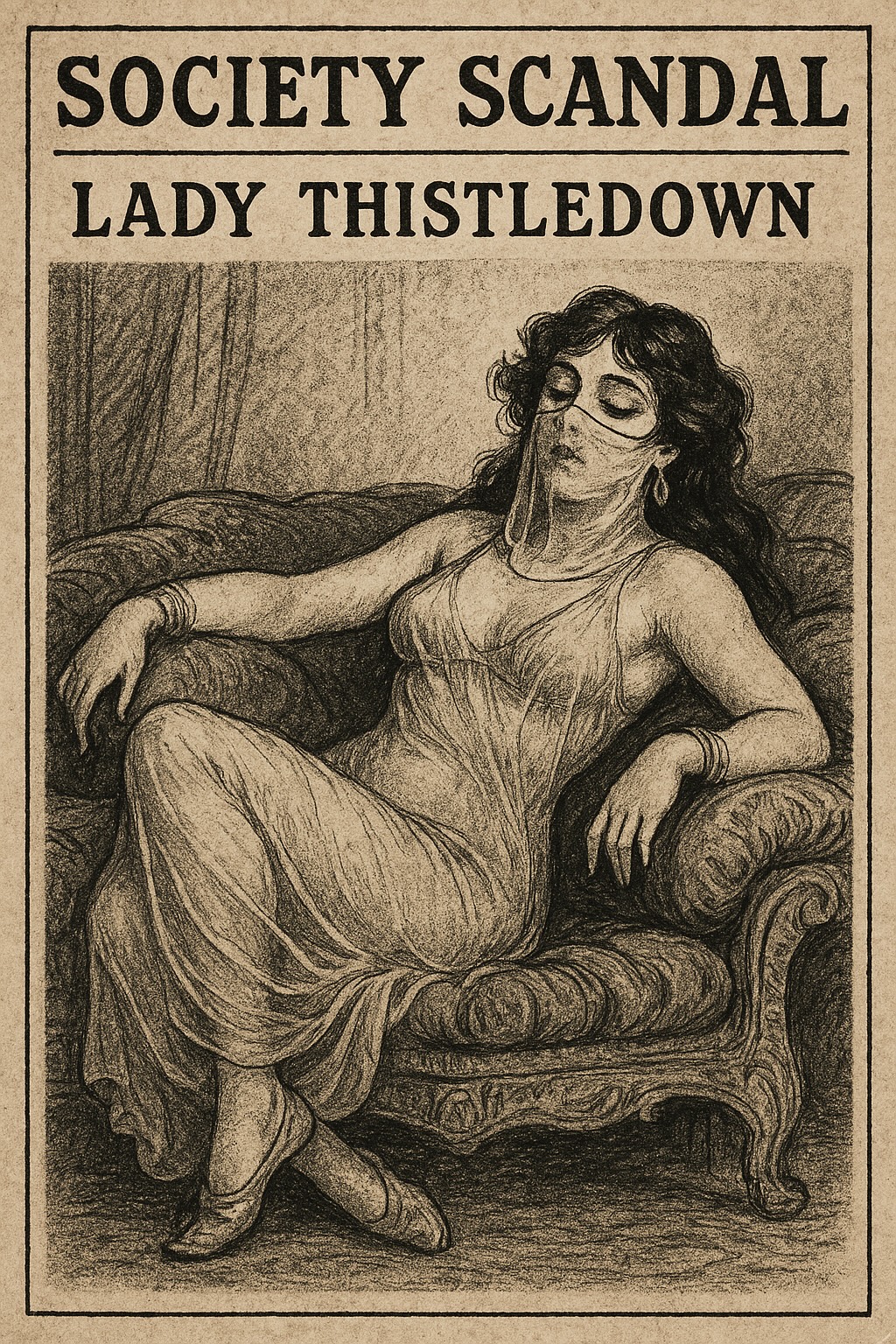
From the Illustrated London News: Lady Thistledown Discovered in a State of Impropriety–an Encounter of Notable Indiscretion with an Eastern Envoy.
Dunsley’s piece in the Illustrated London News skirted the line of propriety, avoiding outright pornography while heavily implying carnal impropriety.
The headline read: “An English Viscountess in Eastern Silk: Whispers from Albemarle.” Choice quotes hinted at impropriety: “Lady Agatha Thistledown, clad in foreign silks, found in a compromising tableau with the illustrious Kemal Bey, raising questions of national loyalty and cultural subversion.”
Quietly, Rainsford reported Lady Agatha’s name in connection with the leak of minor yet genuine Foreign Office correspondence. The revelation triggered a silent investigation, casting a shadow over Lord Thistledown’s household and humiliating him in the process. The whiff of compromised state secrets added a layer of disgrace, compounding the personal scandal.
Seraphina, meanwhile, paid off Kemal Bey, ensuring his silence as he faced recall to Constantinople under a cloud of suspicion. The affair had tainted his reputation, leaving him with little choice but to leave London behind.
The fallout was swift. Lady Agatha became a social pariah, shunned by the society she had once graced. Her disgraceful conduct and the ensuing scandal tarnished her name, leaving her isolated and ostracized. Lord Thistledown, humiliated by his wife’s indiscretions and the implications of compromised secrets, found his standing diminished, his once-respected household now a source of whispered gossip and shame. Invitations ceased. A seat on the Reform Club board quietly disappeared. Even his name was no longer mentioned in the corridors of Whitehall.
For Seraphina, the plan had unfurled beautifully, her vengeance exacted with precision. She had dismantled the life of the woman who had once sought to control her, leaving behind a legacy of scandal and ruin in her wake. Two down, one to go.
London
As Seraphina mulled over her next move against Mrs. Blackthorn, she realized that a direct approach was out of the question. Traveling to the remote Loch Thorne would draw too much attention and risk compromising her carefully crafted anonymity. In such an isolated place, any stranger would stand out. Instead, she needed the bustling populace of a large city like London to act as her cover, allowing her to operate unnoticed amid the throngs of people.
The reformatory’s graduation ball, held annually in late July, presented the perfect opportunity. It was the event where Mrs. Blackthorn showcased her “products” to single men of good fortune and particular tastes—those desiring tightly laced and obedient wives. For Seraphina, this was the only time Mrs. Blackthorn ventured into the big city. The ball would provide not only a chance to confront Mrs. Blackthorn but also the ideal stage to escalate the scandal to a magnitude that could not be ignored or concealed.
These were not suitors in search of love. They were collectors, fetishists, seeking girls shaped into submission, trained to flinch prettily and never raise their voices. Each one expected a dress-doll wife—corseted, polished, silent. The end of school was not freedom for these girls; it was merely a transfer of control. Seraphina had edperienced their type before firsthand: men who loved the wardrobe more than the woman inside it. And Mrs. Blackthorn was only too happy to supply them.
With time running short, Seraphina knew she had to act quickly. She enlisted Pike once more, instructing him to gather dossiers on the various girls finishing at Mrs. Blackthorn’s school this year. Armed with this information, she would pinpoint the perfect target to execute her plan, ensuring the scandal would be so damaging that Mrs. Blackthorn’s reputation would be permanently tarnished.
Pike found Seraphina in her study, the afternoon light filtering through the lace curtains in delicate patterns, when he delivered his findings. He shuffled through a sheaf of dossiers, each file representing one of Mrs. Blackthorn’s recent charges. His expression was one of practiced neutrality, though his eyes flicked up occasionally to gauge her reaction.
“I’ve compiled the information you requested, ma’am,” Pike began, laying the first dossier on the table. “There are three girls this year who stand out. Troubled, they are, in different ways.”
Seraphina nodded, her interest piqued. “Tell me about them.”
Pike opened the first folder, revealing a photograph of a young woman with sharp features and defiant eyes. “This here is Emily Stokes. Bit of a firebrand, she is. Daughter of a wealthy merchant. Sent to Mrs. Blackthorn’s after she was caught leading a protest at her boarding school. Something about unfair treatment of the staff.”
Seraphina arched an eyebrow. “A protest, you say? She sounds… passionate.”
“Indeed,” Pike replied. “But her family found it unbecoming, especially for a girl of her standing. She’s got spirit, that’s for sure.”
He placed the next dossier in front of Seraphina. The photo showed a girl with soft curls and a nervous smile. “This one’s Mary Fletcher. Came from a good family, but she’s a bit of an odd duck. She’s fascinated with seances and spiritualism. They say she claims to speak with the spirits of the dead.”
Seraphina tilted her head, intrigued. “An unusual hobby for a young lady.”
“Aye,” Pike agreed. “Her family didn’t take kindly to it. Sent her to the reformatory to set her straight, so to speak.”
Finally, Pike laid the last dossier on the table. “And then there’s Charlotte Hargreaves.” He tapped the photograph of a girl with haunted eyes, her expression a mixture of vulnerability and defiance. “Youngest daughter of Rear Admiral Hargreaves. Her story’s a bit more… colorful.”
Seraphina leaned forward, her gaze intent. “Go on.”
“Officially, they say it was ‘disruption’ and ‘moral laxity,’ but the truth’s a bit spicier,” Pike explained. “She was caught in a rather compromising embrace with a parlor maid. And there are whispers of laudanum abuse and self-starvation.”
Seraphina considered the information, her mind already calculating the possibilities. “She sounds perfect,” she murmured. “A girl with a story like hers could be quite… useful.”
Pike nodded, understanding her intent—then hesitated. His fingers brushed the edge of the dossier, his voice quieter when he added, “Just be careful with her, ma’am. That one’s already been bent near breaking. You twist her any further, you might not get the shape you’re aiming for.” He held her gaze a moment longer than usual—measuring something he wasn’t sure he wanted to see.
Seraphina smiled, the pieces of her plan clicking into place. “Thank you, Mr. Pike. I believe she will be exactly what I need.”
Pike hesitated again, then cleared his throat. “If I may say so, ma’am… some girls, when you set ’em free of their cage, don’t always walk the path you give ’em. Sometimes they run wild—or straight back into the fire.” He gave a short nod toward Charlotte’s photo. “Just saying. That one’s got a storm behind her eyes.”
Seraphina needed a way to contact Charlotte and propose an opportunity for revenge against Mrs. Blackthorn—a notion Seraphina imagined Charlotte would readily entertain. From her own experiences, Seraphina had a keen understanding of what Charlotte’s life at the reformatory would have entailed: Mrs. Blackthorn’s unique brand of “restraint therapy,” likely a stint in the isolation cell to start, and of course the cane, followed by a strict regimen designed to break her spirit. Seraphina’s plan hinged on the hope that Charlotte retained a spark of defiance, a will to strike back at her oppressor.
Langham Hotel
The morning after Pike messaged her, via a messenger boy, that Mrs. Blackthorn and her girls had returned to town and were staying at the Langham Hotel, Seraphina set her plan into motion. She instructed Amara to dress her as a parlor maid in the Langham uniform—though her conditioning demanded that she be more tightly laced and higher heeled than was typical for such a position. Crucially, Amara applied a thick layer of concealing makeup to disguise her features and prevent Mrs. Blackthorn from recognizing her.
Caped and transformed, Seraphina made her way to the hotel, slipping in through the servant’s entrance alongside the morning delivery of food, bread, and milk. Once inside, she moved as swiftly as her restrictive attire allowed, navigating the labyrinth of servant’s corridors until she reached the wing where the reformatory girls were housed.
Adopting the guise of “Rose,” she approached the staff with a fabricated tale. “I’m a replacement for Becky, who’s under the weather,” she explained, her voice carrying an air of urgency. “Please, don’t rat me out to the Head Housemaid—or Becky’ll be in trouble.”
The other staff, sympathetic to her plight, nodded in understanding, and helped by distracting the Head Housemaid. This allowed Seraphina to slip into the service unnoticed, her eyes scanning for the face of Charlotte Hargreaves.
In the early light of dawn “Rose” quietly entered the room where Charlotte Hargreaves lay. The faint light revealed her form bound by the elaborate night gear mandated by Mrs. Blackthorn’s regime.
“Morning, Miss Hargreaves,” Rose announced softly, her voice carrying a note of feigned cheer.
Charlotte stirred, her expression a mix of grogginess and irritation. “Who’s there?”
“Rose, ma’am,” Seraphina replied, her hands already working to undo the mittens that encased Charlotte’s hands. “Just here to help you get ready.”
With careful precision, Rose removed the sack-like nightgown, its narrow cut restricting Charlotte’s legs. Next came the night corset, extending from Charlotte’s knees to her bust line. The release from its confines brought a fleeting moment of freedom, allowing Charlotte to stretch her limbs and breathe more deeply. Rose undid the mittens and the heel-less night boots that forced Charlotte’s feet into an en-pointe position.
Charlotte sat up, rubbing her wrists where the mittens had chafed. “Thank you,” she murmured, a trace of surprise in her voice at the unexpected kindness.
“Let’s get you washed up,” Rose suggested, guiding Charlotte to the washbasin. The cool water was a welcome relief, and Charlotte splashed her face, savoring the brief taste of autonomy.
“Feels good to be able to move,” Charlotte admitted, her eyes meeting Rose’s in the mirror.
“We don’t have much time, so let’s make it count,” Rose replied, offering a conspiratorial smile as she began the lengthy process of preparing Charlotte for the day.
As Rose worked, she spoke softly, her words carrying a weight that made Charlotte pause. “I need to tell you something, Miss Hargreaves. I’m no maid. Like you, I was once a girl at the reformatory.”
Charlotte’s eyes widened with intrigue. “You were?”
Rose nodded, her expression serious. “You should be able to tell from my waist alone. Mrs. Blackthorn’s cruelty is something I know all too well. I’m here because I need your help. I want revenge, and I thought you might, too.”
Charlotte’s interest was piqued, and she nodded, her resolve hardening. “I do. I hate her.”
“Good,” Rose said, a glint of determination in her eyes. “Tonight, at the ball, I can spice Mrs. Blackthorn’s tea with laudanum. Once she’s under, you’ll have your chance to be alone with her. Do with her as you wish. But I need to know you’re committed to this.”
Charlotte’s eyes lit with a mix of hope and malice. “Really? And you’ll give me more laudanum?”
“Enough to take the edge off for you, too,” Rose promised, lacing the corset tighter still. “But you must be careful—our chance depends on subtlety.”
Charlotte exhaled sharply as the stays pulled her waist into an impossibly tight silhouette. Her gown for the ball, a lavish creation of deep blue satin, awaited beside the bed. Its high neckline and delicate lace trim painted a picture of elegance, but the truth was evident in the restrictive cut and impeccably boned structure.
“I want to see her brought down,” Charlotte confessed, her voice low.
“Then we have an agreement,” Rose said, a hint of triumph in her tone as she tied off the final lace. “Now, let’s make sure you’re the belle of the ball. They’ll never see you coming.”
As Charlotte stood, her posture rigid from the corset’s grip, she felt the spark of defiance reignite within her.
As Rose, Seraphina navigated her duties throughout the day with careful precision, narrowly escaping exposure. In the grand drawing room, Mrs. Blackthorn sat poised with a cup of tea, her sharp eyes observing the staff as they moved about. Rose approached with a tray of biscuits, her heart thudding beneath her tightly laced uniform.
“Your waist is quite admirable, dear,” Mrs. Blackthorn remarked, her gaze lingering on Rose’s silhouette. “What is your name?”
“Rose, ma’am,” Seraphina replied, keeping her voice steady.
Mrs. Blackthorn peered closely at her face, a glimmer of suspicion in her expression. Rose held her breath, hoping the layers of makeup would hold. After a moment, Mrs. Blackthorn nodded, seemingly satisfied, and returned her attention to her tea.
The evening arrived, and the ballroom at the Langham Hotel was a vision of opulence. Crystal chandeliers cast a warm glow over the polished floors, and a string quartet played softly in the background. The invited guests, a mix of young, wealthy, single men with particular interests and a few accompanying matrons or parents, mingled with anticipation.
Rose moved deftly through the crowd, balancing a tray of pastries and light drinks with practiced ease. Her eyes flitted over the guests, noting their expressions and lingering glances as they observed the preparations.
The processional entrance of the girls was announced, and a hush fell over the room. Mrs. Blackthorn stood at the top of the grand staircase, overseeing the proceedings with an air of authority. One by one, the girls descended the stairs, their gowns resplendent in the candlelight.
At the bottom of the stair, she curtsied gracefully and took her place along the edge of the ballroom. The men watched from across the room, their eyes attentive and appraising.
Mrs. Blackthorn stepped forward, her voice carrying over the hushed assembly. “Esteemed patrons of Loch Thorne, it is my pleasure to welcome you to our annual ball. Tonight, we celebrate the accomplishments of these young ladies in discipline, composure, and feminine restraint.”
A murmur of approval rippled through the crowd, and Mrs. Blackthorn extended her hand to a distinguished gentleman standing nearby. “May I present Lord Everingham, a loyal patron of our reformatory.”
Lord Everingham, a titled gentleman of considerable influence, bowed with a dignified air. “The pleasure is mine, Mrs. Blackthorn.”
The quartet struck up a lively tune, and Mrs. Blackthorn led Lord Everingham onto the floor for the first waltz. Despite her lacing and the restrictive gown, Mrs. Blackthorn moved in step with Lord Everingham, which set the tone and pace for the evening.
Midway through the dance, the invited gentlemen began to join in, each approaching a girl to ask for the honor of a dance. The ballroom filled with the sound of laughter and conversation as the couples twirled gracefully across the floor. The lively pace of the dance took its toll on Mrs. Blackthorn, who graciously thanked Lord Everingham for the dance, pausing afterward to catch her breath. Her cheeks were flushed, and she fanned herself lightly.
“An invigorating waltz, Lord Everingham,” she remarked with a polite smile, “though it seems I am not quite as youthful as my charges.”
“Indeed, Mrs. Blackthorn, but you are as graceful as ever,” Lord Everingham replied, offering a courteous bow before retreating to the sidelines.
Rose approached with impeccable timing, carrying a delicate china cup filled with tea. The steam carried the rich aroma of spices, masking the laudanum she had generously laced into the brew.
“Some tea, ma’am?” Rose offered with a perfect curtsy.
“Bless you, girl,” Mrs. Blackthorn murmured, accepting the cup with gratitude. She sipped it eagerly, the heat and flavor providing a welcome respite. “Delightful, truly. Just what I needed.”
Rose nodded, her expression demure. “I’m glad it pleases you, ma’am.”
As the minutes passed, Rose kept a watchful eye on Mrs. Blackthorn, noting the subtle changes in her demeanor. The older woman’s movements grew languid, her eyelids drooping ever so slightly. When she swayed on her feet, Rose was at her side in an instant, a steadying presence.
“Feeling a bit dizzy, ma’am?” Rose inquired, feigning concern.
Mrs. Blackthorn blinked, her composure slipping. “Yes, perhaps… perhaps a moment to rest is in order.”
“Allow me to assist you, ma’am,” Rose insisted gently, guiding her towards the exit. “You’ve been skipping meals again, I wager.” As she left the room, Rose discreetly gestured to Charlotte, who had been lingering near the entrance, waiting for her cue.
On the way to the salon to retire for a moment, Mrs. Blackthorn chuckled, her inhibitions loosening with each step. “Oh, Rose, your waist is quite exceptional,” she remarked, her words slurring slightly. “The very ideal my institution strives to produce. So natural, so… impeccable.”
Rose smiled modestly as she led Mrs. Blackthorn up a discreet staircase to a small salon on the next floor. The space was quiet, removed from the noise of the ballroom below.
“Let’s have you rest here, ma’am,” Rose suggested, easing Mrs. Blackthorn into a plush chair. “Miss Hargreaves here will assist you.”
“Miss Hargreaves,” Rose beckoned with a fake smile. “Mrs. Blackthorn needs a bit of help. She’s feeling faint.”
Charlotte’s eyes gleamed with anticipation. “Of course, Rose. I’ll make sure she’s well taken care of.” As Rose passed by Charlotte, she leaned in close and whispered, “There’s a bag behind her chair; it contains things you may find useful.” Something about the gleam in Charlotte’s eyes gave Seraphina pause. She had seen that look before—just not always on the faces of survivors. With a final nod, Seraphina, as Rose, slipped quietly out of the salon, her mission complete. Once in the corridor, she donned her cape and veil, blending seamlessly back into the guise of anonymity. Her footsteps were soft and measured as she exited the hotel.
Outside, the evening air was cool against her skin. She spotted a runner boy loitering nearby, his cap askew and eyes alert for work.
“Here, lad,” Rose—now fully Seraphina—called softly, handing him a coin and a sealed note. “Deliver this to Felix Dunsley, at the Illustrated London News. It’s urgent.”
The boy nodded, pocketing the coin with a quick smile. “Right away, ma’am!” he chirped before darting off into the night.
Inside the hotel, Charlotte steeled herself, determination mingling with anticipation. She approached Mrs. Blackthorn, who sat, lulled by the laudanum, in the plush chair.
“Mrs. Blackthorn,” Charlotte began, her voice low and firm. “Allow me to assist you.”
Mrs. Blackthorn blinked slowly, her mind clouded. “Charlotte, dear? What are you—”
But Charlotte silenced her with a glance, retrieving the bag Rose had mentioned. Inside, she found ropes, gloves, and other items—tools for enacting her long-held revenge.
By the time Felix Dunsley arrived at the Langham Hotel, the atmosphere was charged with unspoken tension. He made his way to the green salon on the second floor, curiosity piqued by Seraphina’s cryptic message.
The scene that greeted him was shocking. The air was thick with the scent of scandal, and before him, Rear Admiral Hargreaves’ daughter and Mrs. Blackthorn were entwined in a lurid tableau of sapphic depravity.
The scene that met Dunsley was startling, even for a man accustomed to society’s shadows. The room smelled of perfume, laudanum, and something more intimate. Mrs. Blackthorn and Charlotte Hargreaves lay tangled together on the narrow bed, bound in a pose so charged with implication it needed no explanation. Silken cords secured Charlotte’s ankles to the bedposts, her wrists fastened behind her with padded cuffs. Her body was bare, her skin flushed and marked by signs of intense, prolonged contact.
Mrs. Blackthorn, stripped of her usual corset and dignity, lay collapsed across Charlotte. A medical device—an electrical stimulator commonly prescribed for hysteria—hummed quietly on the bed beside them, its wires trailing across the floor. Between them, a leather harness with an attached two-way godemiche hinted at the nature of their contact, its polished fittings slick with use. A faint smile lingered on Charlotte’s lips, her expression peaceful, almost triumphant. Mrs. Blackthorn’s head rested on her chest, her powdered hair tousled, her lipstick smudged in a way that left little doubt about what had transpired.
Dunsley, steady in hand but racing in thought, surveyed the scene. He knew exactly what he was seeing: the collapse of a carefully guarded reputation, the exposure of a woman who had built her fortune on modesty, decorum, and control. He would not need to embellish. The facts alone would ruin her.
The scandal broke with a force that tore through polite society like a blade through silk. The Illustrated London News stopped just short of naming names, but other broadsheets were not so cautious. Rumors gave way to certainty, and soon every drawing room from Belgravia to Mayfair echoed with the same tale: Mrs. Blackthorn, proprietress of the Loch Thorne School for the Refinement of Wayward Ladies, had been found in the most shocking circumstances imaginable—with one of her own charges, no less. The names, the details, the illustrations—each more damning than the last—left no room for denial.
Mrs. Blackthorn did not face trial. Her friends abandoned her. Her staff disappeared. What remained of her wealth was quietly redirected to ensure a scandal of this scale did not touch more prominent names. And so, within days, she was removed from public view entirely. Doctors, summoned by her remaining family, pronounced her unfit—morally compromised and dangerously excitable. She was committed to the Bethlem Royal Hospital, known by another name on the street: Bedlam.
There, she was subjected to the very therapies she once recommended for others. Hydrotherapy. Restraint. Dietary controls. Weeks passed without real clothing. Months went by without conversation. Her hair was cut. Her corsets removed. She was bathed, examined, penned, and catalogued. No one came to visit. No one asked after her. She had once ruled over silence, obedience, and control. Now she sat mute in a locked room while attendants charted her moods and dosed her with mercury chloride.
With her revenge complete, Seraphina found herself at a crossroads. She had achieved what she set out to do, yet the victory felt strangely hollow. The restrictive attire she wore remained a constant companion—her tightly laced corsets, towering heels, gloves, and veils were no longer tools of reform but habits embedded deep into her daily life. Much of her inheritance had been consumed in the pursuit of justice. Now, with her enemies disgraced and gone, she faced the far more mundane question of survival.
Meanwhile, the Loch Thorne Reformatory, left leaderless in the wake of scandal, stood in quiet disarray.
Loch Thorne
Seraphina sat by the window of her London hotel, watching the soft drizzle trail down the glass. The scandal had broken precisely as intended. Mrs. Blackthorn was finished—her name spoken only in hushed, scandalized tones. The reformatory, leaderless and disgraced, had gone into quiet chaos. Girls were being sent home or relocated, instructors dismissed, and the remaining staff unsure what came next.
It was the perfect opening.
Seraphina had not been named, implicated, or even mentioned in the aftermath. She was still seen as a respectable widow of impeccable bearing, a former alumna who had emerged from Mrs. Blackthorn’s care as a model of composure and restraint. But she was also nearly out of funds. Her revenge had cost her dearly—bribes, travel, layers of disguise, and the upkeep of her appearance. She needed not only shelter and security but a future.
And perhaps, more than that, she felt something stir beneath the satisfaction of revenge: the understanding that no one else would protect those girls. Not from people like Mrs. Blackthorn. Not from the men who funded the institution and demanded obedience in exchange for charity. If someone with insight, and memory, and control did not take the reins, then another woman like Blackthorn would rise in her place.
So she drafted a letter.
It was written on pale blue stationery, the handwriting elegant and steady. It was addressed jointly to Rear Admiral Hargreaves and Lord Everingham—both discreetly involved in the reformatory’s governance. She presented herself not as a petitioner but as a solution: an alumna with firsthand understanding of what made the institution effective, but also what had allowed its failures. She proposed a new model—one that retained discipline but offered dignity. Modern restraint, gentler methods, and outcomes that would appeal to both society and the press.
She emphasized her neutrality in the scandal, her respectability, and her knowledge of the girls’ needs—emotional, behavioral, and educational. She positioned herself not as a reformer, but as someone who could protect the reformatory from further scrutiny by quietly restoring its purpose under new, careful leadership.
Both men replied within the week. A luncheon was arranged. At the table, she spoke with warmth, precision, and a hint of humility. She acknowledged the difficulties ahead, but assured them she had the discretion and steadiness to lead. Lord Everingham, ever pragmatic, admired her composure. Rear Admiral Hargreaves, perhaps remembering his daughter’s troubled path, respected her poise.
Within a fortnight, a formal announcement was made—quietly, without press or notice.
Mrs. Seraphina Arabella Hartwell was appointed Headmistress of the Loch Thorne School for the Refinement of Wayward Ladies.
Soon after assuming her new role as Headmistress, Seraphina began to sense the difference between managing a vision and enforcing one. Most of the girls at Loch Thorne adapted quickly to the restructured routines—softer in tone than Mrs. Blackthorn’s, but no less exacting in detail. Yet there were a few who resisted.
Foremost among them was Elisabeth Gainsley, the daughter of a solicitor and a known sympathizer of the suffrage movement. At seventeen, Elisabeth was clever, defiant, and disinclined to cooperate with even the gentlest corrections. She refused the high collars. She shortened her curtsies. She slipped books on political theory into her embroidery basket and refused to allow her waist to be cinched beyond twenty-four inches.
She was a liability.
Seraphina summoned her to the office after several classroom disruptions. The girl stood with her arms crossed and her chin high, a stance that had once belonged to Seraphina herself, in another life.
“Miss Gainsley,” Seraphina said calmly, “you are aware that the reformatory exists to cultivate comportment, not argument.”
“And yet you argue very well, Mrs. Hartwell,” Elisabeth replied, her voice crisp. “Why shouldn’t I?”
The remark struck more deeply than Seraphina cared to admit. She dismissed the girl, saying only, “Report here tomorrow morning. We will begin a new kind of lesson.”
That night, Seraphina sat at her desk long after the halls fell quiet. The candle burned low, its light flickering across the brass surface of the Himalayan prayer machine, tucked neatly behind the cabinet doors. She stared at it for a long time.
She had promised herself she would never use it on another. But now she faced the possibility of disorder in her ranks. Elisabeth wasn’t the only girl with ideas of rebellion. And if the institution faltered under her leadership, she would not be given a second chance.
Still, as her gloved hand reached out and touched the machine’s curved handle, she hesitated. She was no longer under duress. She was not a pawn.
She was choosing.
The next morning, Elisabeth was escorted to the office under the pretense of a posture evaluation. She sat stiffly in the chair across from Seraphina, who maintained a gentle tone, even as she dimmed the curtains and unlocked the cabinet.
“What is that?” Elisabeth asked, eyes narrowing.
“Nothing harmful,” Seraphina replied. “But very helpful. Just a few minutes of focus, to ease your thoughts.”
The machine hummed to life.
Its colored wheels began to spin, casting soft, rhythmic light across the walls and over Elisabeth’s face. The girl shifted, unsettled. Seraphina remained seated, voice low and even.
“Just breathe, Miss Gainsley. Sit tall. Let yourself listen.”
Within minutes, Elisabeth’s posture changed. Her jaw slackened. Her gaze fixed. And as the pulse of light deepened its rhythm, Seraphina spoke carefully, slowly, reinforcing the patterns already etched into her own mind—obedience to male guidance, a craving for restrictive dress, a hunger for precision and order.
After twenty minutes, the machine slowed and stopped. Elisabeth blinked rapidly, swaying slightly as she stood.
“You’ll return tomorrow morning,” Seraphina said, as if the matter were routine.
“Yes, ma’am,” Elisabeth replied, her voice quieter than before.
Within days, her waist measured twenty inches. She began to speak more softly in class. When her father visited, she flushed and followed his instructions without resistance.
Seraphina observed it all with mixed feelings. The reformatory was stabilizing. Her model was succeeding. But alone in her office, she sometimes stared at the prayer machine and asked herself what Mrs. Blackthorn would have done—and how far she had come from being the girl who once fought not to be bent.
Still, she told herself, it was only one girl. Just enough to preserve the school. To protect the others. To prove she could lead.
And besides, Elisabeth looked beautiful in a corset. Peaceful. Almost grateful. It was then that Morag burst in, her cheeks flushed. “Beggin’ yer pardon, ma’am,” she said breathlessly, “but there’s a right mess in literature class. Daisy and Helen’ve been caught wi’ one o’ them vulgar penny romances—illustrated, no less. Filthy thing, if ye ask me.” Seraphina set down her pen, her thoughts already shifting. Another test of balance between discipline and leniency. As Morag waited, wringing her hands in the doorway, Seraphina stood and smoothed her skirts, her expression unreadable. “Bring them to my office,” she said calmly. “We’ll settle this before luncheon.”
Loch Thorne, Autumn 1985
The wind off the water hit harder than she’d expected.
Claire Alden stood at the edge of the narrow dock, her canvas duffel slung over one shoulder, jacket zipped to the chin. The Loch stretched before her like a piece of cut slate, dull and silver, reflecting nothing. Across the water sat the island, dense with pine and mist, and on its rise—half-choked in bracken and shadow—stood the building. The reformatory.
She hadn’t even known she had Scottish roots until the lawyer called. Something about a great-aunt several times removed. A reclusive widow. A name scratched into a will no one remembered drafting. Now, after three plane rides, two train transfers, a hired car, and one very narrow road full of sheep and fog, she was here. At the edge of her inheritance.
She still wasn’t sure what she’d inherited, exactly. When the solicitor mentioned “a mansion,” Claire had imagined something modest, maybe ivy-covered stone and a few creaking rooms. Not an island. Not that hulking silhouette rising through the mist like a fortress abandoned mid-siege. She hadn’t even known she had Scottish ancestry—no stories, no tartan, nothing passed down. Just this. Some great-aunt with a widow’s name and no known heirs, and now Claire, staring at the edge of her own family’s ghost story. She figured she’d stay a day or two, take a look around, maybe get a sense of the place. Then what? Sell it, probably. Unless it couldn’t be sold. Unless it wasn’t worth anything at all.
“Right then,” the woman beside her said. “Let’s not dawdle.”
The ferry was barely more than a boat—dark green, metal-hulled, and dented in places that suggested age and experience, like its owner.
The ferryman—ferrywoman—was named Isla Duncan. A stout woman in a thick wool sweater, with hair tied in a kerchief and boots that looked war-tested. She didn’t smile, but she wasn’t unkind.
Claire climbed aboard and sat on the metal bench as Isla pushed off with a practiced kick and turned the outboard motor. The boat trembled, then groaned forward into the water.
“Bit late in the year for sightseeing,” Isla called over the wind, voice thick with a Highland burr. “You’re the American, then?”
“I am. Claire Alden.” She offered a hand, then laughed at herself—too far to shake.
Isla nodded. “Aye, they said you’d come. Lawyer phoned MacCallum’s shop for the number. Told him I knew the way well enough.”
The wind picked up, whipping strands of Claire’s hair into her eyes. “So—what do you know about the place?”
Isla’s eyes didn’t leave the dark shape of the island. “Locals call it the Hartwell House, but that’s not what it was, not really. It was a school. Or… a kind of school. For girls. They called it a reformatory back then. Victorian times. Girls sent there to learn their place, if you catch the meaning.”
Claire raised an eyebrow. “That sounds ominous.”
“Aye. Was,” Isla said. “The women ran it—strict types. Real lace-and-discipline sort. They say the headmistress came from the colonies, India maybe, wore black every day and never once unlaced her corset. Mad as a hatter, but elegant, so they say. Mrs. Hartwell, she was called. No one saw her much in town, but the ferrymen used to bring crates for her—cases of gloves, veils, corsets, and dresses tailored too tightly for comfort. Things too fine for island living. Things meant for display, or for correction. She ran the place like a queen. Girls came off the island changed, if they came back at all.”
Claire felt a chill that had nothing to do with the weather.
“So what happened to it?”
Isla shifted in her seat, frowning. “Closed just before the war. Some say the government got interested. Some say there was a scandal. Most just say it got too strange. Last few girls weren’t right, they say. Always quiet. Posture too good. Wouldn’t speak unless spoken to.”
The island loomed larger now, its trees rising dark and still behind the broken stone wall that rimmed the landing cove.
“Weren’t any family left, not that we knew,” Isla continued. “But I suppose you’re it now. The Hartwell line, or some long thread of it.”
Claire managed a laugh, thin as the wind. “Not a name I’ve ever heard in my family.”
“No surprise. Families bury the strange ones. Easier to forget.”
The boat slowed as they reached the landing—a short bridge of warped wood lashed to rusting moorings. A wrought-iron lantern hung askew from a post, its glass cloudy with age. The steps leading to the path had recently been scraped clean of moss. Beyond the landing, the gravel path curved up into the trees toward the house, which loomed in partial view beyond the rise.
Claire climbed out, her boots thudding against the damp planks. The trees whispered faintly now, wind curling through the pines. But there was no carriage. No figures waiting at the gate. Just the iron arch above the gravel path, its sign still faintly legible in the twilight.
Just the silence of abandonment.
Isla remained in the boat a moment longer, then reached under the bench for two crates. “Right—provisions,” she said, hauling them onto the dock. “Bit of bread, tea, tinned soup," she tapped one crate. “Greens, potatoes, and a bit of meat,” she tapped the other. “Not fancy, but enough for a few days.” She set the crates down near the steps. “Fuel was brought over three days back, and we tested the generators and boiler then. Still working, if a bit temperamental. Just don’t rush them.”
Claire nodded, taking the sack from her. “That’s… nice, now that it’s getting colder.”
Isla shrugged. “Folk in town don’t much talk about this place, but we don’t forget it, either. And MacCallum doesn’t like an inheritance gone cold.”
Claire turned to look at the building. The reformatory stood two stories tall, all blackened stone and arched windows—many boarded, others bare like staring eyes. Ivy had crept up the sides and died there, brittle against the stone. The roof sloped steep and narrow, chimney stacks rising like sentries. The front door sat beneath a half-circle portico of cracked columns. A brass plate on the lintel read:
“Loch Thorne School for the Refinement of Wayward Ladies”
The lettering was worn but legible.
Claire exhaled, long and slow. “This is it?”
Isla nodded. “Aye. Might not look it now, but she was once a grand place. Strange. Beautiful. And full of rules.” She paused. “You planning to stay long?”
Claire looked up at the windows again. “A few days. Just long enough to figure out what I’ve inherited.”
Isla gave a wry smile. “That’s the trick, isn’t it? Knowing what you’ve inherited. I’ll check in day after tomorrow.”
And with that, the ferry engine growled to life, and Isla Duncan began to pull away from the dock, her silhouette shrinking against the slate-gray mist. Claire stood at the edge of the dock until the boat faded into the fog, the hum of its engine swallowed by distance.
Then she turned toward the house. She was alone. The house watched.
Lugging the crates was harder than she’d expected. The path to the house climbed gently but steadily, and the wind bit at her as she made the slow trudge uphill, stopping every dozen steps to shift the weight. Her jacket was damp with sweat by the time she reached the porch.
The keys waited beneath the porch stone. They were easy to find—cold and heavy in Claire’s hand, the old brass loop clinking softly as she lifted the slab and found them just where Isla had said they’d be.
She caught her breath, bent double for a moment, then stood and turned the key in the lock. The front door creaked open with effort, the hinges groaning like something roused from sleep.
Inside, the air was dry and heavy with dust. Not decay, exactly—just stillness. The kind of stillness that settles in a place long waiting to be remembered.
She set her bag down in the vestibule and took a moment to breathe it in. Cold. Sharp. But not damp. The floors were wood, dark with age, still gleaming in places where varnish had held on. Oil lamps were mounted on the walls beside electric sconces, a strange overlap of eras. Wires traced along the moldings toward switches that looked pre-war, at best.
Claire lugged the crates inside and, for now, stored them just behind the entry doors.
She descended to the basement first, guided by a narrow staircase and the faint metallic scent of machinery. The air there was colder, but not unbearable. A small metal door yielded to the turn of a key, and beyond it: the generators.
Claire whistled. “Well, you’re not what I expected.”
The equipment was well-maintained, surprisingly modern—1950s, maybe early ’60s. Clean lines. Industrial beige. She found the control panel, flipped a few switches, and the generators hummed to life without protest. A moment later, overhead bulbs buzzed on. Not all, but enough to scatter the shadows. MacCallum had done fine work, keeping things oiled and fueled.
She found the boiler next—oil-fed, hulking, squat. A flip of another switch, a mechanical cough, and then warmth, low and growing.
She stood in the glow for a long moment, arms wrapped around herself. A place this size would need a great deal of heating to be comfortable. But something told her comfort had never been the priority for the girls who lived here.
Upstairs again, light chased away the gloom as she explored the building. She found the kitchen and put her supplies in there for later.
The building had been used as a boarding school. The first hall stretched long, lined with narrow doors. She opened one, then another. Thick oakwood, more solid than necessary. The bedrooms—if they could be called that—were spartan cells, with high window slits letting in weak light. But the beds were carved and solid, with pressed linens still folded at the foot. Each room had a dressing stand, a mirror, a small wooden chest. Personal. But in the way of a monastery. Or a convent. Or a prison.
The classrooms came next—larger rooms with blackboards still mounted, desks bolted to the floor in perfect, straight rows. Pre-war furniture: ink wells, carved initials, iron hooks for satchels. One desk still had a book inside.
An Introduction to Domestic Order and Feminine Resolve.
Claire snorted, but didn’t move on just yet. She flipped the book open, thumbing through brittle pages filled with neat handwriting, diagrams of posture, meal plans, even instructions for lacing corsets to precise measurements. Her brow furrowed. This wasn’t just outdated—it was disturbing.
She let the book fall shut with a soft thump. “Jesus,” she muttered, her voice echoing faintly off the chalk-dusted walls. “What the hell kind of place was this?”
She looked around again, slower this time, the weight of inheritance settling heavier on her shoulders. Not a house. Not even a school. A system, built to mold girls into someone else’s idea of right. And now it was hers.
She continued down the hall and came to a room labeled “Fitting Room” in faded gilt script.
Inside, floor-to-ceiling cupboards lined the walls. She opened one and found rows of neatly hung uniforms. Identical sets in all sizes: coarse slips, drab gray corsets, narrow underskirts, and charcoal wool dresses so stiff and scratchy they looked like they could stand on their own. Each uniform came with a pair of woolen stockings, black high-heeled boots, kid gloves, detachable stiff white collars, plain aprons, and bonnets. Everything was labeled, catalogued, preserved.
On the far wall, a framed illustration depicted the proper way to wear the uniform. A girl stood stiffly, chin tucked, gloved hands folded. Next to it, another frame displayed a list of rules in formal Victorian script:
Proper, clean, and complete uniform at all times
Always speak with decorum: “Ma’am” and “Sir” only
Curtsies before and after speaking
No speaking unless addressed
Eyes downcast unless responding
Claire stepped back, studying it. The illustration. The rules. The implication.
She turned to the uniforms again, running a hand down the boning of a corset.
“They really wore this every day?” she muttered.
There was a strange pull to it—fascination mixed with discomfort. Part of her wanted to know what it felt like. Not out of nostalgia, but curiosity. Just to understand what had been expected. She checked a few labels—yes, they’d have her size. It would be easy enough to try one on.
But she didn’t. Not yet. This wasn’t dress-up. These weren’t costumes. Whatever this place had been, it took itself seriously. And it had taken its girls even more seriously.
Claire closed the cupboard gently and stepped back into the corridor, the overhead lights flickering as if deciding whether to stay on.
Then she found it.
At the end of the west wing, behind a pair of heavy doors that stuck in their frame, lay a room unlike the others. Tall-ceilinged. Almost bare. The air was warmer, filled with golden late afternoon light that poured through an enormous arched window. And in the center of the room, on a large carved table, stood a box catching the sun.
She turned to the table itself—a broad slab of carved wood, its surface cleared for the box, but with several drawers beneath.
One stuck slightly, then gave. Inside lay a thick ledger, leather-bound, its edges gilded and worn with use. The cover bore no title—just a single embossed monogram: S.H.
Claire lifted it out, blowing dust from the top.
Inside: names. Lines and lines of entries in tidy script, columns dated between 1901 and 1935.
Pupil Name. Parent or Guardian. Cause for Admission. Tier of Treatment. Annual Fee. Outcome.
She skimmed:
“Beatrice Weatherby – Col. Weatherby (ret.) – Improper correspondence with stablehand – Advanced Therapy – £700 – Married, 1912 (Brig. Saunders, 1st Lancers)”
“Diana Fortescue – Lady Fortescue – “Strong-mindedness,” refusal to wear proper dress – Advanced Therapy – £700 – Married, 1914 (A. Calthorpe, solicitor)”
“Eleanor Macintyre – Mrs. J. Macintyre – Disobedience, chronic lateness, academic pride – Standard Instruction – £100 – Emigrated to Canada, 1925”
Claire turned quickly through the pages. There were dozens more. Maybe hundreds.
The handwriting changed after 1919, but the pattern didn’t. Always the same: cause, fee, outcome. “Advanced Therapy” appeared in bold, with extra ticks and occasional notes in the margin.
“Mild resistance in months 2–5. Breakthrough after corset regimen intensified. Full compliance observed by 8th month. Advanced therapy recommended bimonthly thereafter.”
Claire’s pulse quickened. “Advanced therapy? What the hell was that?” Claire stared at the pages, the tidy handwriting suddenly grotesque. These weren’t just school records. They were product sheets. Girls sent in, behavior cited, price paid, and outcome—always marriage, always to someone who wanted a wife shaped just so. It read like livestock entries. As if “strong-mindedness” were an illness. As if “full compliance” were a goal. Her stomach turned.
This wasn’t a school. It was a factory. And “Advanced Therapy” wasn’t education—it was correction. Reform, maybe. Or erasure.
She looked around the room again, newly unsettled by the silence, by the neatness. Whoever ran this place had done so with purpose. And someone—several someones—had paid for it. Encouraged it. Expected it. Handed over their daughters who did not conform to the standards their families demanded, reshaped into model women fit for marriage, society, or silence.
Claire exhaled slowly, the air thick in her lungs. She closed the ledger gently, as if shutting the book might muffle what she’d just learned. It didn’t.
A second book in that drawer was obviously a diary. She flipped forward, past faded ink, until she came to a marked entry near the middle.
August 17th, 1899
Today marks the final settlement of accounts with the Hargreaves estate. With the Rear Admiral’s passing and no male heir to contest, I have at last secured full ownership of the institution. Lord Everingham proved gracious, as ever—his patronage remains vital, but he sees the wisdom in unified leadership. A school cannot thrive by committee. Continuity has been preserved. I have written to the solicitor confirming the dissolution of the founding consortium. I hold the deeds myself now. The reformatory’s future is mine to shape, without compromise, without interference.
May it remain a place of discipline and order in an era increasingly given over to indulgence. I shall carry forward its mission—refined, yes, but unswerving.
Claire frowned. She flipped to the front, toward the earliest entries, and read.
January 2nd, 1885 It is not without some heaviness of heart that I accept the burden placed upon me today. The reformatory was never my ambition, nor do I imagine myself a natural schoolmistress. But with my husband’s affairs concluded, and my situation pressing as it is, I cannot afford discretion. And yet I do not despair.
With Mrs. Blackthorn’s… departure—at last—and with her, I pray, the cruelty she so thinly veiled as correction. I will run the school differently. Not softly, but justly. The girls must be guided, not broken. Restrained, but not humiliated. There is dignity in discipline if meted with compassion.
This place can change them for the better, I am sure of it. It need only change its heart first.
Claire closed the book.
It didn’t add up. That first voice—tentative, almost tender—was a world away from the cold precision of the ledger. Somewhere between that winter and the turn of the century, Mrs. Hartwell had changed. Or the school had. Or both.
And whatever “Advanced Therapy” was, it hadn’t been born of compassion. Claire needed to understand what had truly happened in this place.
Her gaze drifted back to the box.
It didn’t belong here. Not in a Victorian stone mansion tucked away in the Scottish highlands. The box was made of dark, polished wood—almost black, with a lacquered sheen—and carved all over in intricate, swirling patterns that shimmered faintly when the light hit them. Not floral. Not quite geometric. Almost… alive. The corners were inlaid with what looked like jade, cool and green, while the panels shimmered with embedded stones: turquoise, lapis, violet glass, flakes of gold. Delicate scrolls and cylinders were integrated into the design, like a music box crossed with something religious. The whole thing radiated presence. Not just exotic—ritualistic. As if it had come from somewhere older, deeper, and far from here.
Claire stepped forward, holding her breath, and laid both hands on the lid. It opened like a triptych. The outer panels folded back with a soft click, revealing a strange, layered interior: brass rods, interlocked gears, scrollwork spindles, and etched plates that caught the sunlight like fire.
She had no idea what it was.
But she was certain it had been used. Many times.
She turned one of the cylinders. It moved with a gentle resistance, then clicked into place.
A hum began. Low and deep. It settled into her chest like distant thunder rolling through stone. Behind the embedded gems, lights began to stir—faint at first, then brightening into a full cascade of motion and color. Sapphire, emerald, violet, gold—reflections spun across the walls and floor like living prisms gone wild.
Claire watched.
She meant to look away. She even tried, just for a second. To laugh. To mutter “What the hell is this thing?” But she didn’t. The lights pulsed in slow rhythm, each wave of color drawing her deeper inward. The hum settled into her bones. Her breath slowed.
Her shoulders lowered.
The buzz of thought began to fade, smoothed into stillness. Behind her eyes, the tightness unwound.
She sat down without thinking—on the edge of a trunk, or maybe a stool—her gaze still locked on the machine. It moved in delicate motion now, cylinders turning, light shifting in time. She couldn’t look away. Didn’t want to.
Time stuttered, then vanished.
The light seemed to fill the space where thought had been. Her limbs were heavy. Her mind, warm. The outside world dulled into quiet.
She blinked once.
The machine continued. The lights shimmered. The hum vibrated low and sweet.
She didn’t move.
And then—softly, like a thought not quite hers—came a voice beneath the hum, a whisper inside the stillness:
You don’t have to think right now. Just listen.